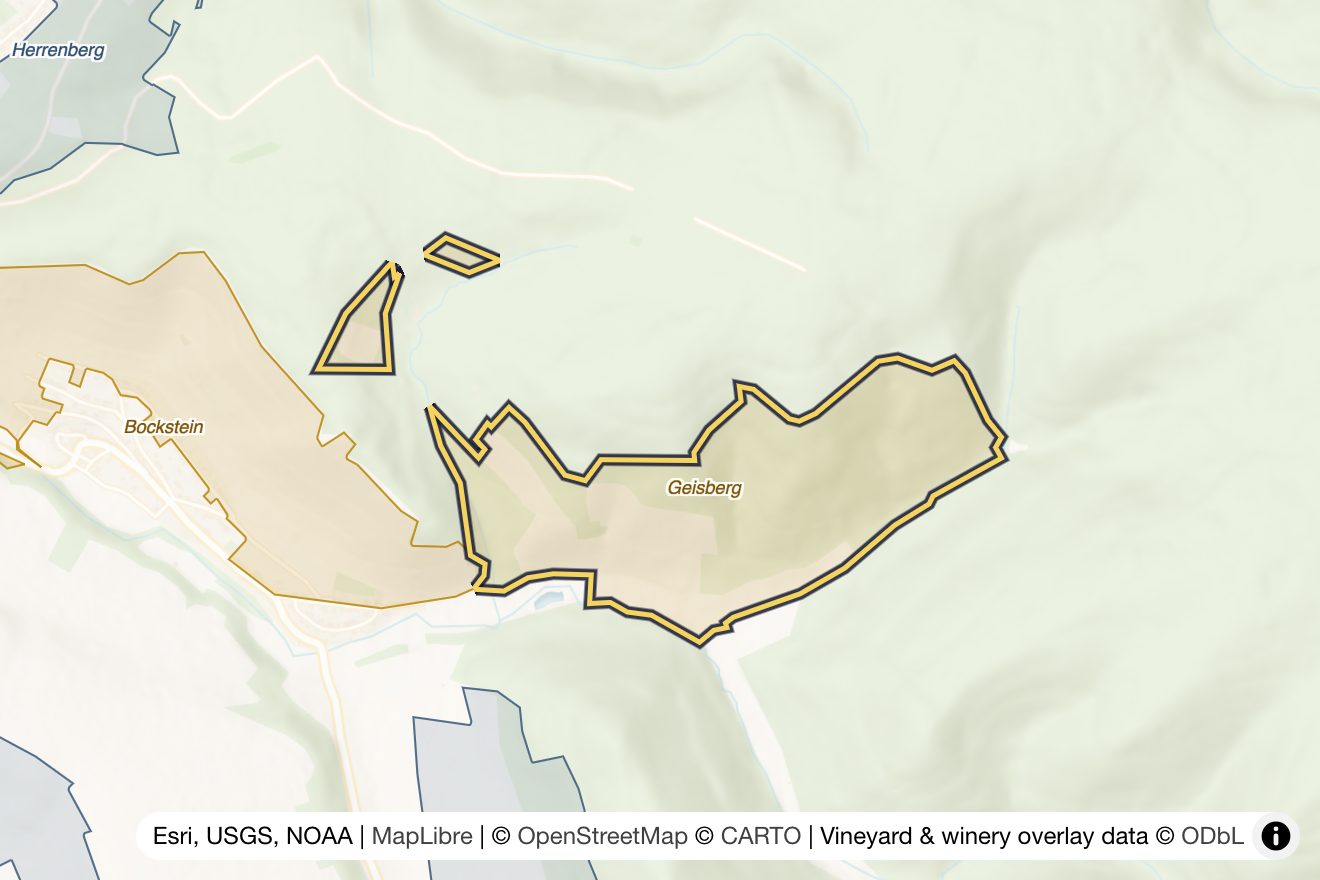
The einzellagen layer WineSaint ships delimits the Geisberg at 75.89 hectares, a block roughly two kilometres wide and just over a kilometre deep, straddling the Gemarkungen of Ockfen and Schoden. Any planted figure published elsewhere will be a fraction of that, both because delimited ground counts legal outline rather than vines, and because for most of the past half century this hill carried almost no vines at all.
Water, rock and exposure
Three brooks drain the bowl around the site: the Herrenbergbach, the Ockfener Bach and the Geisbergbach, all of them running down to the Saar. That drainage pattern is the reason the older German literature keeps returning to the Geisberg's water supply as a distinguishing feature, in a subregion where thin slate over bedrock more often produces stress than surplus. The exposure runs south to south-southwest.
The VDP records the soil simply as Devonian slate. That undersells it. Carlberg describes the slope as heavily charged with quartzite-bearing sandstone over grey slate, and the same mix is documented next door on the Bockstein, where the VDP notes skeletal, gritty weathering soils of Devonian slate and greywacke with patches of quartzitic sandstone and a little yellowish fine earth. The sandstone component is what separates this corner of the Saar from the blue slate of the Mittelmosel: coarser, paler, faster to drain, and slower to hand back heat at night.
From Benedictine ground to complete abandonment
Van Volxem's account has the site laid out by Benedictine monks in the Middle Ages, secularised under Napoleon and then sold at auction in Paris. By the nineteenth century it was in the hands of names that mattered: Clemens Freiherr von Schorlemer, Prussian minister of agriculture under Wilhelm II, and Albert von Bruchhausen, a founder of the association that became the VDP, both worked it and pushed its wines to top prices at the Trier auctions and onto the lists of international luxury hotels.
Carlberg's reading of the Prussian tax maps gives the shape of the expansion. The Clotten sheet of 1890 shows about ten hectares of vines here, with the lower western Gewann Dollbüsch, planted around 1850, carrying the dark red of Otto Beck's top bracket. By the 1906 edition the planted surface had passed fifty hectares. The leading Geisberg shippers of the 1890s were C. Gebert, A. Rheinart, Kerckhoff, Amlinger-Keller and Geltz.
Then it collapsed. Post-war vintages struggled for ripeness, the cost of working the steepest ground became indefensible during the Mosel crisis from the late 1970s, and the Geisberg went fallow, entirely and for decades. Bottles survive from the last working generation, including a 1973 from the Friedrich-Wilhelm-Gymnasium estate still catalogued in collector databases, but by the 1990s the hill was scrub and trees.
The replanting, and who owns the result
Roman Niewodniczanski of Van Volxem found the site through pre-1914 documents and was convinced by a bottle of the 1964. Recovering it meant buying parcels from roughly fifty separate owners, clearing woody growth, and rebuilding terracing. Markus Molitor was initially a partner in the project and later withdrew to concentrate on the Domäne Serrig; Otto Minn had kept a small piece under vine and eventually sold it on. Replanting to Riesling began in spring 2016. Van Volxem puts its core holding at about twelve hectares; Carlberg puts the recultivated surface at about fourteen.
Parcels within the Geisberg totalling 16.00 hectares are classified VDP.GROSSE LAGE for Riesling, and Van Volxem is the only VDP member estate the association lists here. That is roughly a fifth of the delimited polygon, and it is held by one house. The contrast with the neighbouring Bockstein is instructive: 58.00 hectares classified there, worked by five VDP members (Van Volxem, Nik Weis St. Urbans-Hof, Reichsgraf von Kesselstatt, von Othegraven and Forstmeister Geltz-Zilliken). A Bockstein bottle can be cross-read against four other interpretations. A Geisberg bottle cannot.
The modern record is correspondingly short. The first wine came in 2020, a Kabinett, with a Grosses Gewächs following. The vines are young, the yields are still finding their level, and the case for the site rests on nineteenth-century auction prices and on pre-collapse bottles rather than on anything yet proven in the glass. The einzellage belongs to the Grosslage Scharzberg, which covers essentially the entire Saar from Serrig to Konz and tells a buyer nothing whatever about this hill.