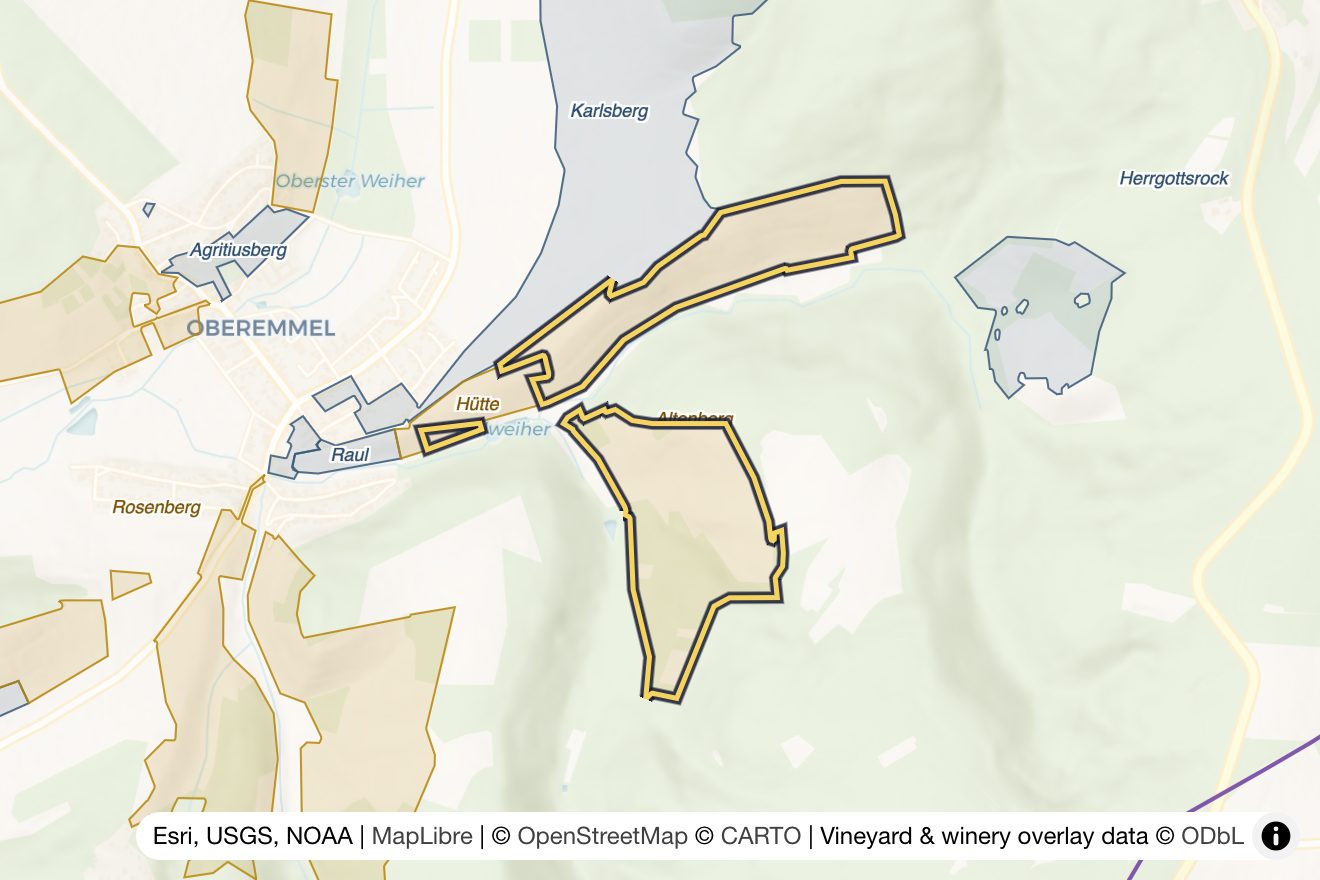
Two names and two hectare figures
Oberemmel ceased to be its own commune on 7 November 1970, when the administrative reform folded it into the town of Konz along with several other old wine villages of the side valleys. Officialdom followed the new boundary and the trade did not, which is why the site is filed under Konz and sold as Oberemmeler Altenberg. The village itself is far older than the paperwork, recorded as Embilaco in 893.
Precision about the village matters here more than usual, because Altenberg is one of the most reused names in German viticulture and the Saar carries three of them. Kanzem has one, a monopole of von Othegraven. Krettnach has another, worked by Hofgut Falkenstein, and Krettnach is also part of Konz, so the commune alone will not tell the two apart.
The gap between 52.3 and 9.0 is a different kind of confusion. Delimitation under the 1971 wine law drew boundaries around ground that could carry vines, not around ground that did. On the Altenberg the two figures then diverged further, because the site was largely given up and has only lately begun going back under vine.
Rock and aspect
The slope is steep, faces south to southeast, and sits at the mouth of the Konzer Tälchen, a dried former channel of the Urmosel that runs off Oberemmel's south-eastern edge. Underneath is skeleton-rich weathered Devonian slate mixed with greywacke, and the growers reading it from their own parcels emphasise different fractions of the same hill. Agritiushof records slate and greywacke weathering soils, partly rust-tinted by iron oxide. Willems-Willems describes grey, warm slate threaded with quartz. Rinke stresses blue slate combined with the fine sediment laid down while the Tälchen still carried water, and credits that mixture for the site's mineral signature.
Being off the river in a cool side valley used to count against the Altenberg. Rinke states the reversal plainly: a cold, neglected side valley made workable by a warming climate, where a very long hanging season is now an asset rather than a hazard.
Who works it
Three estates bottle the site. Agritiushof, in the village at Galgenweg, farms eleven hectares of which more than seventy percent is steep, and picks Altenberg Riesling from vines past sixty years old. Its 2023 was hand-harvested into twenty-kilo crates, whole-bunch pressed and fermented spontaneously, finishing at 12.5 percent with 11.2 g/l residual sugar against 6.8 g/l acidity, the estate reading fennel, lemon balm and lemon zest over warm, smoky slate.
Rinke works the site from the Grünhäuser Mühle at Mertesdorf on the Ruwer, farming to Bioland standards, and holds only steep ground here, planted from 1963 onward with much of it still on single stakes. The 2020 Alte Reben came in at 9.5 percent with 12.1 g/l residual sugar and 7.2 g/l acidity, apricot and lychee with pepper on the close. Altenberg fruit also goes into a Sekt given more than forty months on lees. The same estate holds parcels in the Wiltinger Braunfels.
Willems-Willems, 4.5 hectares run out of Oberemmel by Carolin Hofmann since 2001, works Altenberg vines past seventy years old and bottles across dry, feinherb and Kabinett.
What the classification says
The Altenberg was listed in the Prussian classification of 1868, and both Willems-Willems and Agritiushof lean on that record. Nothing in the modern VDP hierarchy attaches to the site. The classified ground in Oberemmel is the Hütte, five hectares in the same side valley as the Scharzhofberg, held as a monopole by von Hövel, whose holdings went back to the secularisation of 1803 and which stopped trading on 1 January 2026.
Großes Gewächs on an Altenberg label is therefore the statutory term rather than the association's. The 2021 revision of German wine law wrote Erstes Gewächs and Großes Gewächs into the code and handed the detailed rules to the regional Schutzgemeinschaften, with tighter requirements applying from the 2024 harvest, so an estate outside the VDP can now put the words on a bottle. That is the route by which Agritiushof labels its Altenberg a Großes Gewächs.