Konz, Krettnach and the register
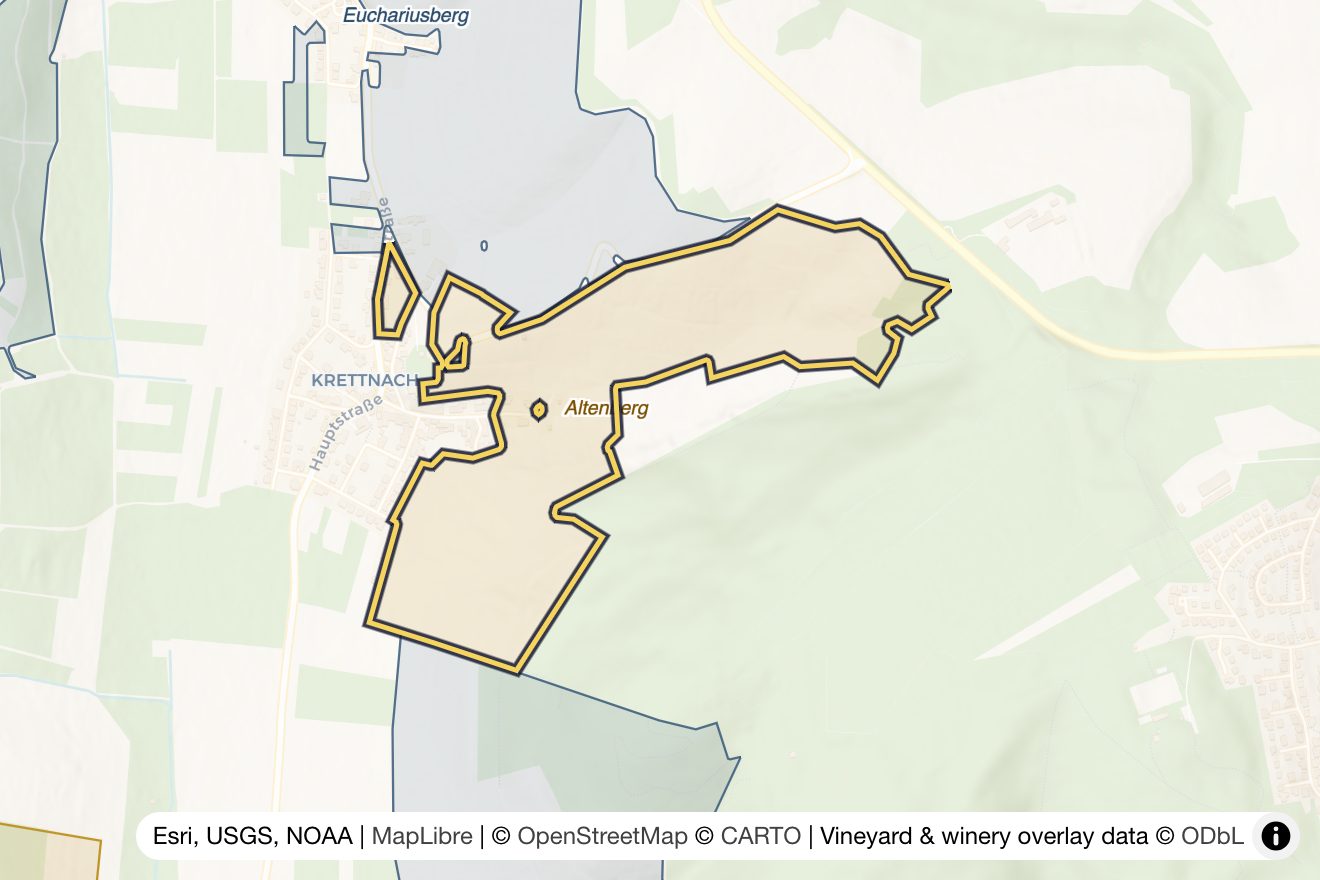
Krettnach is no longer a commune. It merged with Niedermennig on 7 June 1969 to form Mennig, and Mennig was absorbed into Konz on 7 November 1970. Because the modern commune swallowed several old wine villages, the Rheinland-Pfalz Weinlagen register files the site under Konz and records Krettnach only as the Gemarkung, while growers, importers and auction catalogues go on writing Krettnacher. The register entry is Lagen-Nr 460228, in the Grosslage Scharzberg of the Bereich Saar.
Two hectare figures circulate and they count different things. The register books 21.7 hectares planted. The delimited boundary, measured geodesically, encloses 46.9 hectares. The gap is not an error. The 1971 delimitation drew its lines around ground that could carry vines rather than ground that did, so a large share of the Altenberg as mapped is scrub, orchard, wood and headland.
A dry valley above the Saar
Krettnach lies about six kilometres southeast of Konz in the Konzer Tälchen, a broad sickle of dry valley running parallel to the Saar between Konz and Wiltingen, cut long ago by a meander of the ancestral Mosel and now carrying no river of its own. Niedermennig, Obermennig, Krettnach and Oberemmel are strung along it. None of these sites front water, so the thermal cushion that works for Ayl or Kanzem is simply not available here.
Altitude accounts for the rest. The village stands at 236 metres and the vineyard climbs well above it, with Weinmanufaktur Petershof placing its parcel at 360 metres; the site sits roughly a hundred metres higher than the vineyards at Niedermennig. The main hillside faces south, which is the reason Riesling ripens at all. Mean annual temperature recorded on that south face is around 9.4 degrees Celsius, close to a degree under parts of the adjacent Euchariusberg, and the Altenberg is cooler still than the Niedermenniger Herrenberg. Harvest comes late. Hofgut Falkenstein, which finds the soils here deeper and more vigorous than at Niedermennig, nonetheless takes Spätlese-weight fruit off the slope in most years.
Slate, quartz and a vein of diabase
The bedrock is iron-tinged grey slate, stony and sharply drained, threaded with quartz and quartzite-bearing sandstone, with loam skimmed over the surface. What separates it from its neighbours is diabase, a green basic volcanic rock intruded in veins and most pronounced on the western flank closest to the houses. Diabase is scarce on the Saar, surfacing again at Saarburger Rausch, and growers here treat it as the site's signature: Saarweingut Weber Brüder names its bottling from the slope Diabas outright.
That western flank had its own name within living memory. Before 1971 the hillside read west to east as three sites, Silberberg, then Altenberg, then Goldkaul, with Silberberg reaching from the Gewanne Ober Schäfershaus and Auf dem Hölzchen across to In der Kirschheck. Consolidation under the 1971 wine law, accompanied by a Flurbereinigung of the slope, put all three under one register entry. Silberberg is not an old name: it turns up on labels only from the middle of the twentieth century and is missing from nineteenth-century maps and books. The older record is plainer, and better. Clotten's viticultural map of the Saar and Mosel, in its fourth and final edition of 1906, gives the slope as Crettnacherberg and shades part of it dark red, the highest of the three bands the map used to compress eight Prussian tax brackets.
Who farms it
Hofgut Falkenstein, the Weber estate in the Tälchen at Niedermennig, bottles cask by cask under the official test number: its Krettnacher Altenberg Riesling Spätlese trocken carries AP 7 and the cask name Altenberg, bone dry, built on brioche, yellow fruit and steel, reductive and pithy in youth with anise and fennel behind. Stefan Müller, based in Krettnach itself, works the oldest parcels and rates the Altenberg the most powerful Riesling in his range, made both dry and as a Kabinett of about 8.5 percent alcohol in which mint and menthol cut through grapefruit, yellow apple and mirabelle. Michael and Stephan Weber of Weber Brüder in Wiltingen have farmed a parcel here since 2009, fermenting the Diabas spontaneously and leaving it six months on fine lees. Weinmanufaktur Petershof took its high parcel on the Altenberg as the first vineyard of its own.