Ground and geology
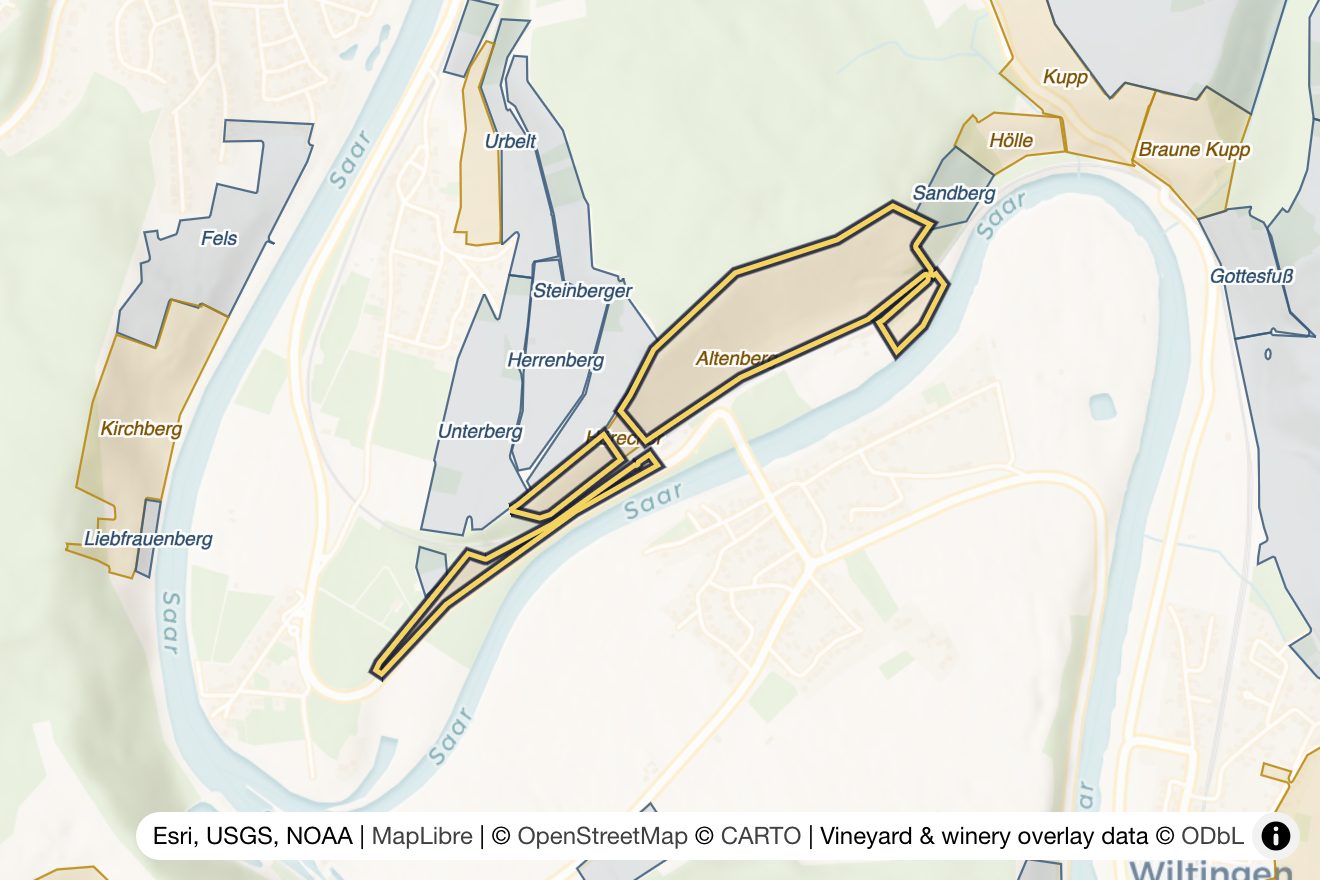
The einzellagen layer WineSaint ships delimits 21.22 hectares, measured geodesically. The register splits the site across two Gemarkungen under Lage 460216: 17.7 hectares of vines in Kanzem and a further 1.3 in Filzen, which belongs to the town of Konz, for 19.0 hectares planted in total. Planted and delimited areas count different things, vines against ground, and normally diverge sharply; on this site they almost coincide. Nearly every delimited hectare is under vine, which on the Saar is unusual and is itself a verdict on the land.
The VDP's profile gives the essentials: south-southeast exposure, a crest at 250 metres, and a gradient running from 55 to 89 per cent, which places it among the steepest cultivated slopes in Germany. Terrain sampled across the polygon puts the working ground between roughly 140 and 255 metres and confirms the south-southeast reading across the whole face. The evenness of the pitch is the site's visual signature; from across the water the slope looks ruled rather than folded.
Soil is greenish-grey and grey Devonian slate, with the VDP's description adding weathered Rotliegend, the Permian red bed material, to the mix. A wooded crown above the vineyard blocks the north and west winds while summer heat rises off the river below, so the site both gathers light off the bend and holds it.
The Grosslage is Scharzberg, the 1971 collective that covers every Einzellage in the Saar, and which for decades allowed anonymous blends to trade on the reputation of sites like this one.
VDP standing and who farms it
Parcels within the Altenberg are classified VDP.GROSSE LAGE, 14.43 hectares of them, for Riesling only. The VDP names three member estates at work in the site: Van Volxem, von Othegraven and the Stiftungsweingut Vereinigte Hospitien, the Trier charitable foundation. The classification attaches to those parcels rather than to the einzellage as a whole, and roughly a quarter of the planted ground sits outside it.
Von Othegraven farms about 16 hectares in total, almost entirely Riesling, and treats the Altenberg as the core of the estate; its other classified sites are Ockfener Bockstein and Wiltinger Kupp, alongside the Wawerner Herrenberg, which it holds as a monopole. Van Volxem, which built its portfolio around the Scharzhofberg and the Wiltinger Gottesfuss, added the Altenberg to its holdings after 2000 as part of a deliberate expansion into the valley's other first-rank slopes.
Kanzem's second classified site, the Hörecker, lies barely 90 metres west and is a fraction of the Altenberg's size, which makes the two a useful pair for anyone testing how far scale and gradient can be separated on the Saar.
The wine
The combination that defines the site is extreme pitch, a southerly turn and a river bend that returns both light and heat, set against the Saar's cold baseline. Riesling here reaches full ripeness without shedding the acidity that makes the valley's wines what they are, which is why the Altenberg carries the whole ladder from Kabinett to Trockenbeerenauslese and, increasingly, serious dry bottlings.
The slate does the rest. Devonian slate at this depth and angle stores warmth through the day and forces roots several metres down, and von Othegraven attributes the salty, mineral signature of its wines directly to it. The house profile across producers is consistent: concentration and a savoury, stony grip rather than the floral lift of the softer Saar sites, with the structure to hold for decades in bottle.