The Name and the Hill
The three sites on the Grünhaus hill were named by rank rather than by geography. The abbey of St. Maximin in Trier, to which the vineyards passed in 966, split the slope by station: the abbot took the choicest cut (Abtsberg), the choir monks, the Herren, took the middle band (Herrenberg), and the lay brothers took the bottom (Bruderberg). Herrenberg is therefore the second growth of a monastic table, not one of the sixteen generic lords' hills scattered across the Mosel.
The rock is the working distinction. Red Devonian slate dominates the Herrenberg, where the neighbouring Abtsberg runs on blue slate, and the two behave differently under vine. Aspect swings through the site from southeast round to southwest, gradients reach roughly 70 percent at the steepest, and the Grüneberg forest closes in above the upper parcels. Estate and importer descriptions agree on what that produces: Herrenberg is cooler and less steep than Abtsberg, with the woodland acting as a shelter belt against winter wind and frost. The practical consequence is a slightly later, gentler ripening curve on ground that holds warmth less aggressively than the blue slate next door.
Delimited Ground Versus Planted Vines
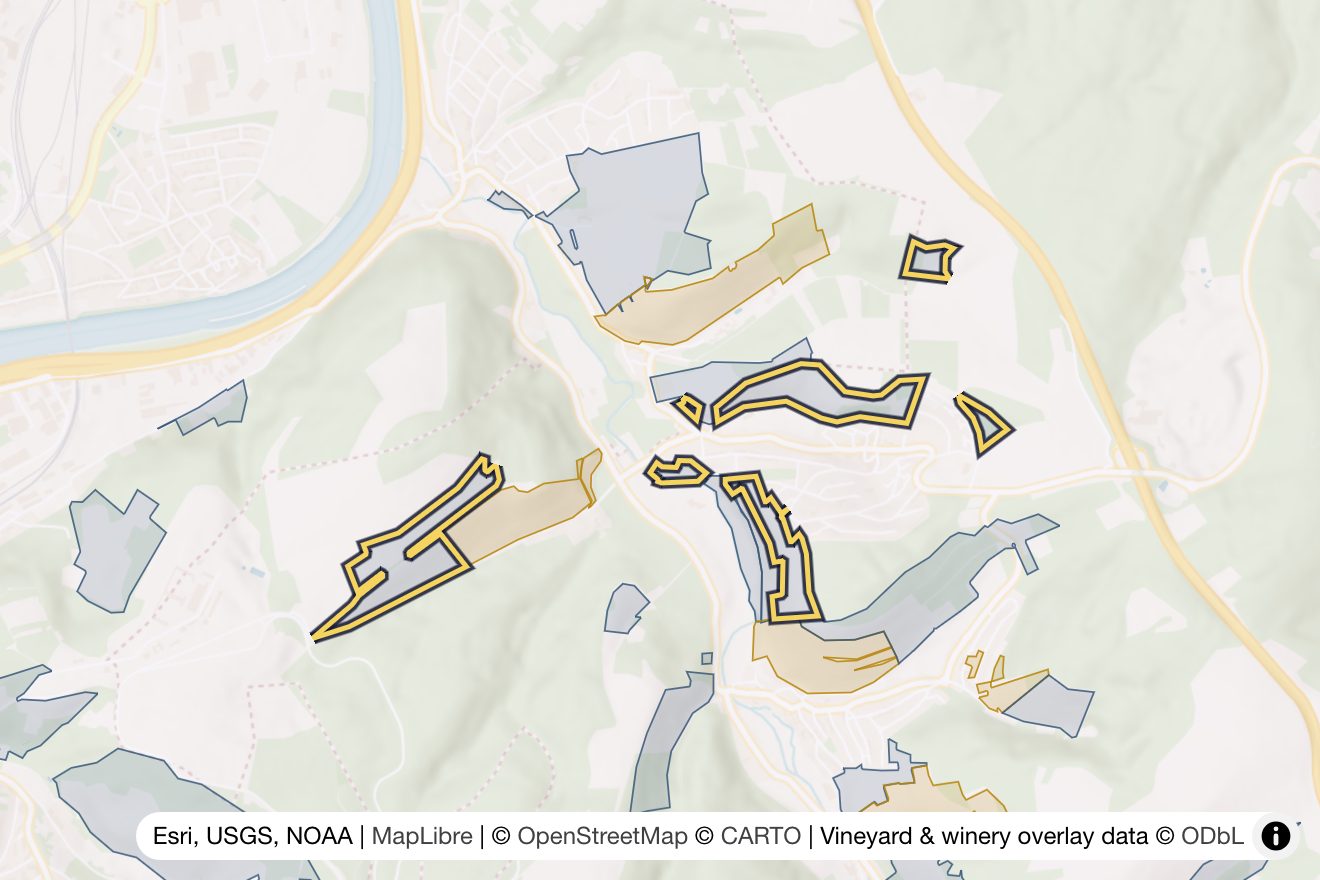
The polygon delimited for this site measures 48.67 hectares, taken geodesically. Maximin Grünhaus puts its Herrenberg at 19 hectares. Neither number is wrong. Delimitation follows the boundary drawn in the vineyard register, which sweeps in headlands, scrub, walls, terraces long out of production and slope that was never planted at all; the estate counts rows.
The scale of that gap matters here more than in most Mosel sites. Mertesdorf works around 65 hectares of vineyard in total, so the delimited Herrenberg on its own accounts for three quarters of everything the commune has under vine. Any reading of the polygon as planted vineyard will overstate the site by a factor of two and a half.
Who Farms It
Parcels within the Herrenberg are classified VDP.GROSSE LAGE, and vdp.de names Maximin Grünhaus, the von Schubert estate, as the member behind that classification, alongside Abtsberg and Bruderberg. The estate runs to about 34 hectares, planted 89 percent Riesling with small blocks of Weissburgunder and Spätburgunder, and describes its three sites as Alleinbesitz, sole family ownership. Its Herrenberg block is genuinely contiguous.
The delimited einzellage nonetheless reaches past that block. Erben von Beulwitz, a ten hectare estate in the village held by the Weis family since 1982, bottles Mertesdorfer Herrenberg Riesling across dry, off-dry and Grosses Gewächs tiers. Weingut Erhard Scherf, in neighbouring Kasel, has carried the name since at least 1993, when it made a Mertesdorfer Herrenberg Riesling Eiswein; it still lists a Findling Spätlese and a vintage Lagensekt from the site. Read the polygon as a monopole and those bottles have nowhere to come from. Read it as registered ground that includes a monopole, and everything reconciles.
The Wine
Grünhaus works the site across the full ladder: a Kabinett, a dry VDP.GROSSE LAGE bottling, a Superior selection and a Grosses Gewächs. The house line on Herrenberg is that it drinks earlier than Abtsberg without giving up longevity, and the wines bear that out. Young Herrenberg is juicier and rounder, with orchard and tropical fruit sitting forward and a tang of citrus underneath; Abtsberg at the same age is narrower, more acid driven and less willing. Ten years on the difference narrows considerably, which is why Herrenberg is the more useful of the two to buy in quantity.
Warming vintages have moved the site. Ground once treated as the cool insurance policy on the hill now ripens fully and often, and the dry bottlings in particular have gained weight and definition over the past decade. The Kabinett remains the clearest statement of what the red slate does: tart, saline, low in alcohol, built on acidity rather than extract, and unmistakably Ruwer rather than Mittelmosel in its narrowness and drive.
The von Beulwitz wines make a different case for the same ground, drier in emphasis and more overtly worked, and they are the easiest way to taste the site outside the monopole block.