Where It Sits, and What the Registers Say
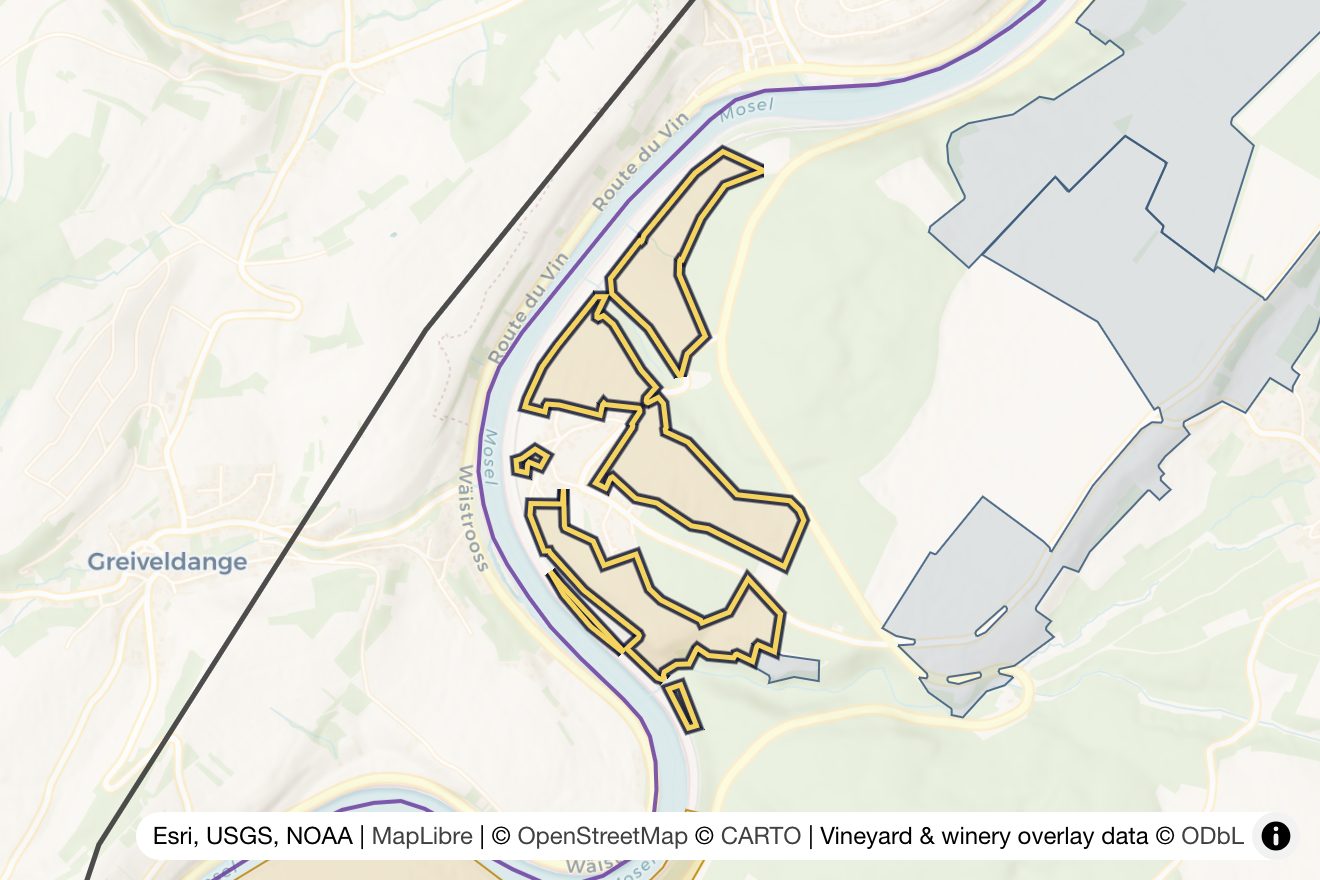
The site occupies the right bank between Palzem and Wincheringen, near 49.589 N, 6.382 E, with the Helterbach cutting into the hillside from the east and the working faces looking west and southwest across the river to the Luxembourg side. Structurally it is two vineyards at once: steep, broken, terraced ground falling to the Mosel, and gentler parcels running back to the northeast, which is where most of the easily worked vines now are.
The einzellagen polygon used here delimits 51.39 hectares. The Rhineland-Palatinate wine register for the 2024 harvest, which counts vines rather than delimited ground, records 35.9 hectares of bestockte Rebfläche under Lagennummer 420124 (Gemeinde Palzem, Gemarkung Wehr). The roughly fifteen-hectare difference is an honest measure of how much of the hard terraced ground has gone out of production. Palzem's five sites together (Rosenberg at Wehr, Carlsfelsen and Lay at Palzem itself, Kapellenberg at Helfant, Schloß Thorner Kupp at Kreuzweiler) come to 207.3 planted hectares, which is why the commune is routinely credited with about 200 hectares of vines.
Administratively the Rosenberg falls in Grosslage Gipfel, one of two collective names in Bereich Obermosel. Gipfel covers 678 hectares and 27 einzellagen across eleven communes, from Wasserliesch and Oberbillig in the north down to Palzem. At that size it is a genuinely regional label rather than one of the sprawling Mittelmosel collectives that discredited the Grosslage idea.
On VDP standing, none applies. The VDP.Mosel-Saar-Ruwer association has no member estate anywhere in the Obermosel, and the VDP's own vineyard directory lists no site in the Bereich at all. Datasets that tag this polygon as VDP.GROSSE LAGE, including the layer these guides ship with, are carrying an error.
Shell Limestone, Cliffs and Terraces
None of the geology here resembles the Mosel most drinkers picture. There is no Devonian slate. The Obermosel sits on Triassic Muschelkalk, shell limestone and dolomite laid down in a shallow sea roughly 240 million years ago, part of the same broad formation that surfaces again in Champagne and Burgundy. Bare limestone crags interrupt the Rosenberg's face, and the terraces were built between and around them.
Those terraces are the site's signature and close to unique on the German bank of the Obermosel. Regional tourism material describes original plots of about 89 to 120 square metres each, retained by a mix of natural rock and dry stone walling, most of them reachable only on foot. A short via ferrata now threads the cliffs and terrace steps, with a pavilion at the summit erected by the Heimat- und Kulturverein Wehr. The old walls and the half-abandoned ground have left the slope unusually rich in habitat: vineyard peaches, stonecrop, grape hyacinth, wall lizards, mullein moths. In 2020 the Rosenberg was designated a focal point of biodiversity.
Collapse and Repair
The site's nineteenth-century reputation, when the wines reportedly fetched top prices, did not survive mechanisation. Growers along the three-country Mosel pulled back from ground that no tractor could work, terraces went to scrub, and the walls began sliding toward the railway line below. Federal spatial planning work ran Palzem-Wehr as a model project between January 2012 and April 2014: clear the fallow, rebuild the historic dry stone walls, lay out terrace vineyards again, and part-fund the effort by tying the slope into the Moselsteig hiking network with a six-kilometre premium loop. A local organic estate had already started that clearing and wall repair before the programme began.
Who Farms It, and What It Gives
Weingut Carlsfelsen of Palzem, founded in 1959 and run by Armand and Fabian Frank across about nine hectares, is the estate now identified with the Rosenberg's steep sections; it bottles a Pinot Gris and a rosé under the Rosenberg name alongside its home site and a parcel in the Nenniger Schlossberg. Weingut Zusammenfluss, the small operation of Ramona Neisius and Michael Winkel, bottles a dry Wehrer Rosenberg Elbling.
The planting follows the rock rather than Mosel habit: Elbling first, then the Pinot family, Auxerrois, Chardonnay, with Riesling a minority interest. Limestone here gives lean, high-acid, chalky whites and Pinots built on structure rather than sugar. Local accounts insist the Wehr wines carry a faint rose scent, which is either the site talking or the name doing its work.