The Site
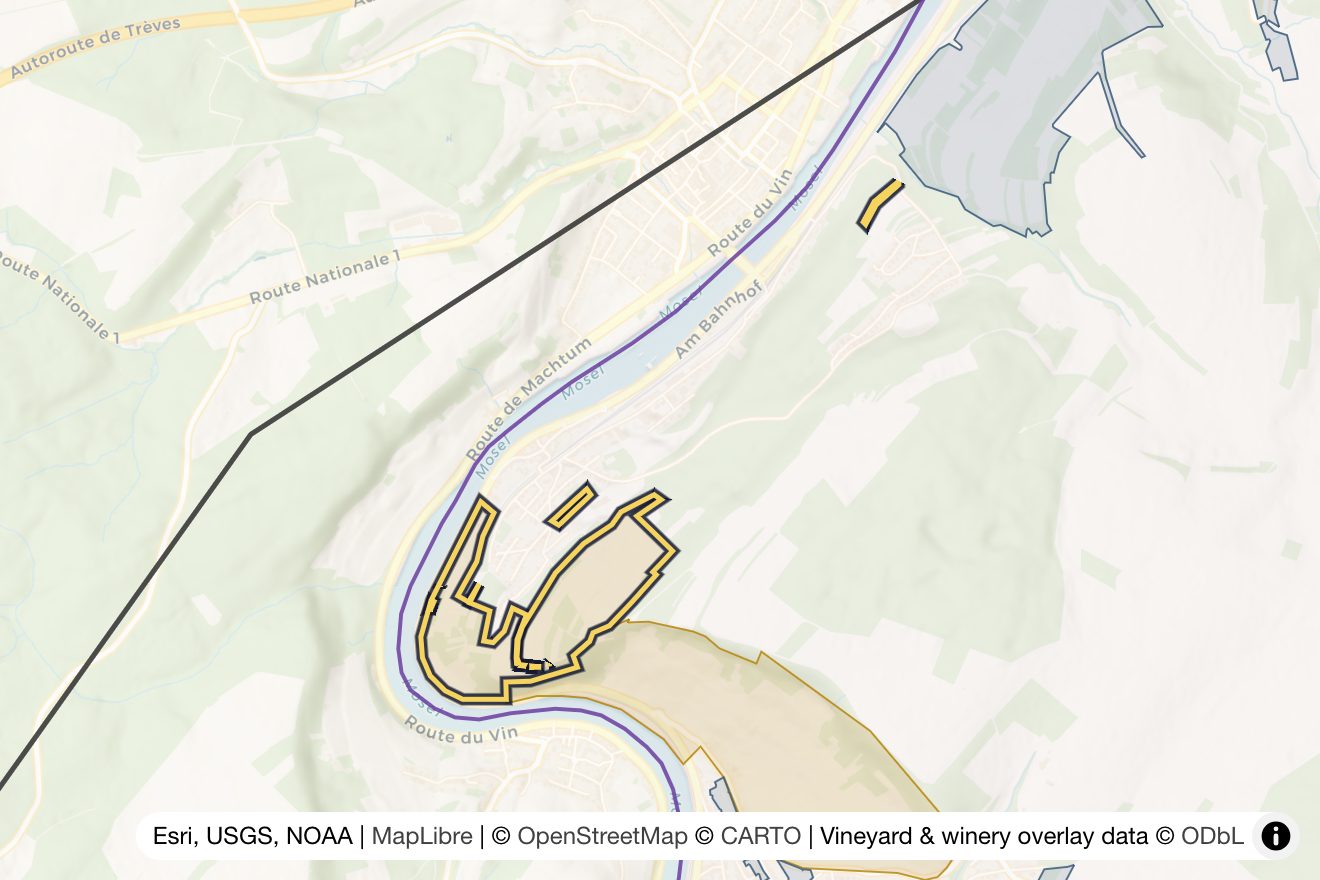
Wellen lies at about 150 metres on the right bank in the Verbandsgemeinde Konz, downstream of Nittel and upstream of Temmels, directly opposite Grevenmacher and on one of the sharper bends the Mosel takes along this stretch. The Altenberg runs across the slope behind and to the south of the village, centred near 49.664 N, 6.433 E, and its exposure is essentially western: afternoon and evening sun, and the accumulated warmth that both Elbling and Pinot need on ground this far up the valley. The best parcels are the steep ones at the southern end, where the site meets the Nitteler Leiterchen.
The einzellagen polygon used here delimits 32.62 hectares. The Rhineland-Palatinate register for the 2024 harvest counts 14.3 hectares actually under vine (Lagennummer 420125), a gap that reflects both the difference between delimited ground and planted rows and the long retreat from steep work across the Obermosel.
The site sits in Grosslage Gipfel, the larger of the two Obermosel collectives at 678 hectares over 27 einzellagen and eleven communes. No VDP classification applies here: the VDP.Mosel-Saar-Ruwer has no member estate in the Obermosel, and the association's vineyard directory lists nothing in the Bereich.
Limestone, Dolomite and a Vanished Waterfall
The soil is Muschelkalk, the Triassic shell limestone that defines the Obermosel and divides it absolutely from the Devonian slate downstream, mixed in places with Keuper marl. The dolomite band that forms the Nitteler Fels, the cliff wall standing some twenty metres high and running nearly a kilometre above Nittel, stops abruptly just short of the Altenberg. A detailed German account of the local geomorphology explains the break: around 120,000 years ago, during the Eemian interglacial, the Mosel pressed against that dolomite and fell over a waterfall roughly where the vineyard now stands, and the river spent the following millennia cutting it back.
Who Farms It
Weingut Wietor of Nittel, a fourth-generation estate of about 25 hectares run by Günter Wietor with his sons Patrick and Frank, counts the Wellener Altenberg among its best sites alongside the Nitteler Leiterchen and the Rochusfels. Its range is the standard Obermosel spread: Elbling first, then Weissburgunder, Grauburgunder, Spätburgunder, Chardonnay, Sauvignon Blanc, Riesling and Kerner, raised in steel for the lighter wines and in cask for the more structured ones.
Elbling grown on limestone here is taut and low in alcohol rather than aromatic, and it repays deliberately reduced yields; it also underpins much of the Winzersekt the Obermosel is known for. The Pinots take the limestone the way Pinot usually does, with firm acidity and a chalky, savoury finish rather than fruit weight.