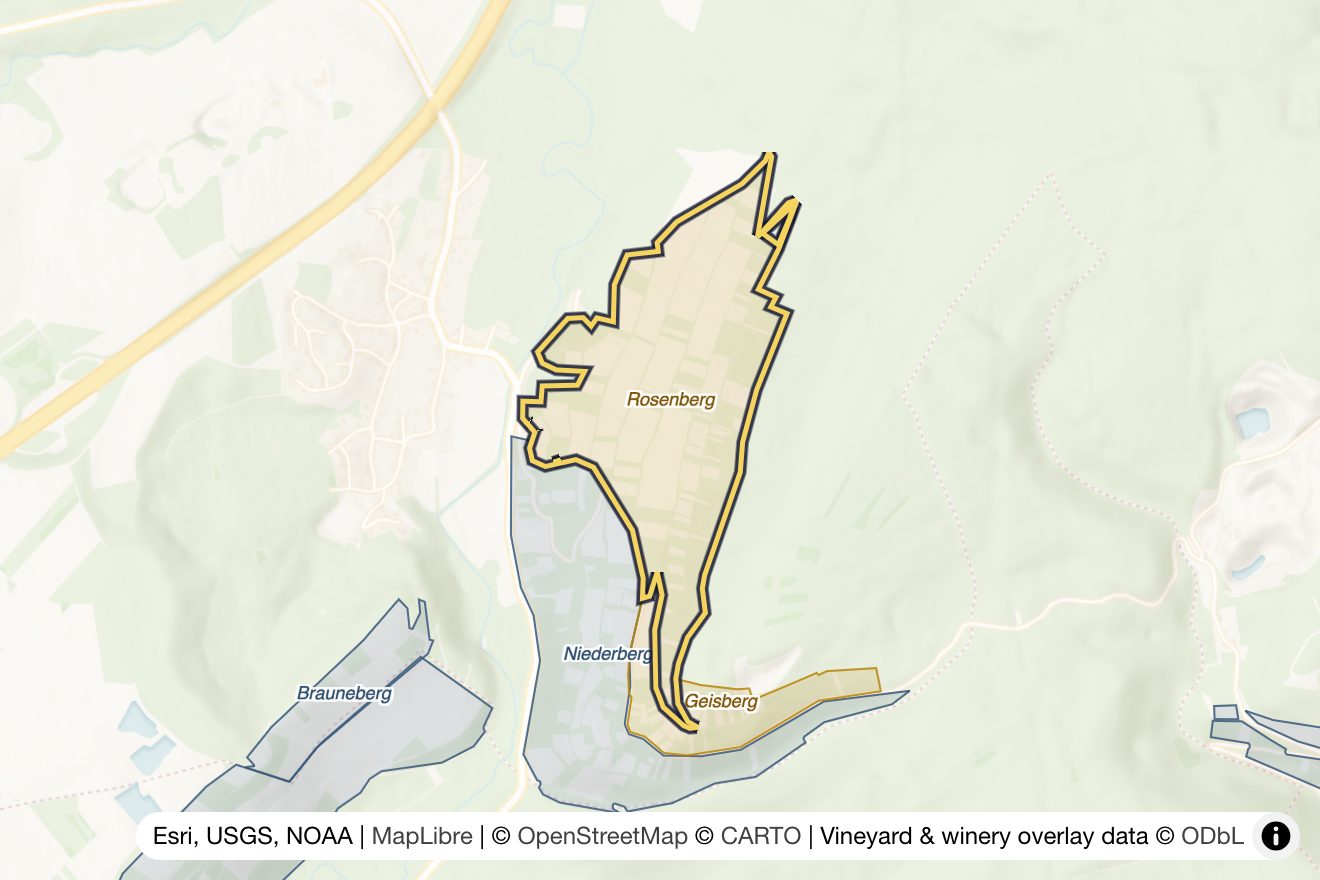
Where It Sits
Rivenich is not on the Mosel. The village lies in the valley of the Salm, a tributary running down from the Eifel toward the Wittlicher Senke, first recorded in 748 as Riveniacus and among the older settlements in the district. Its vineyards are side-valley ground: away from the river's thermal mass and its reflected light, on the slopes that flank the Salm rather than the Mosel gorge.
The Rosenberg (register number 410423) is the village's principal site by a wide margin. The Rheinland-Pfalz register for the 2024 harvest puts 33.8 hectares under vine, against 13.8 for the Niederberg, 3.4 for the Geisberg and 1.8 for a site confusingly named Brauneberg, which has nothing to do with the Juffer village of that name eight kilometres away. Our einzellagen layer delimits 57.73 hectares, meaning a substantial part of the permitted ground carries no vines; published planted figures and delimited figures diverge here more than at most Mosel sites.
The name repeats within the Grosslage itself: Minheim, on the Mosel proper, has its own Rosenberg of 67.0 hectares under the same Michelsberg banner. Village-qualified naming is the only thing that separates them.
Grosslage Michelsberg
Rivenich sits inside the Michelsberg, the Grosslage that gave the world Piesporter Michelsberg. That label is the most notorious construction in German wine law: a Grosslage name permitted to borrow the village name Piesport while drawing on vineyards across the whole collective, most of which never see the Piesport slope. Wine-Searcher puts its extent at around 1,375 hectares. The current register shows it spanning five communes, Piesport, Neumagen-Dhron, Minheim, Trittenheim and Rivenich, with the Piesporter Treppchen in the Gemarkung Niederemmel alone accounting for 234.8 hectares. In the British and American markets of the 1970s and 1980s the name became a byword for cheap, sweetened Müller-Thurgau, and it dragged the reputation of genuinely great neighbouring sites down with it. From the 2026 vintage, German labelling rules require "Region" to precede a Grosslage name in matching type, which will make the distinction visible for the first time.
Who Farms It
Two estates work from the village: Weingut Gebr. Wey and Weingut Mertes-Schönhofen. Wey has been in Rivenich since 1795 and is now in its seventh generation, farming around thirty hectares across the Salm valley, the Michelsberg and holdings in Leiwen and Köwerich, on soils the estate describes as mainly red slate, and vinifying without animal products. Its flagship is the Rivenicher Niederberg rather than the Rosenberg, which is the honest measure of where the Rosenberg sits in the local hierarchy: the volume site, planted to Riesling alongside Kerner, Weissburgunder, Grauburgunder and Spätburgunder, supplying straightforward Kabinett and Spätlese for direct sale rather than wines built to travel.