Where It Sits
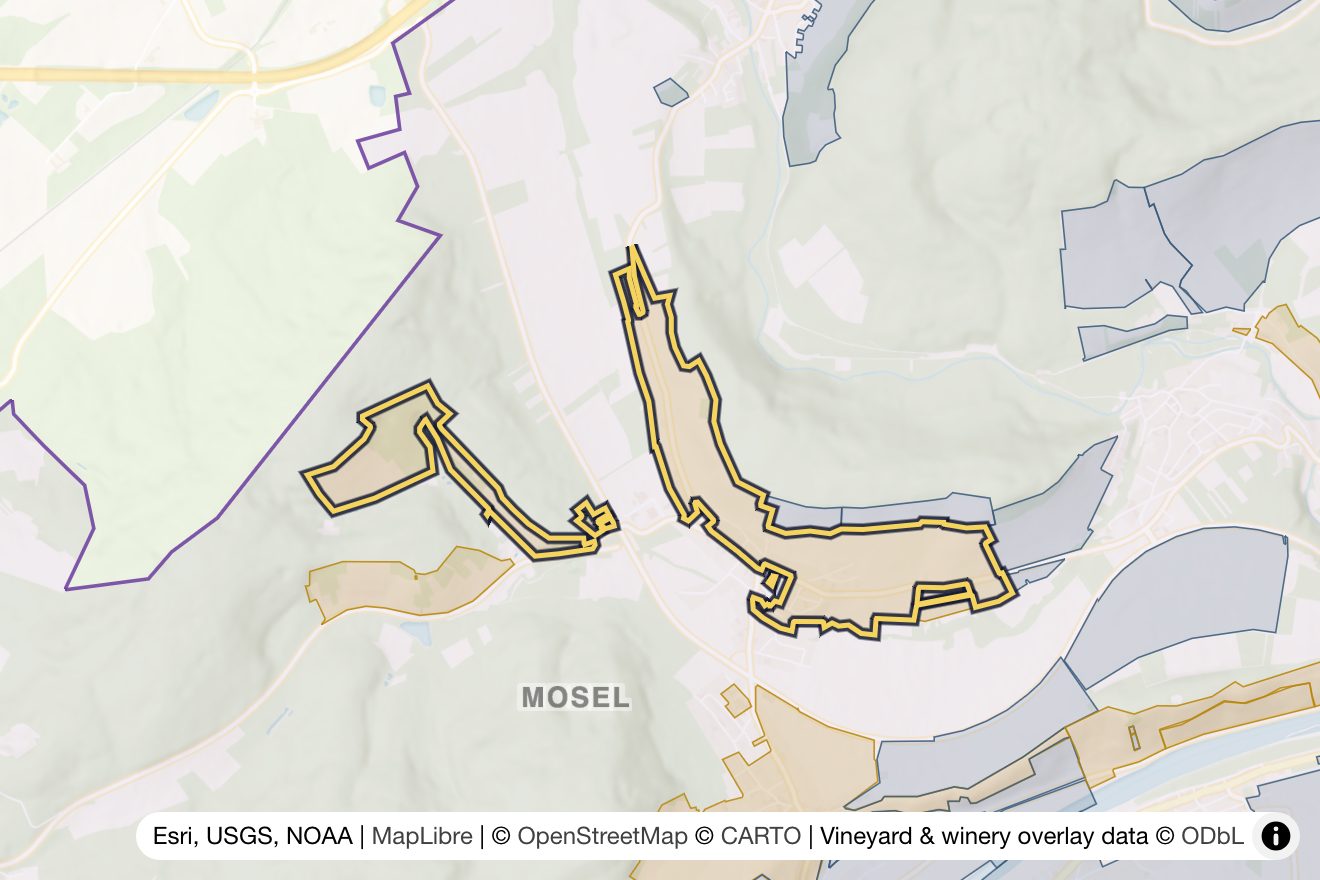
Osann-Monzel is not a riverside village. The vineyards lie on the raised ground above the Mosel, set back from the water between Mülheim and Maring-Noviand, on the shoulder where the valley meets the Wittlicher Senke. That single fact governs the site: no reflected light off the river, no thermal buffering from the water, and a growing season that runs a beat cooler than the famous slopes two kilometres away.
The compensation is aspect. Vinaet describes exposures running from west through south across sloping to genuinely steep ground, with strong afternoon accumulation and a stream at the foot of the hill. Above the Rosenberg's upper edge sits the Osanner Kirchlay; eastward along the same hill run the Monzeler Kätzchen and the Maring-Noviander Römerpfad. The soil is stony Devonian slate carrying a loam fraction, heavier and more water-retentive than the raw slate scree of the riverside Steillagen.
Scale, and Three Different Numbers
The einzellagen layer we ship delimits 165.92 hectares. The Rheinland-Pfalz register for the 2024 harvest records 87.0 hectares under vine. Vinaet cites approximately 92 hectares. The delimited figure is the ground that may legally be planted and labelled Rosenberg; the register counts vines that actually exist, and roughly half the polygon is not currently vineyard.
Even at 87 hectares this is a large site by Mosel standards, exceeded within the Kurfürstlay only by the Wintricher Großer Herrgott and the Brauneberger Mandelgraben. It is also the biggest of the commune's four Einzellagen, ahead of the Monzeler Kätzchen (76.2 hectares across both Gemarkungen), the Monzeler Paulinslay (33.3) and the Osanner Kirchlay (17.6). Osann-Monzel's roughly 214 registered hectares make it one of the largest continuous vineyard blocks on the Mosel, worked by around fifty-five growers.
The Kurfürstlay, and What It Implies
The Rosenberg sits inside the Grosslage Kurfürstlay, which gathers fourteen villages around Bernkastel and folds sites as different as the Brauneberger Juffer Sonnenuhr and the flat hinterland of Osann into a single labelling term. A wine sold as Bernkasteler Kurfürstlay may contain nothing from Bernkastel and nothing from any slope. From the 2026 vintage, German law requires the word "Region" to appear immediately before the Grosslage name in matching type, ending the long ambiguity between a collective and a single site.
Vines and Bottlings
Riesling dominates, at roughly half the commune's white production, with a surviving Rivaner (Müller-Thurgau) component and a red share of about fourteen percent against a Mosel average nearer five, which tells you something about ground that ripens Pinot and Dornfelder but rarely produces trophy Riesling. Weingut Jan Bollig, Weingut Reef, Weingut am Rosenberg and the Weinversand Hubert Braun all bottle the site by name, across a range that runs from Riesling Hochgewächs and feinherb through Spätlese and Auslese to Eiswein. The wines are made to be drunk rather than cellared: aromatic, slate-inflected, priced for the local and direct-sales trade, and largely invisible to the export market.