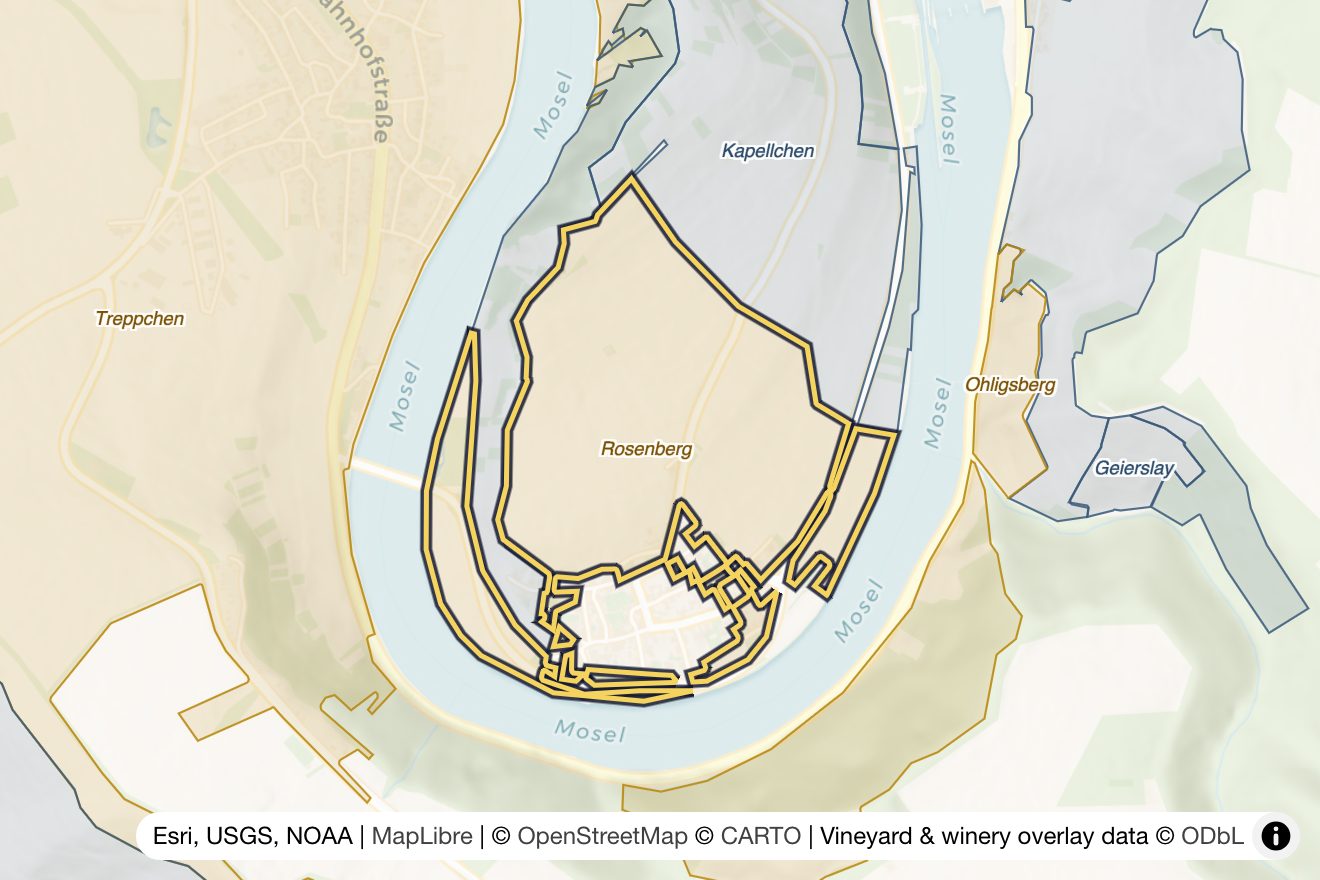
Local figures put the vines at roughly 68 hectares within a Minheim total of about 150. Both numbers can be right at once: the register draws a boundary around viticultural ground, headlands, tracks, walls, scrub and fallow included, while planted figures count only rows in production.
The Loop That Makes the Site
Minheim is very nearly an island. The Mosel wraps the village on three sides in one of the tightest meanders on the Mittelmosel, which is why the commune trades under the name Sonneninsel. The loop is not decoration. A village enclosed by that much water sits inside a thermal buffer, and the canalisation works of 1960 to 1964, which raised and stabilised the river for barge traffic, deepened it. Minheim enters the written record in 1061 in a charter of the Trier cathedral chapter, so this ground has been read as vineyard for close to a millennium.
The Rosenberg occupies the sun-facing apron above the village, climbing from the flood plain toward the wooded rim. Terrain data places the centre of the delimited polygon near 160 metres, some 35 metres above the river.
Slate, Sand and the Question of Gradient
The single most important fact about the Rosenberg is that it is not a steep site, and Minheim's own growers say so plainly. Stephan Thielen of Weingut Thielen-Feilen splits the commune in two: the Günterslay and the Burglay are the Steillagen, hand-worked at gradients reaching 70 percent, their names carrying the old dialect word Lay for slate; the Rosenberg and the Kapellchen are the gently south-inclined ground. Thielen calls the Günterslay the Sahnestück of Minheim, running up against the crag locals name the Mosel-Loreley. The Rosenberg is the workable remainder, and at 82 hectares it is the reason a village of roughly 500 people can farm 150 hectares of vine at all.
The rock beneath is Devonian slate in every stage of weathering, grey-black, heat-retaining, thin toward the top of the slope. Nearer the river the profile changes character entirely: sandy alluvial sediment in the Auen, ground the growers reserve for early-ripening varieties rather than Riesling. A description of the Rosenberg as uniform slate would in fact be a description of the Günterslay.
Grosslage, Classification and Growers
Michelsberg is the umbrella, and it is the umbrella that did more damage to German Riesling's export standing than any other single name. It gathers Minheim's four sites with those of Piesport, Niederemmel, Dhron, Neumagen and Trittenheim, which means Rosenberg fruit can legally leave the village in a bottle labelled Piesporter Michelsberg. The Einzellage name is the only thing on a label that ties a wine to this slope.
The WineSaint data tags this polygon as Grosse Lage. The VDP's own vineyard register records no classified site anywhere in Minheim and lists no member estate farming here, so no VDP tier should be attached to the Minheimer Rosenberg. The nearest classified vineyard of the same name is Kinheim's Rosenberg, downriver in Schwarzlay, which vdp.de does carry as VDP.GROSSE LAGE: a different village, a different hill, light grey clay slate, a south-south-west face and a far steeper core.
Bottlings come almost entirely from Minheim itself. Thielen-Feilen work parcels of over forty years and release them under proprietary names rather than the Prädikat ladder; the Eichelmann guide read their old-vine Rosenberg Riesling as smelling of yeast and peach skin, spicy on the palate, without great length, which is a fair account of what gentle slate ground gives. Christoph Koenen, Thielen-Nilles, Thielen-Schunk and Bollig-Fischer also bottle the site, largely as dry and feinherb Riesling, with Hochgewächs, Kabinett and Spätlese appearing in ripe years. The style is open, fruit-led and early-drinking. The tension the Günterslay delivers is not what this ground is for.