The Site
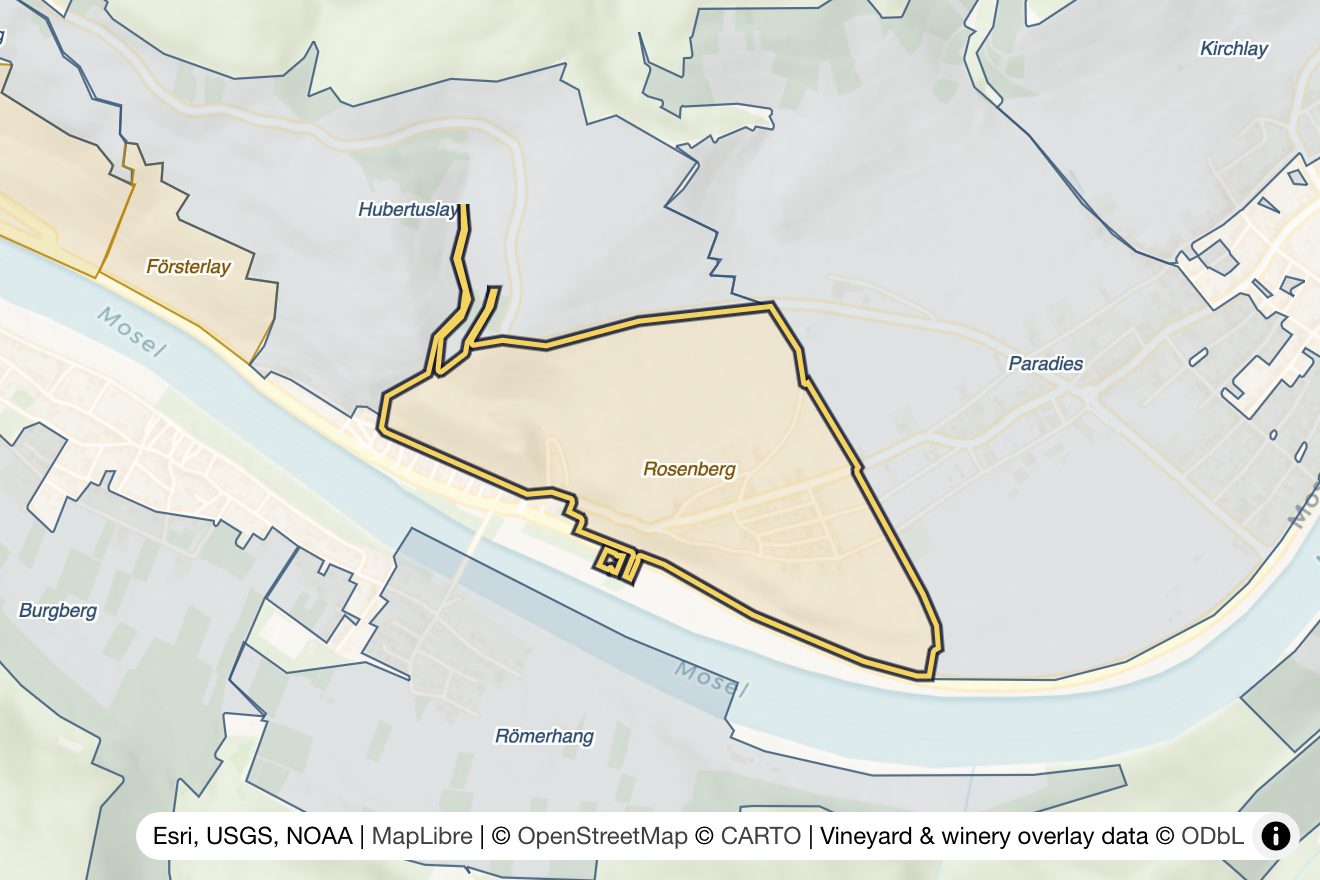
Kinheim sits in the Mittelmosel between Lösnich upstream and Kröv downstream, a short run below the red-slate villages of Ürzig and Erden. The Rosenberg does not face the village so much as wrap around it. Weingut Kees-Kieren, which farms here from a base in Graach, places its parcels directly behind the settlement on a south-southwest face reaching sixty percent gradient. The Mosel reference site Vinaet identifies the steep ground closer to the river and north of the village, on a southwest exposure, as the historically prized portion. Both describe segments of the same hillside arc, seen from different holdings.
The site is a modern composite of older ground. The parcels now inside its boundary were once named separately as Halsbach, Petsch and Bondel, all well regarded in the nineteenth century, and the Prussian tax classification of that period placed the steepest of them in its highest band. Upstream, the Hubertuslay begins on the far side of the Willersbach and climbs to the forest edge, curling around the Rosenberg's upper limit. Downstream the ground relaxes as it runs toward Kröv, where Weingut Schneider-Faber describes sandier loam and gentler angles in the outer sections.
Our einzellagen layer delimits 64.78 hectares. The 2024 register records 43.2 hectares actually under vine, and Vinaet cites roughly 63 hectares. These are not competing claims: the delimited polygon is the ground a grower may plant and label, while the register counts standing vines. Kinheim's other registered sites, the Hubertuslay (34.9 hectares) and the Römerhang (24.3 hectares), leave the Rosenberg comfortably the village's largest.
The Grosslage above it is the Schwarzlay, a name that reads as black slate. It is a very large collective, gathering Ürzig, Erden, Lösnich, Enkirch, Burg and Traben-Trarbach along the river and then reaching inland to Wittlich, Dreis, Hupperath and Bausendorf. A Schwarzlay label therefore guarantees nothing about proximity to the Mosel. From the 2026 vintage, German labelling rules oblige a Grosslage name to be preceded by the word "Region" in matching type, size and colour, which will finally separate collective bottlings from single-site ones on a shelf.
Slate, and a Disagreement About Its Colour
The sources do not agree on the rock. Schneider-Faber calls the core soil hellgrauer Tonschiefer, light grey clay slate. Selbach-Oster, bottling from vines it now works in Kinheim, specifies weathered grey-blue Devonian slate. Vinaet says Grauschiefer. Dr. Loosen, by contrast, names Kinheim alongside Ürzig and Erden as one of the three villages where the Mosel's iron-rich red slate is concentrated.
The reconciliation is geological rather than rhetorical. The red slate that gives the Ürziger Würzgarten its spice is a local anomaly rather than a continuous stratum, and it thins going downstream. Kinheim sits at the outer margin of that intrusion, which is why one grower reports iron staining and another, two hundred metres away, reports plain grey.
What the vine experiences is better documented than the colour. Kees-Kieren describes a high proportion of coarse fragments, heavy slate content and low field capacity, meaning a soil that holds almost no water, and measures 110 to 130 kilowatt hours of direct solar radiation per square metre across September and October. The estate treats drought stress as the site's central risk and its central advantage, since it yields small berries with a high skin-to-pulp ratio.
Classification and Who Farms It
Parcels within the Kinheimer Rosenberg are classified VDP.GROSSE LAGE. The classification attaches to those parcels and not to the einzellage as drawn. vdp.de lists Rosenberg, Kinheim among the Grosse Lage holdings of Weingut Dr. Loosen, alongside the Wehlener Sonnenuhr, the Graacher Domprobst and Himmelreich, and the Bernkasteler Lay. Loosen bottles a Kinheimer Rosenberg Grosses Gewächs, fermented spontaneously and held twelve months on its lees in 1,000 and 3,000 litre casks.
The site's older reputation was built entirely without a classification. Weingut Alfred Merkelbach of Ürzig, run for decades by the brothers Rolf and Alfred, made its name on Kinheimer Rosenberg Kabinett and Spätlese raised in old fuder. Rolf died in 2023 and Alfred in 2024; Johannes and Sebastian Selbach of Selbach-Oster have farmed the vineyards since 2020 and continue to vinify in the Merkelbach cellar under the Merkelbach label. Kees-Kieren works the site exclusively dry. Dr. Hermann in Erden, Schneider-Faber, Markus Molitor (up to Auslese) and Weinhof Sankt Anna also bottle it.
The Wines
Rosenberg does not deliver the exotic top notes of the Ürziger Würzgarten or the density of the Erdener Prälat. Its signature is proportion. Dr. Loosen frames it as among the most finely structured sites of the Middle Mosel, with delicate aromatics and precise acid architecture. The Merkelbach wines, tasted by Terry Theise across four decades, show substance without weight and an intricate minerality, with an occasional musk melon note and a smokiness he likens to burning herbs. Selbach-Oster's Kabinett runs at nine percent alcohol on citrus and stone.
The useful benchmark is Vinaet's: the best Rosenberg parcels sit close to the Lösnicher Försterlay and the Erdener Treppchen in soil, exposure and microclimate. That is the register the site plays in, and the reason a village most drinkers cannot place on a map holds VDP-classified ground at all.