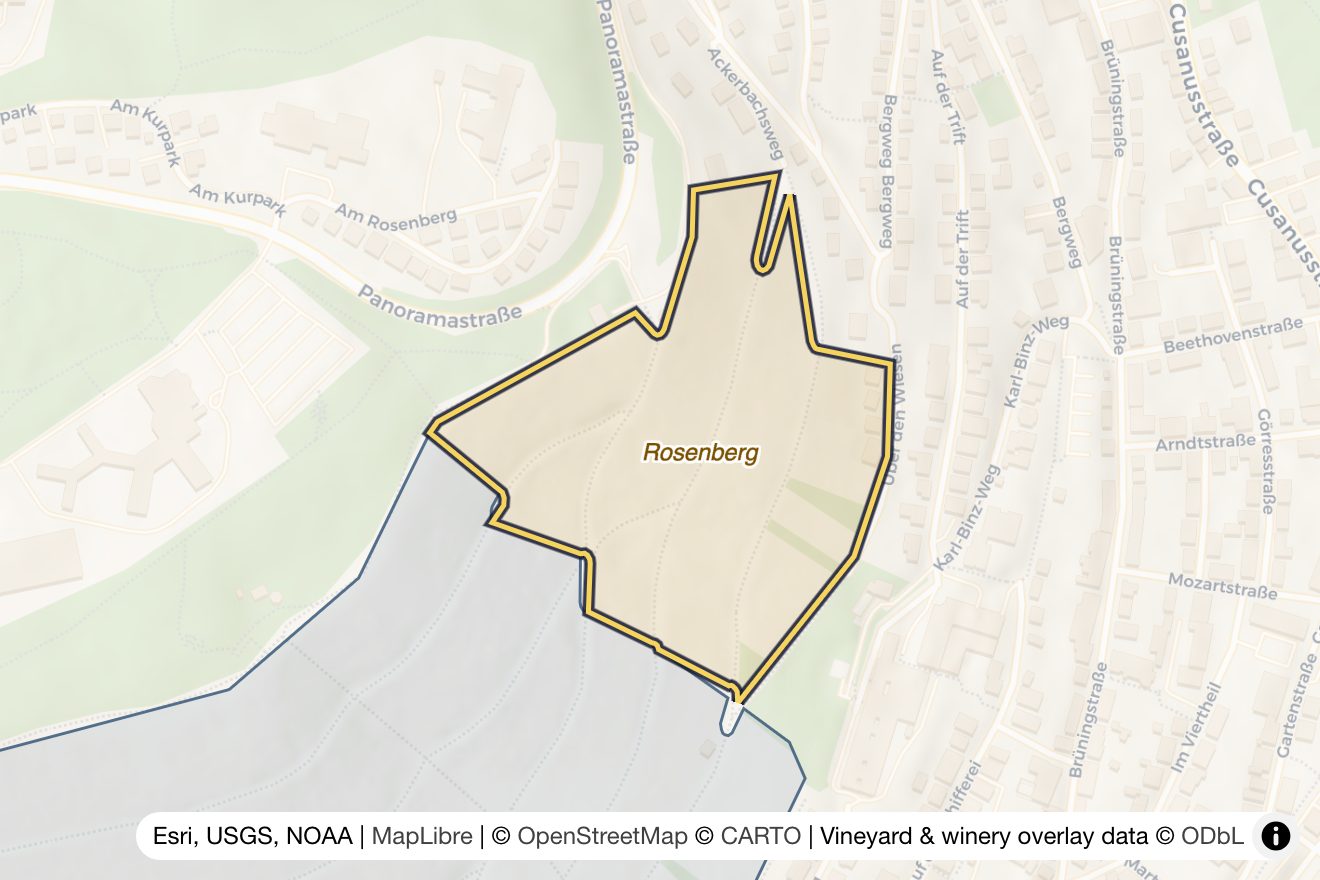
The WineSaint layer delimits 8.35 hectares here, which makes it one of the smaller einzellagen in the commune. Published planted figures will sit lower, because the delimited boundary encloses tracks, walls and untended ground as well as vines.
Position, Rock and Aspect
The Rosenberg lies north of the Kues district on the left bank, immediately east of the Kueser Kardinalsberg, with the Weisenstein beyond that. Behind and above the vines the land flattens into the Kueser Plateau, a state-recognised climatic health resort carrying five clinics, so this slope backs onto open upland rather than the forested valley rim that closes most Mittelmosel sites. The small Fierskapelle stands among the vines at the top of the slope; Andreas Fier, court administrator to the archbishop of Trier, had it built in 1670, with a nineteenth-century rebuild and a thorough renovation in 2003.
What is visible from there is the point. Directly across the water sit the Doctor, the Graben, the Lay and the Schlossberg beneath the ruins of Burg Landshut. The Rosenberg looks straight at the most expensive slate in Germany from a slope that has never commanded a premium.
The soils are slate mixed with loam, and the loam is the whole difference. The Kardinalsberg and the Weisenstein are the recognised slate steeps of Kues; the Rosenberg is softer, deeper, more forgiving ground on the same flank. Exposure runs south to south-south-west and the planting is overwhelmingly Riesling. Terrain data puts the polygon's centre near 200 metres against a river surface around 110 metres, so this is upper-slope rather than riverside ground. The wines follow the soil: rounder, earlier-maturing and less nervy than anything off the Kardinalsberg, typically bottled dry or off-dry, with Hochgewächs and Spätlese in ripe years.
Standing and Growers
The WineSaint data carries a Grosse Lage tag on this polygon. The VDP's vineyard register lists five classified sites in Bernkastel-Kues (the Doctor, the Graben, the Johannisbrünnchen, the Lay and the Badstube) and the Rosenberg is not among them, so no VDP tier should be asserted here.
Kurfürstlay, the Grosslage, reaches from Bernkastel and Kues out through Andel, Lieser, Mülheim, Veldenz, Maring-Noviand, Burgen, Brauneberg, Filzen, Osann, Monzel, Kesten and Wintrich. It contains a second Rosenberg, at Osann. Two sites of the same name inside one Grosslage is exactly the condition that makes village qualification non-negotiable on the Mosel.
Weingut Peter-Jos. Hauth of Bernkastel-Kues farms roughly four hectares of steep and escarpment vineyard across the Kueser Kardinalsberg, Weisenstein and Rosenberg together with the Bernkasteler Graben and Badstube, predominantly Riesling. Jakob Massem, Brunnenhof Herges and Herbert Port-Roels also bottle the name. This is a local grower's vineyard rather than an export site, and it is best understood as the gentler working ground that sits behind Kues's two serious steeps.