The Site
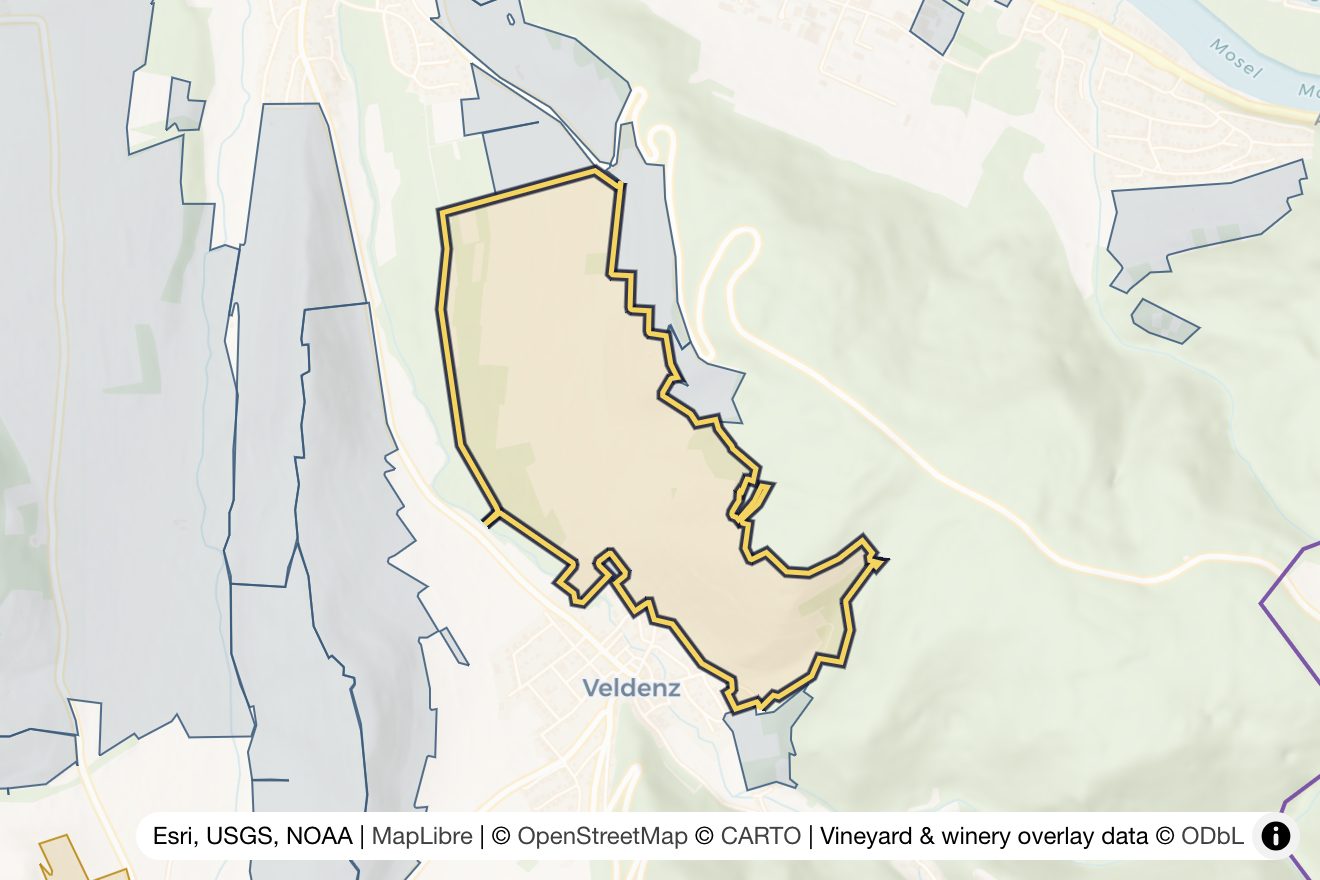
Kirchberg is the church hill, and as at Burgen the name describes the ground exactly: the vineyard climbs steeply behind the village's Catholic church, rising from the valley floor at 170 metres to 320 metres. It is by a wide margin the largest of the commune's five individual sites, ahead of Elisenberg, Mühlberg, Grafschafter Sonnenberg and Carlsberg. Growers give the exposure as south to southwest.
The geology divides in two. The steep core is stone-rich Devonian blue slate, broken enough for deep rooting, and it is here that fifty-year-old Riesling produces small crops of the site's serious wine. The footslope running toward Mülheim is something else entirely: silty and loamy sediments deposited by the Mosel, mixed with gravel the river carried down from France, planted mostly to Müller-Thurgau on larger, easily worked parcels.
Our einzellagen layer measures 110.33 hectares of delimited ground, centred at 7.02253, 49.89655. For context, the whole commune of Veldenz has roughly 130 hectares of vineyard and about a dozen estates, so the delimited figure clearly counts entitled ground rather than standing vines.
Standing and Growers
The administrative Grosslage is Kurfürstlay, the Bereich Bernkastel collective spanning fourteen villages and forty sites. No parcel of the Veldenzer Kirchberg carries VDP classification; the only Kirchberg on the VDP's Mosel register is at Hatzenport on the Terrassenmosel, an unrelated site.
The site is bottled by Weingut Martin Conrad, who works it organically and releases both a straight Riesling and an Alte Reben cuvée, by Becker-Steinhauer of Mülheim, by Gorges-Müller, and by Weingut Bauer, among a small group of local producers. Sweet Prädikat wines from the site have a track record: Becker-Steinhauer's 2005 Beerenauslese and Trockenbeerenauslese are the highest-scored Kirchberg wines in the riesling.de database.
The Wine
Distance from the river is the defining variable. Without the Mosel's thermal mass below them, the Kirchberg vines see cooler nights and a slower finish to ripening, and growers here consistently report a sharper acid profile than sites in direct contact with the water. Weingut Bauer goes further and likens the results to Saar and Ruwer wines rather than to Mittelmosel neighbours, which is a fair reading: the wines are filigree, high-toned and lean rather than broad, with the blue slate showing as a cool mineral thread instead of warm spice. In warm vintages that is an asset. In cool ones the site needs old vines and low yields to carry it, which is precisely what the steep core supplies.