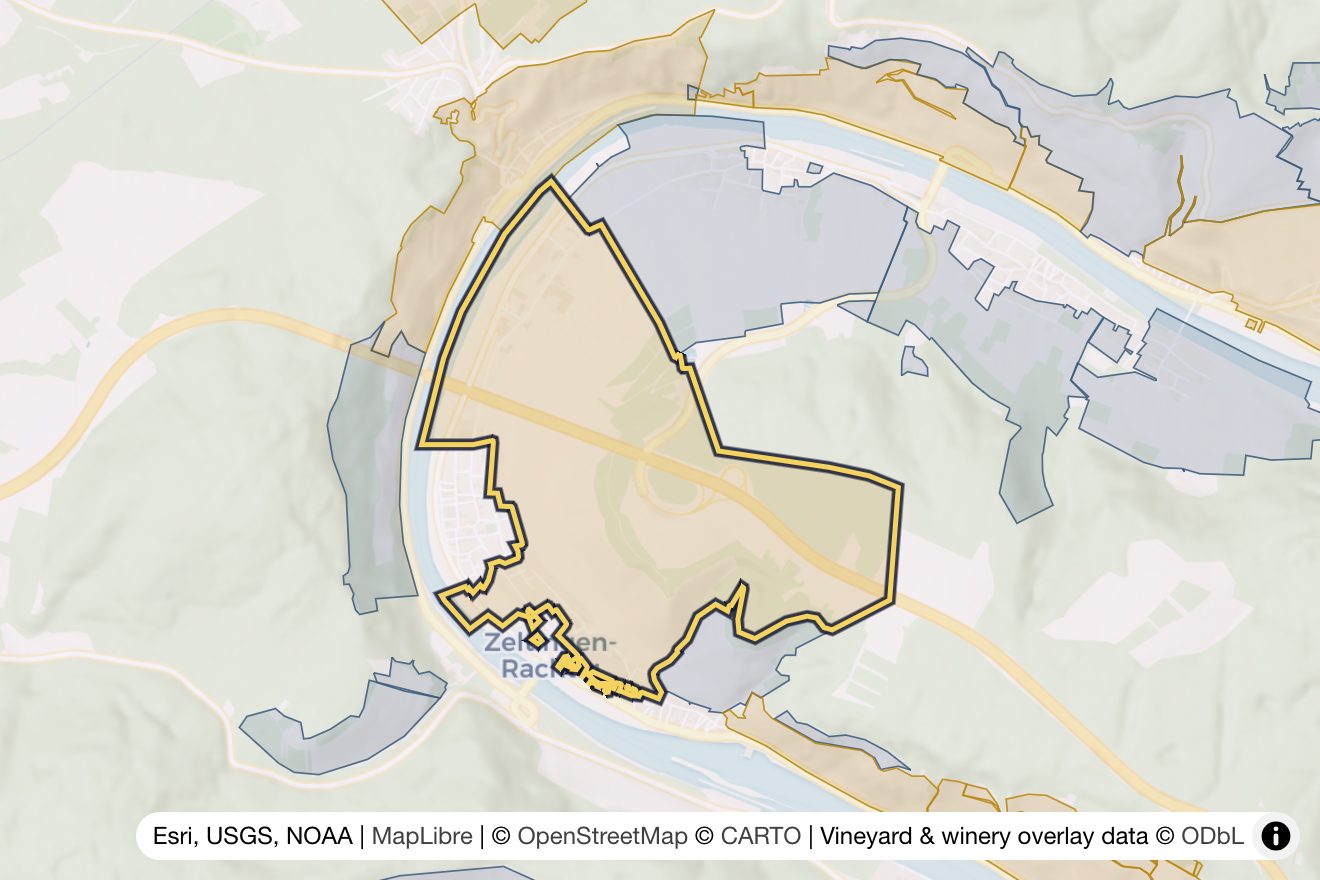
Extent, Aspect and Soil
Our einzellagen layer measures 334.06 hectares of delimited ground, centred at 7.01461, 49.96445. That figure is far larger than anything published for the planted vineyard: German references put the vines at roughly 77 to 79 hectares, and the whole commune of Zeltingen-Rachtig is usually credited with around 170 hectares under cultivation. The delimited polygon records land entitled to the name, including abandoned terrace, woodland edge and plateau; the smaller figures count standing vines. Nowhere in the Mosel is the distinction between delimited and planted area more consequential than here.
German sources place the vines between about 102 and 296 metres, with the great majority of parcels rated steep to very steep and gradients reaching 75 percent on the core slope, thinning to merely sloping ground at the margins. Selbach-Oster describe the orientation precisely: the steep heart faces south-southeast, then swings through southwest to west as the site runs downstream.
The soil separates the Himmelreich from its neighbours more clearly than the aspect does. Where Zeltinger Sonnenuhr is the rockiest and driest ground in the village, the Himmelreich carries deep, finely weathered slate with a high humus content, shot through in places with clay, gravel and other sedimentary stone left by the river. More soil, more water, more fruit, less austerity. It also explains why the Himmelreich is planted to a wider spread of varieties than any classified site nearby: alongside Riesling, growers here work Weissburgunder, Chardonnay, Sauvignon Blanc, Müller-Thurgau and Spätburgunder. That is a working vineyard's plantation, not a monument's.
Standing
The Grosslage is Münzlay, shared with Graach and Wehlen, a small and unusually high-quality pool by German standards.
On VDP classification the record is clear and worth stating plainly: the VDP's Mosel-Saar-Ruwer vineyard register lists Sonnenuhr for Zeltingen and does not carry Himmelreich at all. No parcel of Zeltinger Himmelreich is classified VDP.GROSSE LAGE, even though VDP member estates including Selbach-Oster bottle the site name. Any suggestion that this ground holds VDP grand cru standing is incorrect.
Parcels and Producers
Within the site, two named corners do the reputational work. Anrecht, from Im Annenrech, is a steep south-facing parcel set further back from both river and village than the rest, which makes it marginally cooler. Its subsoil is the deepest in the Himmelreich, broken slate worked through with loam and humus, under a stony topsoil over leafy slate, and its vines are more than forty years old, some ungrafted. Selbach-Oster's own account, repeated in its importer material, places Anrecht in the top bands of the 1868 Prussian tax classification, and the estate normally bottles it as a sweet Auslese: powerful, dense, herb-spiced and emphatically mineral. Schmitt lies directly behind the Zeltingen church, faces due south, and yields the longest-lived wines of the site, dense and saline with noticeable fine phenolics.
Beyond Selbach-Oster, the site is worked by Markus Molitor, whose Himmelreich Kabinett and Spätlese are the widest-distributed expression of it, and by Weingut Heinrichshof, Gessinger and a long tail of village estates.
The Wine
The house style of the Himmelreich is juicy. Yellow orchard fruit, a light spice, and an acidity that is playful rather than piercing: this is the Zeltingen site that gives pleasure early. It is not the site for tension, and comparisons with the Sonnenuhr, thirty metres of slope away, will always run against it on structure and mineral drive. The correct reading is that the Himmelreich's broad shoulders make it Zeltingen's engine, supplying the commune's everyday Riesling, while Anrecht and Schmitt demonstrate that specific parcels within it belong in a much higher bracket than the site's average.