Shape, Rock and the Domprobst Question
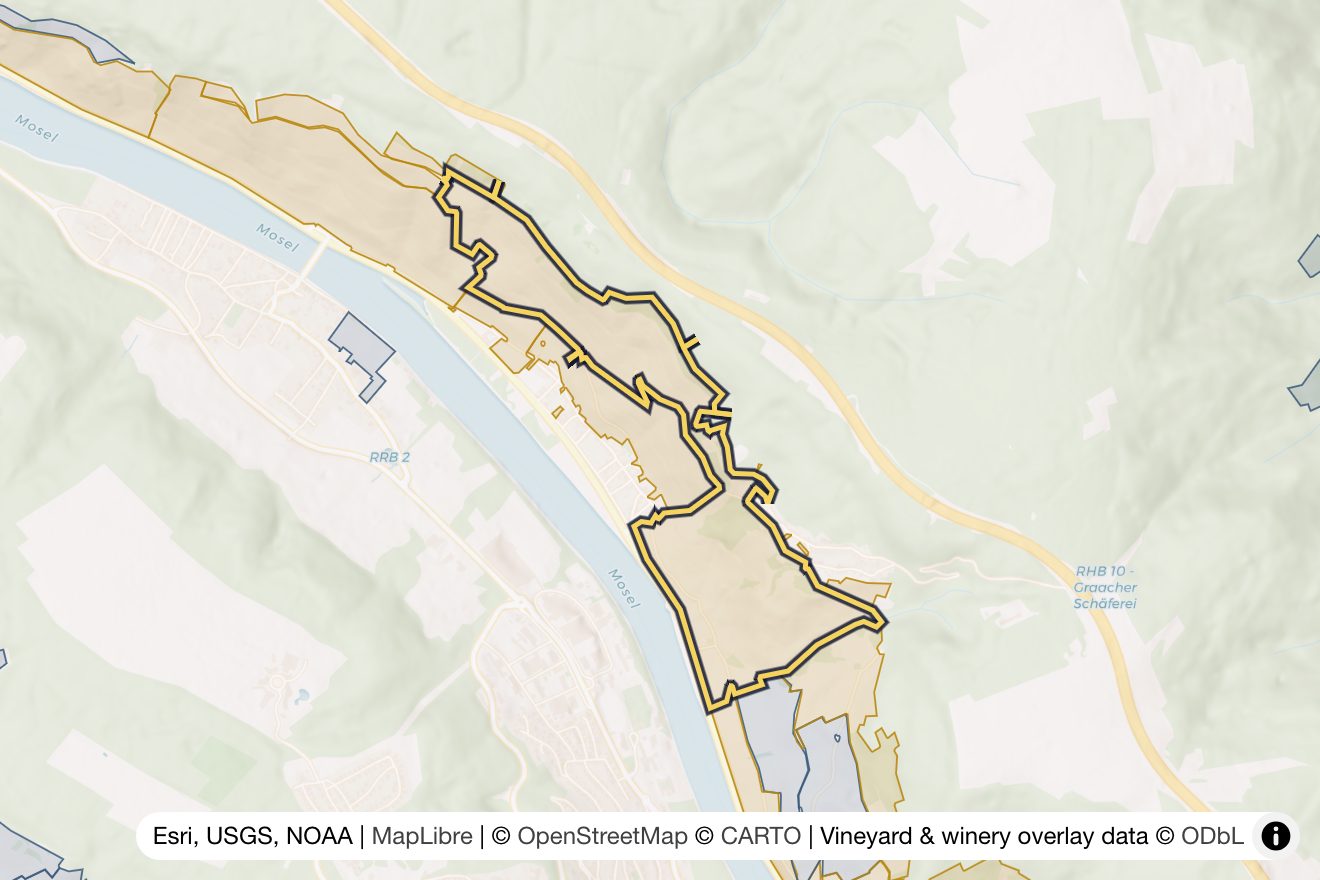
The Himmelreich is the outer wrapper of the Graach slope. It runs along the long, unbroken ridge that carries south-west-facing vineyard continuously from Bernkastel-Kues to Zeltingen, and it curls around the Domprobst and the Josephshöfer monopoly rather than sitting beside them. That geometry matters, because it means the Himmelreich is not a single terroir. The VDP records the alignment as south-west to south, elevations of 110 to 325 metres and gradients of 45 to 75 percent; the Bischöfliche Weingüter Trier, who hold 2.82 hectares here, give 120 to 230 metres and 40 to 70 percent. Neither range is wrong. The site includes near-flat ground at the bottom of the slope, an undulating mid-section, a steep pitch close to the riverbank, and a genuinely severe upper shoulder.
The rock is heavily weathered blue and grey Devonian slate carrying fine earth over a stony subsoil, with a clay fraction and, as several growers stress, underground water veins that keep vines supplied through dry summers. Willi Schaefer, who works two hectares here, points to the same two features that everyone else does: shelter from wind and frost, and slate that heats efficiently.
The comparison that defines the site is with Domprobst, immediately inside it. Domprobst has the deeper topsoil and the higher clay content; its wines are smokier, more mineral, slower to unfold and heavier in the mouth. Himmelreich is lighter in texture, floral and citrus-driven, buoyant, and open on release. The difference between the two is not a difference of quality but of build, and estates that hold both bottle them as a deliberate pair.
Classification and Growers
Parcels within the Himmelreich are classified VDP.GROSSE LAGE, with Riesling as the graded variety. The vdp.de site record puts the graded area at 163.09 acres, about 66.0 hectares, and names the member estates working there: Dr. Loosen, Joh. Jos. Prüm, S. A. Prüm, Willi Schaefer, Schloss Lieser under Thomas Haag, Geheimrat J. Wegeler's Gutshaus Mosel, and Van Volxem. Outside the VDP, Bischöfliche Weingüter Trier, Kees-Kieren and Studert-Prüm are among the established bottlers of the name.
Our einzellagen layer measures 84.51 hectares of delimited ground, centred at 7.06609, 49.93529. German trade and estate sources put the planted vineyard lower, between roughly 57 and 62 hectares, and the VDP's graded figure of 66 hectares sits between the two. The gap is structural rather than contradictory: the delimited polygon covers land entitled to the name, while the published figures count vines.
The Grosslage is Münzlay, and it is one of the very few German collective names that carries no reputational damage. Münzlay is small by Grosslage standards, drawing only on Graach, Wehlen and Zeltingen, and its fourteen constituent sites include Wehlener Sonnenuhr, Zeltinger Sonnenuhr, Josephshöfer and Domprobst. Compared with a sprawling name like Piesporter Michelsberg, the Münzlay pool is genuinely narrow.
The Wine
Graacher Himmelreich Riesling is the silkiest of the great Mittelmosel names. Citrus and white peach dominate the fruit, the acidity is fine rather than cutting, and the minerality reads as wet slate and dried herb instead of the salt and smoke of the sites immediately around it. The wines are approachable young in a way that Domprobst is not, which has always made Himmelreich the more commercially forgiving of the two, and it has also caused the site to be underrated. Well-made Kabinett and Spätlese from the steep sections gain elegance for two decades and more; the near-flat lower ground does not, which is why parcel provenance within the site is worth knowing before buying.