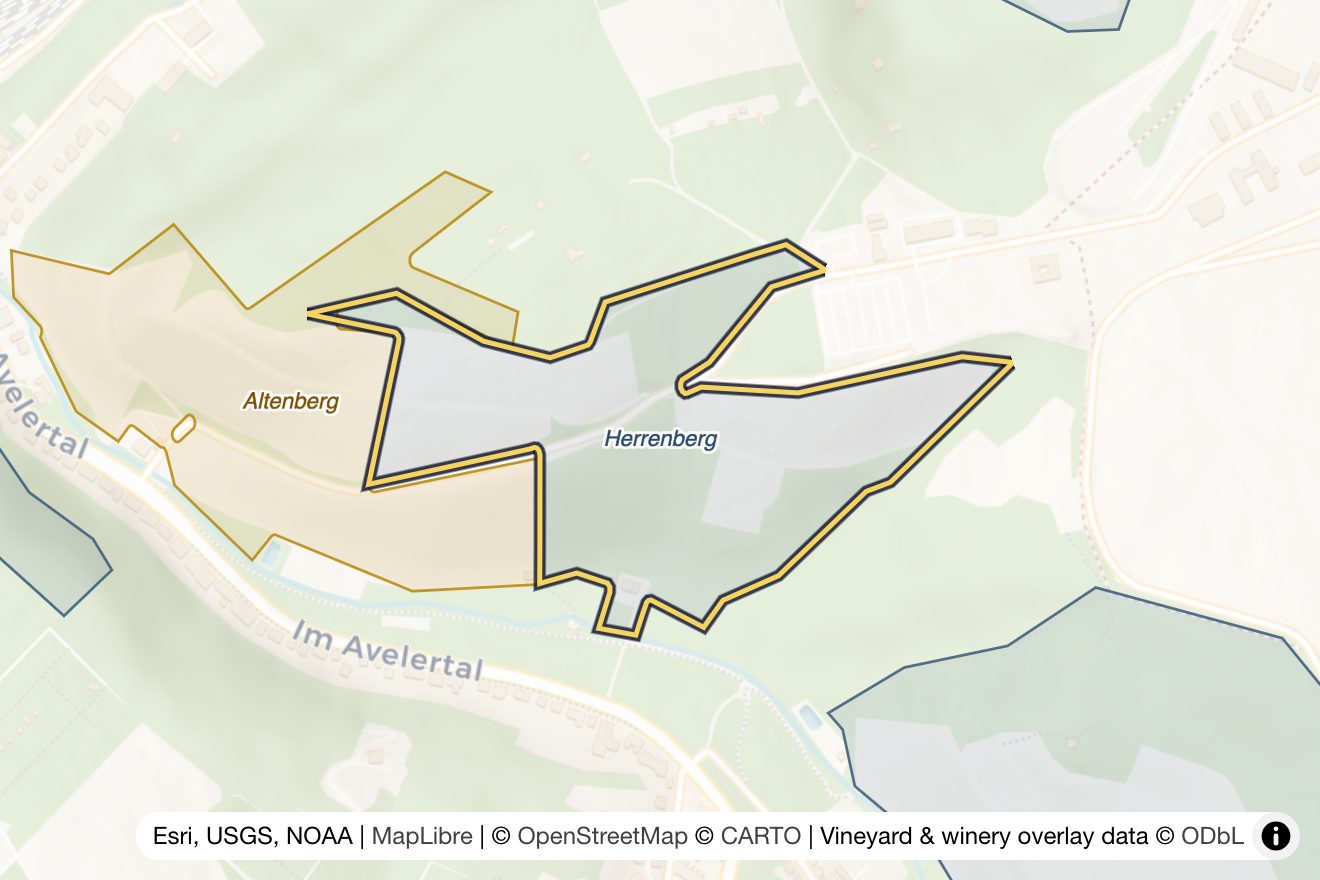
The Two Names
The Aveler Tal sites are registered under Trier, which makes Trierer Herrenberg the official form, but the trade has long been permitted to sell the wines as Avelsbacher instead. Reference works treat Avelsbacher Herrenberg and Trierer Herrenberg as the same ground. The valley's other sites are the Altenberg, the Kupp, the Hammerstein and the Rotlay, and the standard lexicon entries rank the Herrenberg, Altenberg and Kupp as the best of them. Avelsbach's wines are held to differ in character from the Ruwer wines a single ridge away, despite both sitting inside Römerlay.
An Engineered Valley
These slopes were made rather than found. Gut Avelsbach, successor to the Prussian state wine domain founded in 1896 on the initiative of the agronomist Hugo Thiel, records that several hundred thousand cubic metres of slate rock were worked around 1900 to create the valley's steep vineyard terraces. The Trier plantings were laid out from 1901 and completed in 1911, on ground previously managed as Lohwald, oak coppice cut for tanbark. The estate describes the valley's vineyards as shaped by both rotliegend slate and dark, fine-grained Devonian slate.
Standing
Trier's only VDP.GROSSE LAGE is the Augenscheiner, and the WineSaint data records no VDP status for the Herrenberg. Gut Avelsbach's five sites are the Hammerstein and the Rotlay, both monopoles, plus Trierer St. Maximiner Kreuzberg, Deutschherrenberg and Deutschherrenköpfchen; the Herrenberg is not among them. Reference works name the Hohe Domkirche (the Bischöfliche Weingüter in Trier) and the former state domain as the known producers of the Aveler Tal. Current single-vineyard bottlings under either the Trierer or the Avelsbacher form are difficult to locate, which is itself the most honest thing that can be said about the site's present commercial standing.