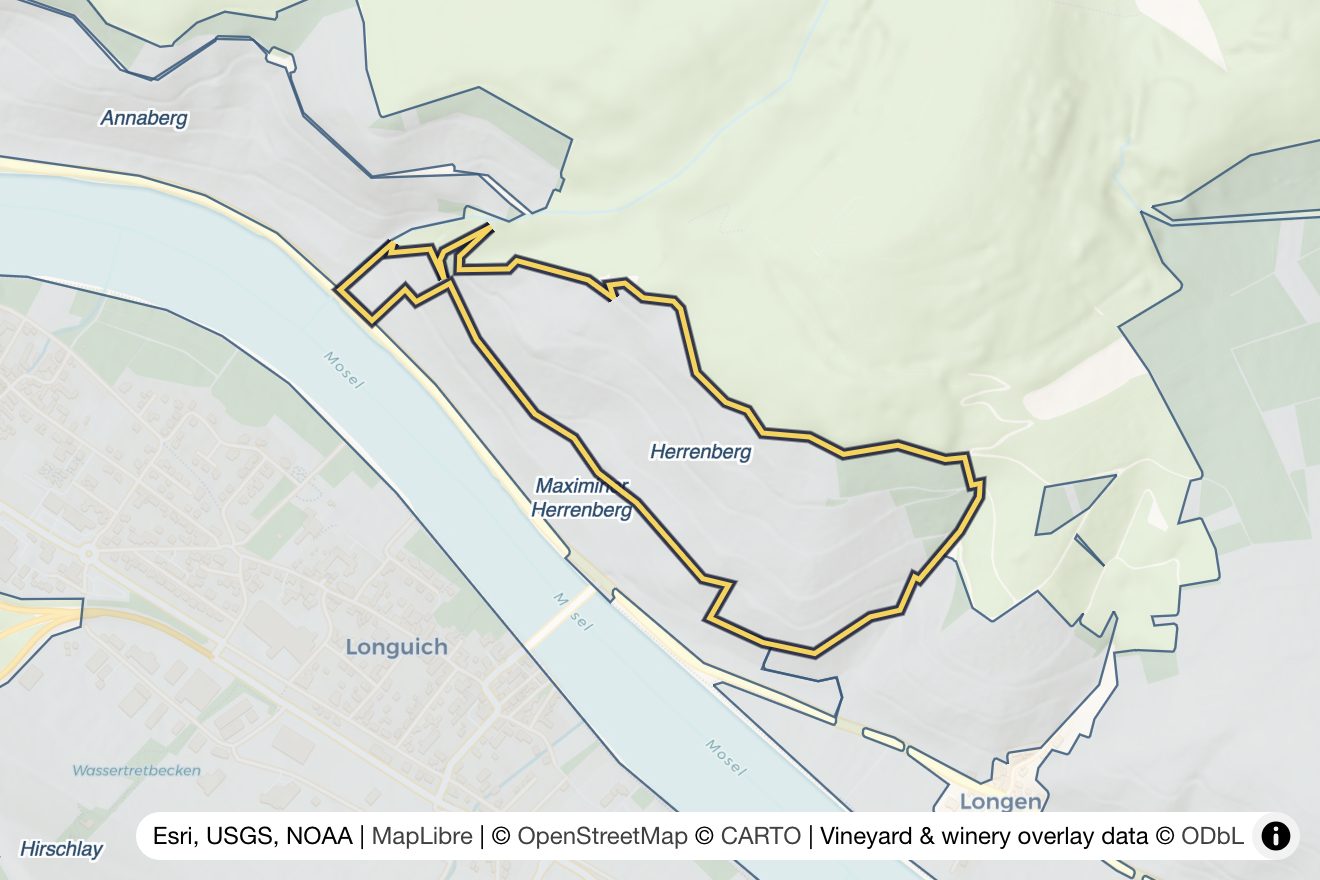
Three Herrenbergs in One Grosslage
Probstberg is small by Mosel standards, twelve Einzellagen across Riol, Fell, Longuich, Schweich and Kenn, and it still manages to contain three Herrenbergs. Longuich holds two of them, the Herrenberg and the Maximiner Herrenberg, and Schweich holds a third across the water.
The Longuich pair are one geological body split by history. The Maximiner name records the Benedictine abbey of St. Maximin in Trier, whose estate house, the Maximiner Hof, still stands in the village. Weingut Hansjosten of Longuich, which farms both, describe the Maximin Herrenberg as sitting in the Kernstück, the core, of the Herrenberg slope. The plain Herrenberg is the larger ground around it: same hill, same rock, without the abbey's provenance and without the prices the Maximin parcels now reach.
That distinction is worth holding firmly. The ungrafted Riesling planted in the Maximin Herrenberg in 1896 by Carl Schmitt-Wagner, since taken over by Carl Loewen and bottled as "1896", is what carried the Longuich name into export markets. Those vines are not in the Herrenberg.
Slate, Gradient and Aspect
Hansjosten call the Herrenberg their Premiumlage and are specific about it: grey Devonian slate, a Steillage reaching 70 percent gradient, oriented squarely south. They take their dry and off-dry Riesling and their Sekt base from it and credit the site with their 2020 competition-winning wine and Sekt. Ferienweingut Jung, also of Longuich, describe their Longuich holdings generally as Devonian slate weathering soils.
The hill is not uniform. Carl Loewen work red slate at the lowest section of the adjoining Maximin Herrenberg, so grey slate dominates the flank with red-lying material appearing near the base. Terrain data puts the centre of the delimited polygon near 255 metres, roughly 130 metres above river level, placing most of this ground high on the slope rather than on the alluvial shelf. The Longuicher Hirschlay, the village's third site, occupies exactly that shelf: lighter slate soils and gravel terraces on the slip-off slope of the old river bed, planted to Rivaner and Weissburgunder rather than to serious Riesling.
Growers and Standing
Longuich's estates are small and largely unexported. Hansjosten farm around eighty parcels spread across Longuich, Schweich, Fell and Riol. Weingut J. Schmitt bottle a Longuicher Herrenberg Riesling Spätlese feinherb. Weingut Burgkeller at the Alte Burg lists holdings in the Herrenberg, the Maximiner Herrenberg and the Hirschlay. Ferienweingut Jung farm the Herrenberg alongside the Maximiner Herrenberg, the Feller Maximiner Burgberg and the Schweicher Annaberg. Carl Schmitt-Wagner bottled a Longuicher Herrenberg historically.
vdp.de records no classified site in Longuich, and the WineSaint data records no VDP status here. Some retail listings for Maximin Herrenberg wines carry Grosse Lage or Erste Lage wording; that language does not come from the VDP, whose member roll does not include Carl Loewen, and in any case it attaches to the Maximin parcels rather than to this site.
Probstberg does what a Grosslage is designed to do. Hansjosten sell their Fell and Riol fruit under the Probstberg name, and Herrenberg fruit can travel the same route. That is not a failure of the system; it is the system, and the Einzellage name on the label is the only correction available.