Site and Rock
The Herrenberg and its neighbour the Burglay occupy one continuous steep slate wall above Kövenig, and Kröv's own viticultural material treats them as a pair rather than as separate propositions. The orientation is east-northeast. That is the site's defining fact and its handicap: it takes morning light and loses the long afternoon radiation that ripens the Mittelmosel's celebrated south-facing walls. Steepness compensates for some of the deficit by presenting the surface more directly to a low sun, but the Herrenberg was never going to compete with Kröv's own south-facing Steffensberg on heat accumulation.
The rock is Devonian slate, in places lying over heavy, clay-rich subsoil. That clay component separates it from the Steffensberg, which local descriptions treat as effectively pure slate, and from the loamier flat ground of the vast Paradies. Clay in a Mosel slate profile holds water, slows the vine and pushes the wine toward breadth rather than the taut cut that thin slate over fractured bedrock produces.
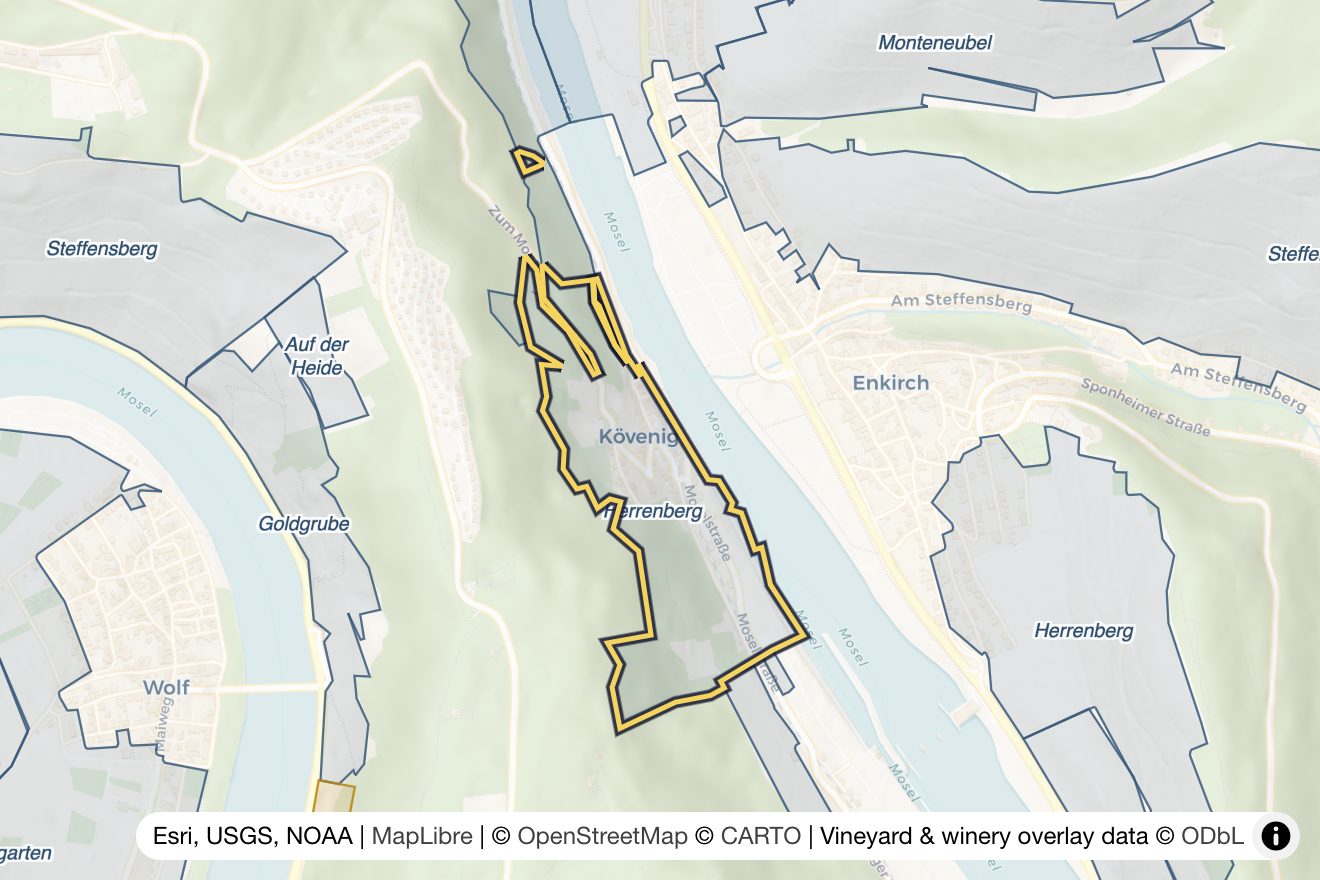
Our einzellagen layer measures 23.59 hectares of delimited ground, centred at 7.1186, 49.98061. Kröv's tourism and wine literature consistently quote about 20 hectares. The gap between those two numbers is ordinary and reflects the difference between polygon geometry and a rounded working figure.
What the Register Shows
The far more telling number comes from the Rheinland-Pfalz Weinlagen register for the 2024 harvest, which records the Kröver Herrenberg (Lagennummer 410602) with 1.5 hectares actually under vine. The adjoining Burglay is listed at under one hectare. Against roughly 20 to 24 hectares of delimited ground, that means the Kövenig wall has very largely gone out of cultivation.
This is the standard economics of Mosel steep slope, applied without mercy. An east-northeast aspect on hand-worked terrain returns less sugar, less reliably, for the same labour cost as a south-facing site, and the vines came out. Kröv's other sites tell the opposite story: Paradies at 80 hectares planted, Kirchlay at 41.6, Letterlay at 16, Steffensberg at 14.8. The Herrenberg name survives on the register far more robustly than the vineyard survives on the hill.
No VDP member estate can be confirmed farming here, and vdp.de lists no classified site anywhere in Kröv, so no VDP standing is claimed for this ground.
Grosslage and Neighbours
The Herrenberg falls under Nacktarsch, a Grosslage of roughly 320 hectares that is unusual in German wine law for being confined to a single municipality. Most Grosslagen sprawl across many villages and dilute the name to nothing; Nacktarsch at least guarantees that the wine came from Kröv. The name's origin is contested between a Celtic root for a rocky height and a derivation from nectar, and a folk story about a cellarmaster spanking boys caught stealing wine has been printed on labels for so long that it now functions as the official explanation. Nacktarsch traded internationally on quality before collapsing in the 1980s into cheap sweet bulk, and producers have been working since the 2000s to detach the village from that legacy.
The most instructive comparison sits under a kilometre away. Measured between the centre points in our own data, the Kröver Herrenberg and the Enkircher Herrenberg lie 0.96 kilometres apart on the same stretch of river, share a name, and are separated by a municipal boundary into different Grosslagen (Nacktarsch and Schwarzlay) with sharply different exposures. Nothing said about one applies to the other.