Ground, Rock and Extent
The site rises from the village onto the steep Mosel flank, and every description of it stresses that it is not uniform terrain. Lower parcels are flat to gently inclined; above them the slope becomes genuinely steep. Exposure runs south to southeast. On the steep sections the shallow stony surface warms quickly in spring, giving the vines an early start, and holds sun through the ripening period.
The rock is weathered Devonian slate carrying a stony, clay-bearing profile, the standard Mittelmosel substrate rather than anything idiosyncratic. Within that, quality is parcel-specific: Weingut Günther Steinmetz identifies blue slate in the sections where its oldest vines sit.
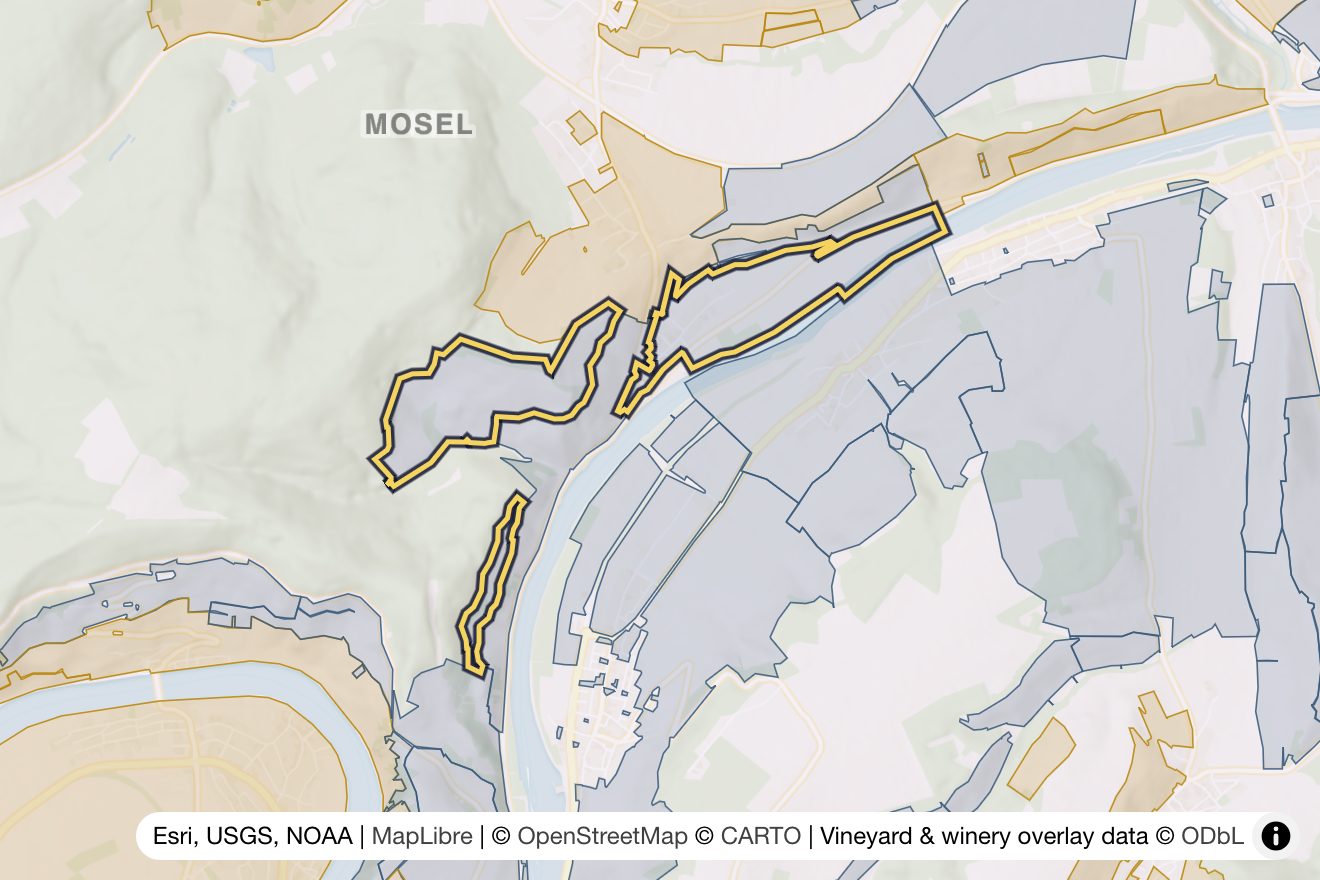
The area figures are worth setting out precisely, because the Herrenberg is a case study in how three legitimate numbers can disagree. Our einzellagen layer measures 132.24 hectares of delimited ground, centred at 6.95413, 49.90235. The Rheinland-Pfalz Weinlagen register for the 2024 harvest records 54.9 hectares actually planted (Lagennummer 410315). Weingut Paulinshof, farming in the village, publishes a working figure of roughly 70 hectares. Delimited boundary, vines in the ground and an estate's own reckoning of the meaningful vineyard are three different measurements, and only the first is what our polygon reports.
For scale within Kesten, the register puts the Paulinsberg at 26.0 hectares planted and the Paulinshofberger at 15.8. The Herrenberg alone accounts for more planted vineyard than both combined.
Name, Ownership and Classification
Herrenberg means the hill of the lords, and in Kesten the lords were ecclesiastical. Monasteries, collegiate churches and abbeys were the dominant vineyard proprietors here until the nineteenth century, and the name simply records who collected the crop. That history is unusually traceable in this village: the Paulinshof estate was an endowed property of the church of St. Paulin in Trier, first documented in connection with wine in 936, and passed into private hands in 1803 through the Napoleonic secularisation.
vdp.de lists no classified site in Kesten, and no VDP member estate can be confirmed farming here, so no VDP standing is claimed for this ground.
The Grosslage is Kurfürstlay, the large collective covering the Bernkastel stretch including Brauneberg, Kesten, Mülheim, Lieser and Bernkastel itself. As with most Grosslagen, the designation functions as a marketing catchment rather than a statement of origin, and a Kurfürstlay label tells a buyer considerably less than the Einzellage name does.
Who Farms It and How It Drinks
Weingut Paulinshof of Kesten is the estate most closely associated with the site, bottling it at Kabinett and dry Spätlese level. Weingut Günther Steinmetz of Brauneberg, under Stefan Steinmetz, sources a Kestener Herrenberg Pinot Noir from the oldest vines it holds of that variety, on the blue slate parcels. Moselweingut Schedler and Weinhaus Karl also work the site.
That Pinot Noir points to something distinctive. The Herrenberg carries a genuinely plural planting for the Mittelmosel: Riesling first, but also Spätburgunder, Gewürztraminer, Dornfelder and, more recently, Cabernet Blanc. Sites of this size, with substantial gently sloping ground alongside the steep sections, can support varieties that a narrow steep-slope cru cannot justify, and Kesten's growers have used that latitude.
On Riesling, Paulinshof describes the wines as spicy, with refreshing acidity and extract-rich aromatics, and the mineral finish that the slate content delivers is the common thread across every description of the site. The overall register is fine-boned and complex rather than powerful.
The honest comparative point is the one Kesten's own growers make. The Paulinshofberger, adjoining the Brauneberg flank, is regularly measured against the Brauneberger Juffer Sonnenuhr on soil, southern exposure and microclimate, and it is the site that sets Kesten's ceiling. The Herrenberg is where Kesten makes its living.