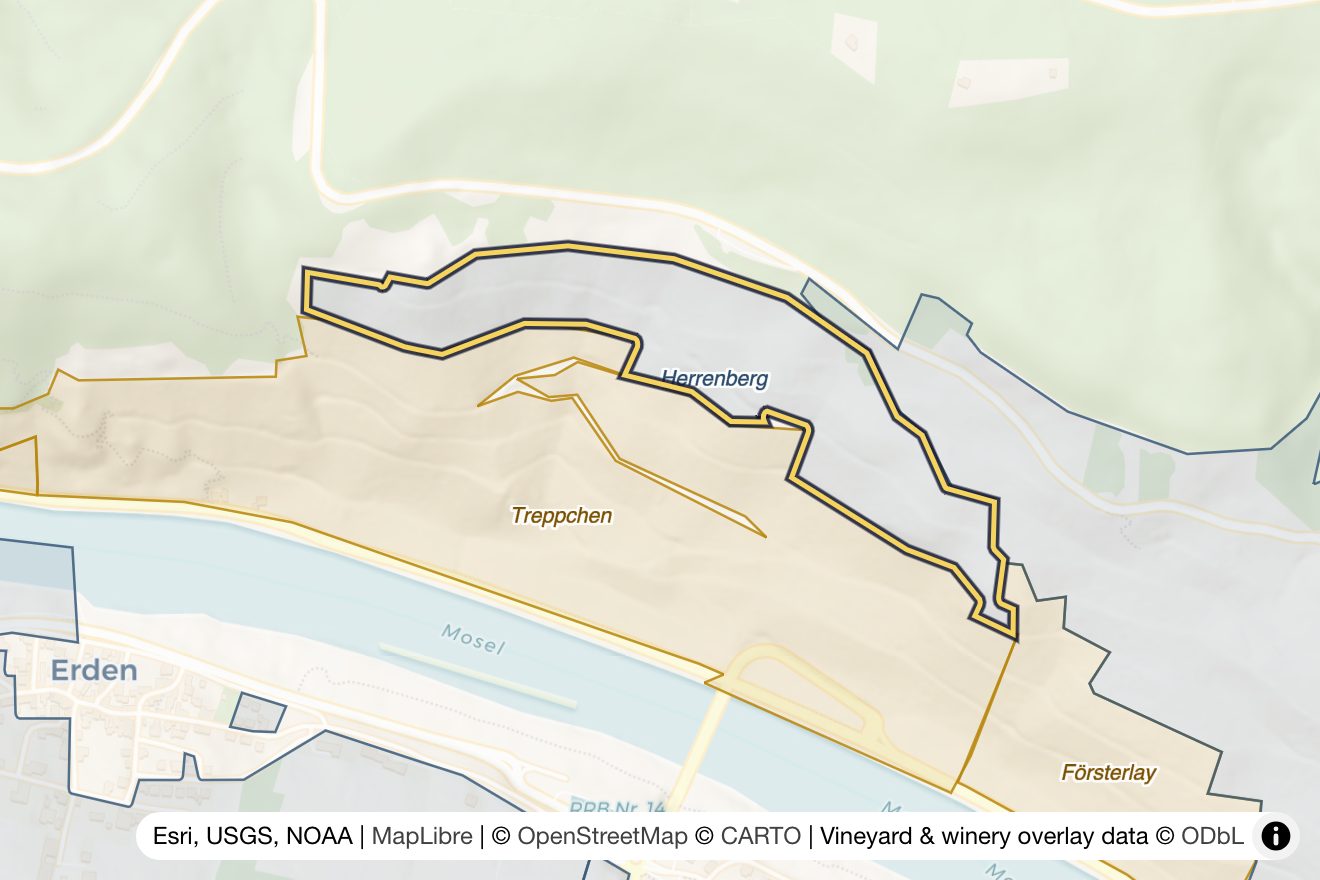
Position and Elevation
Erden sits on the right bank. Its vineyards do not. The Treppchen and the Prälat rise across the water on a cliff face that turns to meet the sun, and the Herrenberg is the band above them, running along the upper rim of the valley. Weingut Schwaab of Erden state it plainly: opposite the village, on the left side of the river, above the Treppchen. Justen-Kiebel measure the strip from 220 to 300 metres; C.H. Berres of Ürzig give 250 to 310. Berres bound it by the Treppchen on the upriver side and by the slopes falling toward the Kinheimer Hubertuslay on the other.
That elevation is the whole story of the site. At 250 to 310 metres the Herrenberg sits well over a hundred metres above the floor of the Prälat's rock amphitheatre, out of the river's thermal shelter and into moving air. Berres describe the consequence as a cooler and windier microclimate. The WineSaint layer delimits 15.31 hectares; growers' published planted figures run lower, since the boundary takes in ground carrying no vines.
The Rock
Grey slate, and unusually consistently so for the Mittelmosel. Berres put the Herrenberg at 85 percent weathered grey slate soils, shallower and less deep-rooting than the neighbouring Kinheimer Hubertuslay. Justen-Kiebel and Schwaab both describe Grauschiefer without qualification. Blue seams appear in places: the estate Riesling at Dr. Hermann, which blends Herrenberg fruit with Lösnicher Försterlay and Kinheimer Hubertuslay, is described as growing on blue and grey slate.
What the Herrenberg does not have is the red, iron-loaded, Rotliegend-shot profile of the Ürziger Würzgarten one village upriver, or the concentrated blue-grey bowl of the Prälat directly below. Berres farm their parcel at a 35-degree gradient facing south to south-west, so aspect is not the constraint. Altitude is, and the growers treat that as a design feature rather than a defect.
What the Site Is For
Producers here are candid about the trade they are making. Schwaab call the combination of height, coolness and grey slate their ideal of a Kabinett: fine, mineral-driven Riesling at moderate alcohol, and they are enlarging their planted area on the strength of it. Berres note that in very warm, dry vintages the Herrenberg turns deeply mineral, with ripe, fine acidity. That is the modern case for the high back-slope Mosel sites in a sentence. The same band that ripened unreliably through the 1980s now supplies freshness the cliff sites have to work for.
The estates involved are almost all local. Dr. Hermann of Erden, farming 13.5 hectares with ten hectares of organically certified steep slope, has released an Erdener Herrenberg Eiswein and folds Herrenberg fruit into the estate Riesling. Schwaab & Sohn bottle a dry Kabinett from it. Justen-Kiebel farm it alongside their Treppchen and Kinheim holdings. C.H. Berres stopped releasing it as a single-vineyard wine in 2003 and have folded it into their IMPULSE estate cuvée since, which is the clearest available statement of where the site sits commercially.
Classification and Grosslage
vdp.de records two classified sites in Erden, the Treppchen and the Prälat, and the Herrenberg is not among them; the WineSaint data records no VDP status here, correctly. The case is instructive. Dr. Hermann is a VDP member and works the Herrenberg, but VDP classification attaches to specific parcels the association has classified, not to every site a member happens to farm. A member's presence in a vineyard is not a classification of that vineyard.
Schwarzlay, the Grosslage, is enormous: Ürzig, Erden, Lösnich, Kinheim, Burg, Enkirch, Traben, Trarbach, Wolf and Starkenburg, then inland to Wittlich, Platten, Dreis, Hupperath and Flussbach. It contains two Rosenbergs and two Herrenbergs. A Schwarzlay label carries no information about slope, rock or river; the Einzellage name is the only thing that does.