Position and Exposure
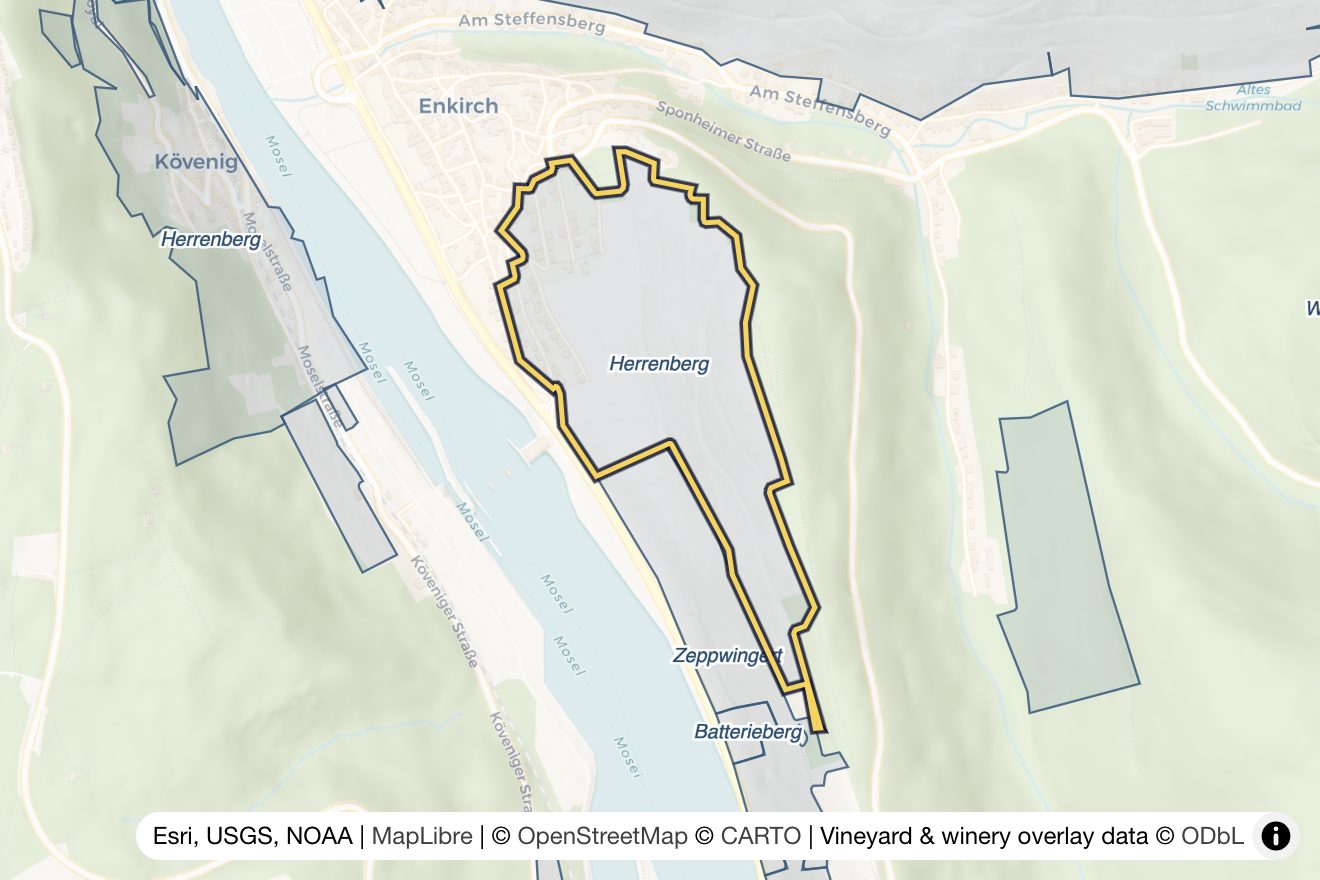
The site lies upstream of Enkirch, at the point where the continuous band of steep vineyard running toward Traben-Trarbach begins. Moving south it steepens and passes into the Zeppwingert, and parcels adjacent to that boundary are the ones estates single out.
Exposure is where the published descriptions diverge, and the divergence is worth stating rather than smoothing over. Reference material on the site emphasises a westerly orientation, with evening sun supplying the warmth; Weingut Immich-Herberts, farming in the village, describes its Herrenberg holdings as facing south to south-southwest near the river. At 31.95 hectares of delimited ground in our layer, centred at 7.13154, 49.97827, the site is broad enough to contain both, and the practical consequence is that Herrenberg parcels are not interchangeable. Where a grower sits on the arc determines how much of the ripening is done by afternoon heat and how much by late light.
The soil is grey Devonian slate, described locally as medium-weight weathered slate rather than the thin, sharply drained profiles found on the very steepest Mosel faces. That grey slate is the standard reference point for the village, and it sets the Herrenberg apart from the Zeppwingert immediately above the river, which sits on blue slate, and from the Edelberg, a gently inclined site with deep soil planted largely to Müller-Thurgau.
Scale, Register and Classification
The 2024 Rheinland-Pfalz Weinlagen register records the Enkircher Herrenberg (Lagennummer 410913) with 11.4 hectares under vine, against the 31.95 hectares of delimited ground our data measures. The two figures are not in conflict: one counts vines, the other counts the boundary drawn around the site, and on Mosel steep slope the ratio between them is routinely this wide.
Within the village, the register puts the Steffensberg at 27.6 hectares planted, the Edelberg at 14.9, the Monteneubel at 9.3, the Zeppwingert at 9.0 and the Ellergrub at 5.3, with the Batterieberg flagged as being in the sole possession of a single estate. That ranks the Herrenberg second by planted area, confirming its role as a working site rather than a jewel.
The Grosslage is Schwarzlay, a wide multi-village umbrella reaching across Enkirch, Traben-Trarbach, Ürzig, Kinheim and Wittlich. A Schwarzlay designation therefore tells a buyer almost nothing about origin; the Einzellage name carries all of the information. No VDP member estate can be confirmed farming here, and vdp.de classifies no site in Enkirch at all, so no VDP standing attaches to this ground.
Producers and Style
The Herrenberg is bottled by a spread of Enkirch estates rather than dominated by one. Immich-Anker uses it for a halbtrocken Riesling, Weingut Gerd Kettermann for a feinherb Spätlese and for Sekt, and Weingut Martin Bautz, Immich-Herberts and Milon Jenßen all work parcels there. Immich-Spier bottles a dry version. The prevailing register is off-dry and Prädikat-scaled rather than austere trocken.
The style descriptions converge more than the exposure descriptions do. Immich-Herberts characterises Herrenberg wines as sturdy and built to keep, and the parcels bordering the Zeppwingert are credited with Spätlesen that reward cellaring. Tasting notes on the dry and feinherb bottlings run to ripe orchard fruit carrying a flinty, smoky slate signature, with the grey slate reading as a drier, more savoury minerality than the blue slate sites downstream deliver.
A final caution on the name. Under a kilometre away, measured centre to centre in our own data, sits the Kröver Herrenberg above Kövenig: same name, different municipality, different Grosslage, and an east-northeast exposure that inverts everything said here.