Ground, Aspect and Position
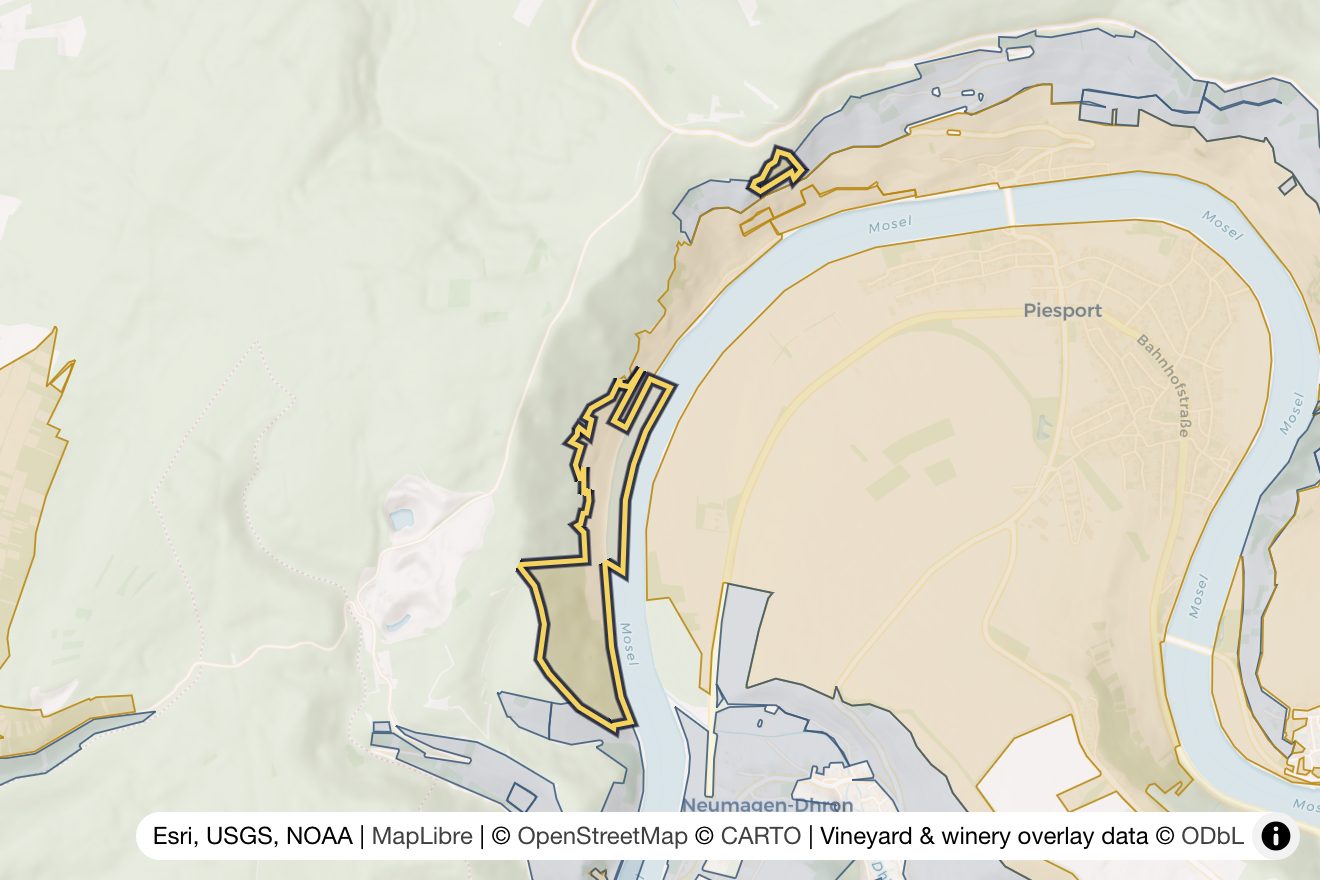
The vineyard runs along the right bank of the Mosel, beginning behind the hamlet of Ferres and continuing downstream to roughly the Neumagen bridge, immediately clear of the Goldtröpfchen's great curve. The VDP's own site record gives the alignment as south to south-southeast, elevations of 120 to 200 metres, and gradients of 50 to 75 percent. Growers working it describe the working faces as east-southeast. Both readings are compatible: the slope pivots through south-southeast into east, which means the Grafenberg takes morning and midday sun and loses the long evening light that the western flanks of Piesport keep well into the summer night. The trade-off is real and it shows in the glass. Early sun burns frost off quickly, the wood crown above the vineyard blunts the fall winds coming off the Hunsrück, and the river below returns heat and damps the temperature swing.
The rock is the point. Red slate here carries conglomerate and sandstone components and, unusually for the Mittelmosel, a high proportion of fine earth mixed through the weathered fragments. That gives the Grafenberg more water-holding capacity than the naked blue-slate scree of Wehlen or Zeltingen, and it puts the site in the small company of Ürziger Würzgarten and Schweicher Annaberg rather than with its blue-slate neighbours a kilometre upstream. Vinaet counts roughly 600 steps in the stairway that climbs from the lower to the upper terraces.
Our einzellagen layer measures 35.33 hectares of delimited ground, centred at 6.89244, 49.87246. Published planted figures are far smaller: Vinaet puts the vines at about 7.7 hectares, and the VDP records a graded area of 17.30 acres, roughly 7.00 hectares. The delimited polygon counts land eligible to carry the name; the smaller numbers count vines actually standing.
Classification and Who Bottles It
Parcels within the Grafenberg are classified VDP.GROSSE LAGE, with Riesling as the graded variety. The vdp.de site record names two member estates working there: Weingut Haart in Piesport, where Johannes Haart runs the cellar, and Reichsgraf von Kesselstatt, whose Mosel holdings also include Goldtröpfchen, Domherr and Josephshöfer. Weingut Günther Steinmetz of Brauneberg farms old vines here as well and bottles the site regularly as Kabinett and feinherb, though the estate is outside the VDP.
The administrative Grosslage is Michelsberg, and the contrast with the VDP classification could hardly be sharper. Michelsberg covers around 1,375 hectares across Piesport and eight further villages, pooling 37 individual sites, and the Piesporter Michelsberg label is the single biggest reason the Piesport name became shorthand for cheap German wine in export markets. The Grosslage tells a buyer nothing about the Grafenberg's rock, gradient or ownership.
The Wine
Grafenberg Riesling reads as spice before it reads as fruit. Where Goldtröpfchen gives white peach, apricot and a creamy breadth, the Grafenberg is drier in outline, herbal and peppery, with the mineral grip arriving late and holding the finish open. The red slate and the eastward turn work in the same direction: less accumulated afternoon heat, more retained acid, more savoury edge. Old-vine bottlings from the steep core show the site at full stretch, with the fine-earth fraction giving flesh that the wine's structure then cuts back. It is a site that rewards Kabinett and feinherb as much as trocken.