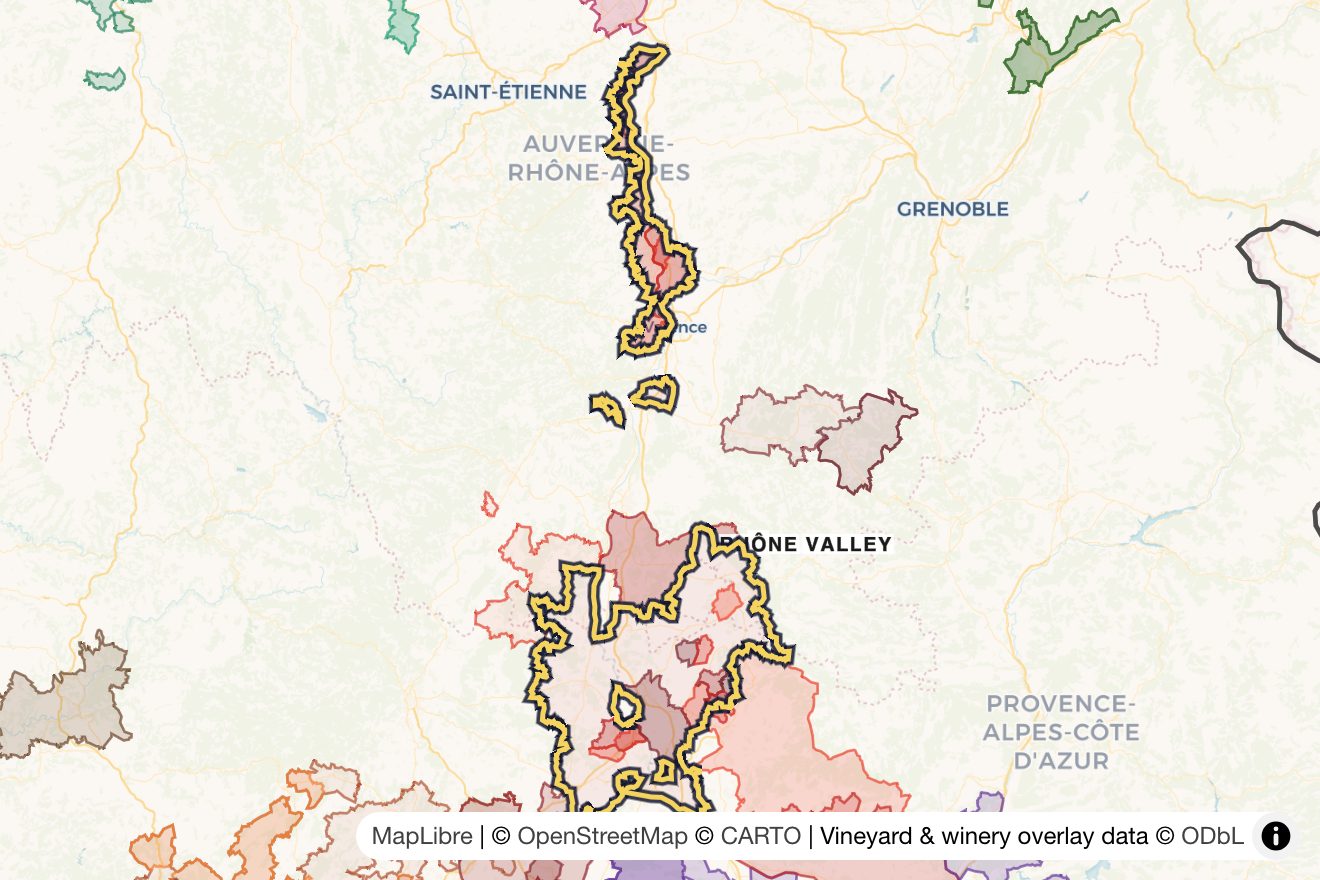
Overview
The overwhelming majority of production is red, and the overwhelming majority of the vineyard lies in the southern Rhône, where Grenache leads the blend. Well over 90 percent of the volume comes from the southern sector.
History
The name derives from an administrative district of the Ancien Régime: the Côte du Rhône was the west-bank district around Tavel and Roquemaure whose wines were marked and regulated for shipment from the eighteenth century. The modern appellation was formalized in 1937, early in the AOC system's history, following the groundwork of Baron Pierre Le Roy of Châteauneuf-du-Pape, whose delimitation work in the 1920s and 1930s shaped French appellation law. Côtes du Rhône Villages was added in 1966, and the roster of named Villages communes has expanded periodically since; crus have been detached from the regional appellation one by one throughout the system's history.
Terroir & Climate
The appellation spans two distinct zones. The narrow northern sector, from Vienne to Valence, has a continental climate, granite and schist slopes, and terraced hillside viticulture. The broad southern sector, from Montélimar to Avignon, is Mediterranean: hot, dry, mistral-swept, with soils ranging from the famous rolled quartzite stones over clay to limestone scree, sand and marl. The mistral is a defining factor in the south, drying the canopy after rain and concentrating the fruit.
Given this range, Côtes du Rhône is less a single terroir than a floor of standards applied across the valley; commune and producer determine character more than the appellation name does.
Grape Varieties & Wine Styles
The appellation recognizes a long list of varieties headed by Grenache Noir, Syrah and Mourvèdre for reds and rosés. In the southern zone, reds must include a minimum share of Grenache with Syrah and Mourvèdre as the principal complements; producers in the northern zone may work with Syrah alone. Supporting varieties include Carignan, Cinsault and Counoise. Whites draw on Grenache Blanc, Clairette, Marsanne, Roussanne, Viognier and Bourboulenc.
Typical red Côtes du Rhône is medium-bodied, supple and spicy, built on Grenache's red fruit and warmth with Syrah's pepper and color, made for drinking within a few years. Rosé is a significant category, and whites, though a small fraction of volume, have grown in quality and quantity. Côtes du Rhône Villages, with stricter yields and higher minimum ripeness, occupies the step above; its named-village wines, from communes such as Séguret, Sablet and Visan, form a recognized proving ground for future cru promotions.
Notable Producers
The appellation spans the entire structure of the southern French wine trade: large negociants such as E. Guigal, whose Côtes du Rhône is among the most widely distributed French reds; major cooperative groups; and cru estates bottling Côtes du Rhône from young vines or outlying parcels, among them Château de Fonsalette of the Rayas family, Coudoulet de Beaucastel from the Perrin family, and Clos du Mont-Olivet. Estate examples such as Domaine Gramenon have given the appellation a serious natural-wine presence.
What to Know
Côtes du Rhône on a label guarantees origin in the valley and a baseline of standards, not a particular terroir; the producer's name carries most of the information. The Villages tier and the named villages offer a meaningful step up at modest cost. Cru estates' Côtes du Rhône bottlings often deliver the house style in miniature and are a conventional entry point to those cellars.