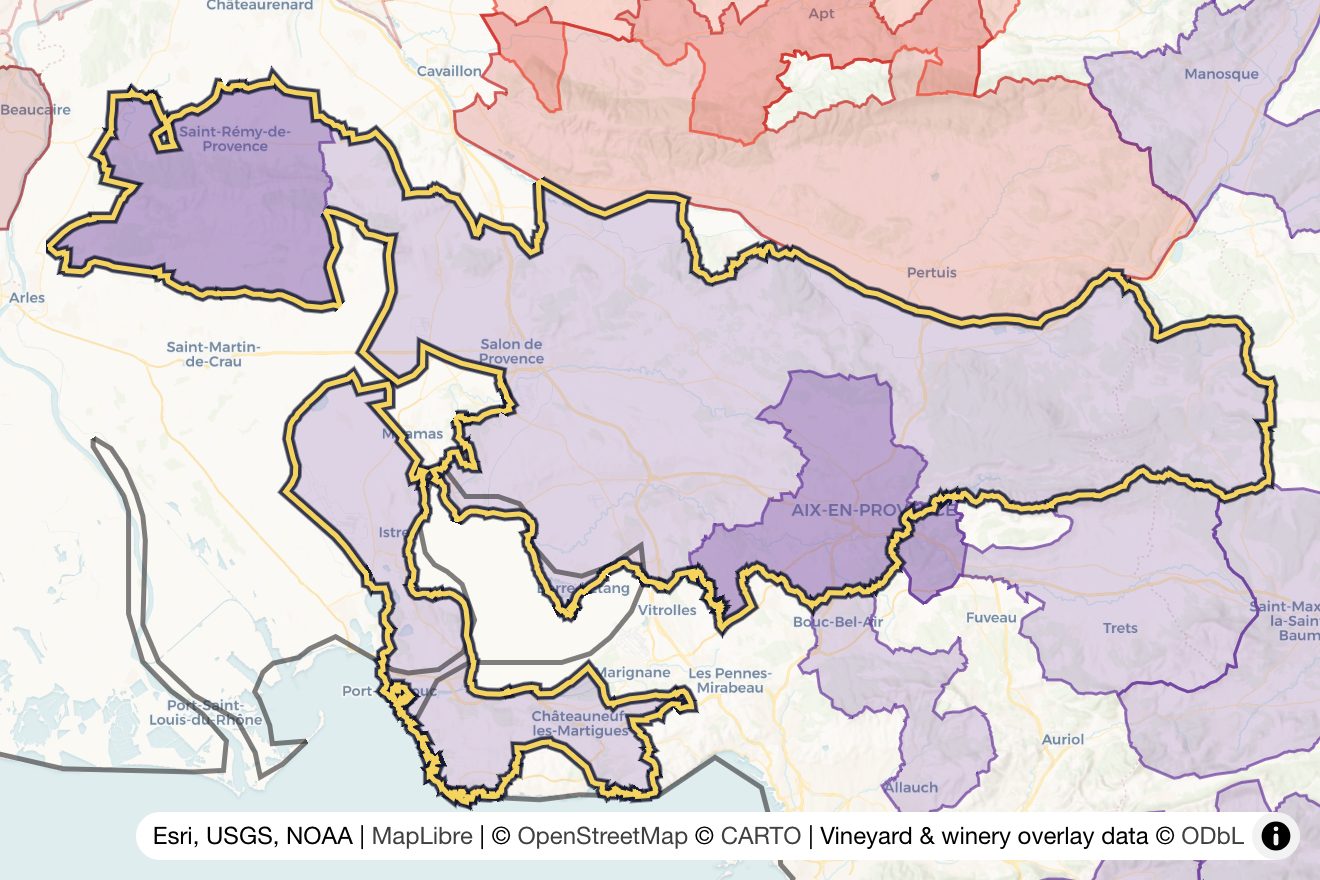
Overview
Coteaux d'Aix-en-Provence is the appellation of western Provence, some 4,000 hectares spread across the limestone hill country around Aix, from the Durance valley south toward the Étang de Berre and west to the edge of the Alpilles. Like greater Provence its production is predominantly rosé, but the appellation holds a distinct place in the region's story: it is the corner of Provence where Cabernet Sauvignon entered the blend rules, and its reds remain among the region's most serious.
History
Vines have grown around Aix since the Greek founding of Marseille, and the district's estates supplied the counts of Provence and the parliamentary city for centuries. The modern chapter began at Château Vignelaure in the 1960s, where Georges Brunet, formerly of Bordeaux's La Lagune, planted Cabernet Sauvignon alongside Grenache and Syrah and proved the district could make structured, age-worthy red; the variety was written into the appellation, granted AOC status in 1985, and remains its signature deviation from Provençal norms.
Terroir & Climate
The zone is classic Provençal limestone: garrigue-covered ridges, clay-limestone slopes and stony plateaus between roughly 100 and 400 metres, with the Trévaresse and Sainte-Victoire massifs shaping its exposures. The climate is Mediterranean at its driest and windiest; the mistral scours the vineyards, keeping disease pressure low and concentrating fruit, while altitude and the district's inland position add cooler nights than coastal Provence sees.
Grape Varieties & Wine Styles
Rosé leads volume, blended chiefly from Grenache, Cinsault, Syrah and Counoise with Cabernet permitted: pale, dry and structured in the Provençal manner, with a slightly firmer frame than Côtes de Provence. The reds justify the appellation's reputation: Grenache-Syrah-Cabernet blends of garrigue spice, dark fruit and genuine cellar span from the leading estates. Whites, a small share, work Vermentino, Clairette, Grenache Blanc and Sauvignon into fresh, herbal wines.
Notable Producers
Château Vignelaure remains the appellation's flagship and its historical argument. Château Revelette, under German-born Peter Fischer, built the modern critical benchmark; Château Calissanne, Château Beaupré, Les Béates and Château La Coste, the latter as much art destination as winery, lead the remaining core, alongside significant cooperative production.
What to Know
The neighboring appellation Les Baux-de-Provence separated from Coteaux d'Aix in 1995, and tiny Palette near Aix is likewise distinct. Within Provence's rosé economy, this is the appellation to watch for red wine: the Cabernet inheritance gives its top cuvées a Bordeaux-Rhône hybrid character unique in the region. Rosé buyers can treat it as Côtes de Provence's slightly sturdier, better-value neighbor.