Overview
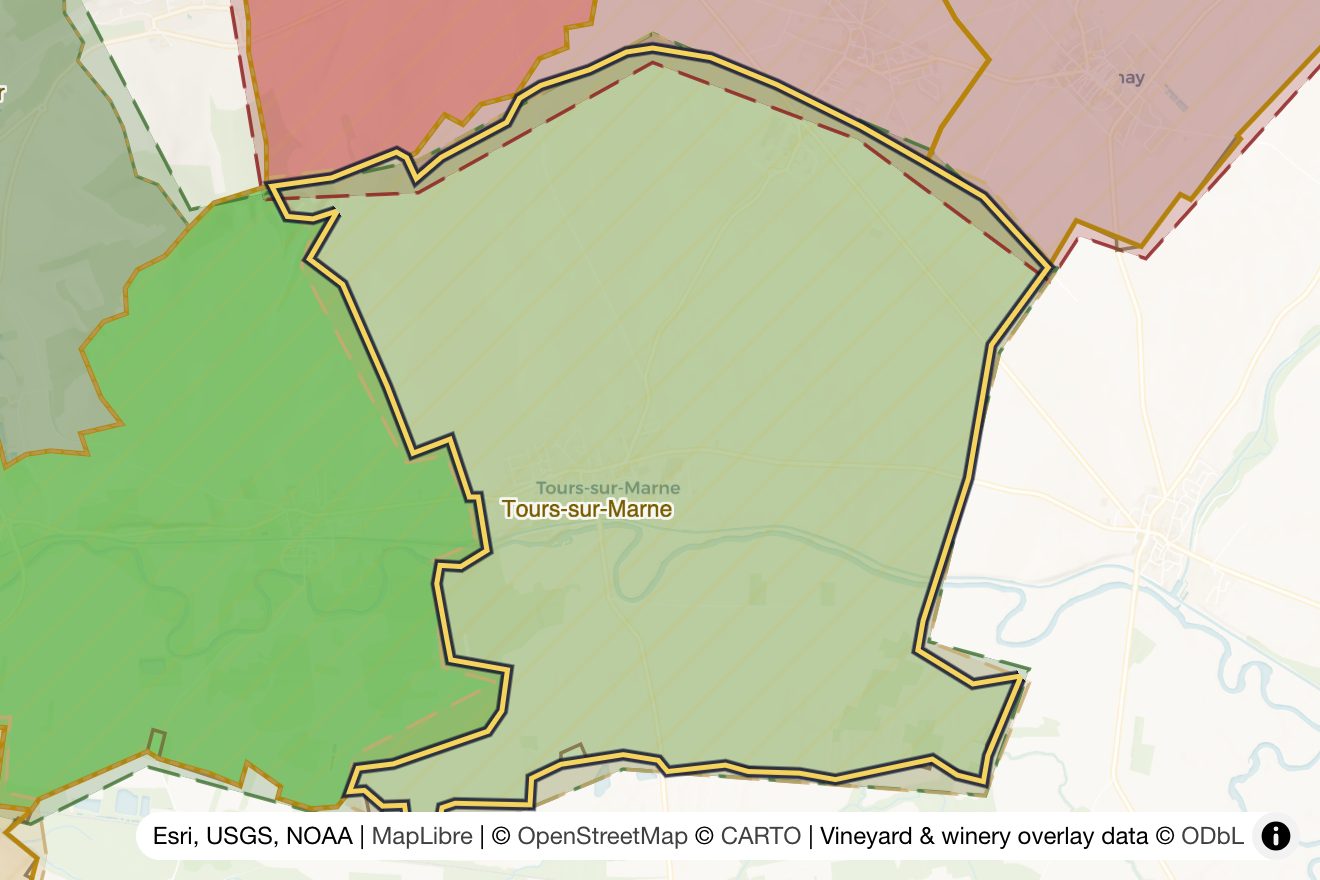
Tours-sur-Marne is a grand cru village in Champagne, situated on the Marne river and the Canal latéral à la Marne at the point where the southern slopes of the Grande Montagne de Reims meet the Grande Vallée de la Marne. Reference works assign it variously to the Montagne de Reims or the Vallée de la Marne; geographically it belongs to both, at the eastern end of the Grande Vallée. The village has about 52 hectares under vine, planted roughly 71 percent Pinot Noir and 29 percent Chardonnay, farmed by around 48 growers. The commune covers 2,351 hectares with around 1,400 inhabitants and is the headquarters of the house of Laurent-Perrier.
History
Tours-sur-Marne carries a distinctive footnote in the history of the échelle des crus: it was rated 100 percent for black grapes but only 90 percent for Chardonnay, the reverse of the split rating applied at Chouilly on the Côte des Blancs. Its grand cru standing therefore historically applied to Pinot Noir; after the échelle was abandoned in 2004, no mixed status survived, and Tours-sur-Marne stands today as one of Champagne's 17 grand cru villages.
The village's commercial history is dominated by Laurent-Perrier. André-Michel Pierlot, a former cooper and bottler, established himself in Tours-sur-Marne as a wine merchant in 1812. The business passed to his son Alphonse Pierlot and then to cellar master Eugène Laurent; after Laurent's death in 1887 his widow Mathilde-Emilie Perrier joined the two surnames as Veuve Laurent-Perrier. Marie-Louise Lanson de Nonancourt bought the house in 1939, and her son Bernard de Nonancourt, in charge from 1948, built it into one of Champagne's largest family-controlled groups.
Terroir & Climate
The village sits low, down by the river and canal, with its vineyards on south-facing slopes rising at the northern edge of the commune toward the Grande Montagne, contiguous with those of Bouzy and Tauxières-Mutry. The soils are chalk-based, in line with the southern Montagne crus; the neighbors upslope include the grand crus Bouzy and Louvois and the 99 percent premier cru Tauxières-Mutry. The riverside position and southern exposure make this reliable ripening territory for Pinot Noir in Champagne's cool continental climate. The commune is large at 2,351 hectares, but most of it is river plain and woodland; the vineyard occupies only a narrow band of slope.
Grape Varieties & Wine Styles
Production follows Champagne AOC rules; wines made entirely from grand cru fruit may carry the grand cru mention. Pinot Noir is the principal variety and defines the local style: full, structured base wines in the manner of the southern Grande Montagne. Chardonnay, historically the reason for the village's 90 percent white-grape rating, occupies just under a third of the surface. Much of the harvest feeds house blends, but growers and small houses release village-labeled grand cru cuvées, including single-parcel Pinot Noir from the lieu-dit Les Meslaines.
Notable Producers
Laurent-Perrier is headquartered in the village, and Moët & Chandon holds vineyards in the commune. Charles Lafitte, part of the Vranken-Pommery Monopole group, is also based there, as is the house of A. Chauvet, founded in 1848 and run by the Paillard-Chauvet family with about 9 hectares of premier and grand cru vineyards. The most visible grower estate is Lamiable, farming roughly 8 hectares including grand cru parcels in Tours-sur-Marne and Bouzy; its single-parcel, 100 percent Pinot Noir vintage cuvée Les Meslaines comes from the estate's first vineyard, planted by Pierre Lamiable in 1953.
What to Know
Tours-sur-Marne is the standard examination example of a split échelle rating: 100 percent for black grapes, 90 percent for Chardonnay, resolved in the village's favor when the échelle lapsed. Buyers should treat it as a Pinot Noir grand cru in practice; its Chardonnay never carried the historical 100 percent rating and remains a minority planting. On lists and in blends its fruit reads with Bouzy and Ambonnay rather than with the Meunier-led villages further west along the Marne. The village is also the answer to a common trade question about Laurent-Perrier: the house is not in Reims or Épernay but has operated from Tours-sur-Marne since 1812.