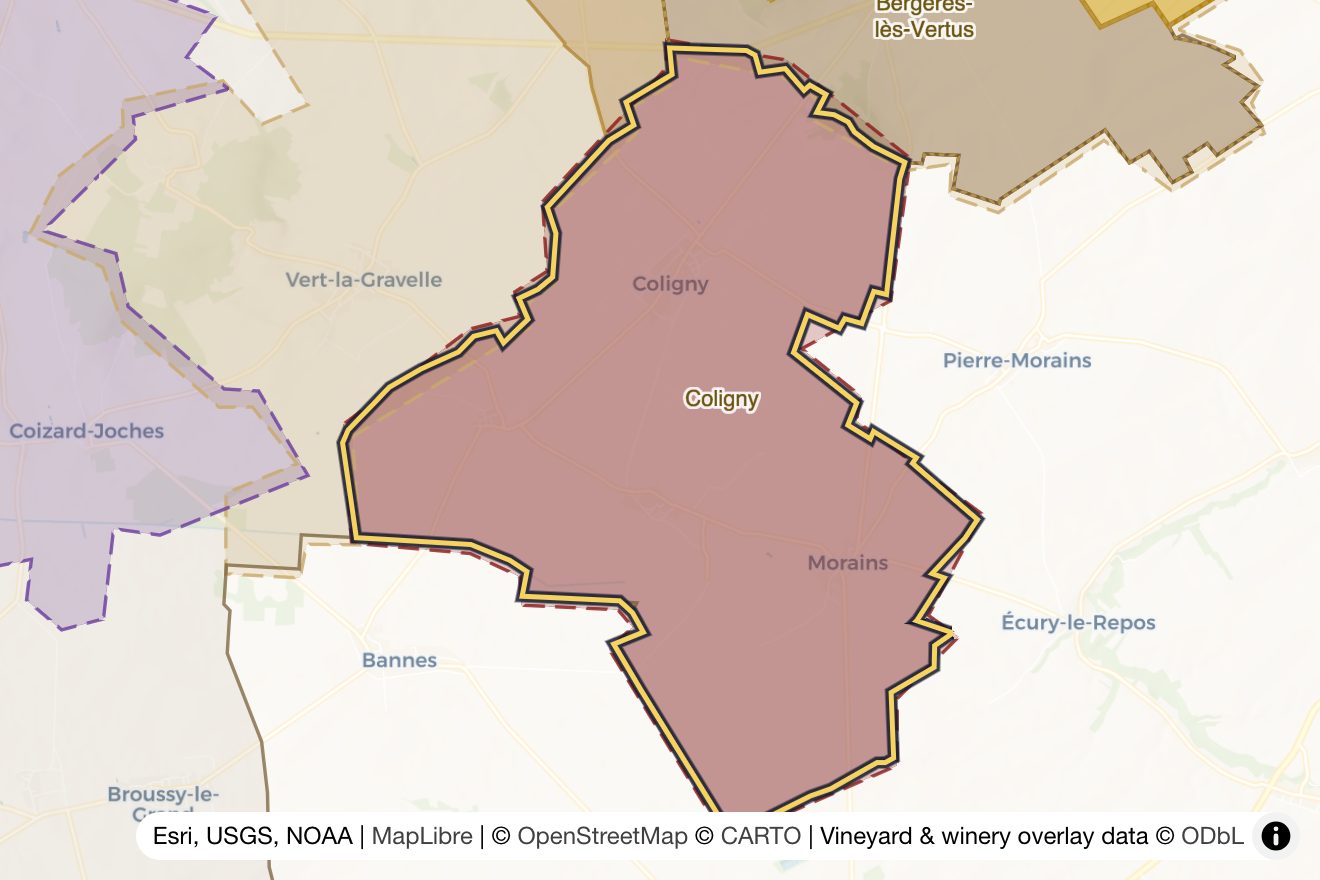
Located in the southern Côte des Blancs, Coligny is a small premier cru village now part of Val-des-Marais. The sub-region encompasses under 30 hectares of vineyards, planted to Chardonnay.
The Geological Foundation
Coligny sits atop a complex sedimentary sequence that dates to the Campanian stage of the Late Cretaceous, approximately 83 to 72 million years ago. Coligny's bedrock consists of alternating layers of belemnite chalk and Micraster chalk, interspersed with thin bands of harder chalk containing higher concentrations of flint nodules.
This geological complexity matters. The belemnite chalk (named for the fossilized remains of extinct squid-like cephalopods) provides excellent drainage while maintaining sufficient water reserves during dry periods. The flint bands, occurring at depths of 40 to 80 centimeters, create natural barriers that force vine roots to spread laterally rather than plunge vertically, resulting in a broader exploration of the soil profile.
The topsoil varies considerably across Coligny's modest expanse. On the upper slopes, you'll find a thin layer of clay-rich loam, typically 25 to 35 centimeters deep, overlying the chalk. This shallow profile produces wines of notable tension and minerality. Mid-slope parcels feature deeper loamy soils, sometimes reaching 50 centimeters, which yield rounder, more immediately expressive wines. The lower slopes transition toward heavier clay content (up to 40% clay in some parcels) creating wines with greater body but occasionally less finesse.
Mesoclimate and Elevation
Coligny occupies elevations ranging from 120 to 180 meters above sea level, with the majority of premier cru vineyards situated between 140 and 165 meters. This places the sub-region in an optimal thermal band for Champagne viticulture, high enough to benefit from good air drainage and reduced frost risk, yet not so elevated as to struggle with full phenolic ripeness in cooler vintages.
The northern exposure of many Coligny vineyards initially seems disadvantageous. Northern slopes receive less direct solar radiation than south-facing sites, typically accumulating 15 to 20% fewer heat units during the growing season. However, this cooler mesoclimate proves beneficial in the context of climate change. Since 2000, average growing season temperatures in the Montagne de Reims have increased by approximately 0.8°C. What was once marginal ripeness territory has become reliably moderate, allowing Coligny's Pinot Noir to achieve physiological maturity without excessive sugar accumulation.
The sub-region benefits from the protective effect of the Montagne de Reims forest to the south, which moderates temperature extremes and provides shelter from desiccating winds. Spring frost remains a concern in lower-lying parcels, particularly those below 130 meters, where cold air pools on still nights. The devastating frost of April 2017 affected approximately 25% of Coligny's vineyards, primarily in these vulnerable low points.
Precipitation averages 650 millimeters annually, distributed relatively evenly throughout the year. This sits slightly below the Champagne regional average of 680 millimeters, meaning water stress can occur during particularly dry summers. The 2018 and 2019 growing seasons both saw significant hydric stress in shallow-soil parcels, resulting in smaller berries with concentrated flavors but reduced yields, down by 20 to 30% in some cases.
Viticulture and Vine Management
This fragmented ownership structure has both advantages and limitations.
The positive aspect: diversity of approach. Some growers maintain traditional high-density plantings of 8,000 to 9,000 vines per hectare, using the classic Champagne cordon training system. Others have adopted wider spacing (6,000 to 7,000 vines per hectare) with Guyot Simple training, arguing that lower density improves air circulation and reduces disease pressure in Coligny's relatively humid mesoclimate.
The challenge: inconsistent quality. Without the resources of major houses or large estates, some growers struggle to implement precision viticulture practices. Canopy management varies wildly from parcel to parcel.
Herbicide use remains common, though this is changing. As of 2023, approximately 30% of Coligny's vineyards are managed using sustainable viticulture practices with grassed inter-rows, and roughly 8% are certified organic or biodynamic. This lags behind progressive zones like Avize (15% organic) but exceeds the Champagne regional average of 5%.
Rootstock selection has evolved considerably since the 1990s. Older plantings predominantly use 41B and SO4, rootstocks selected for vigor control and chalk adaptation. More recent plantings incorporate Fercal and Gravesac, rootstocks better suited to active limestone soils and showing improved drought tolerance. Given climate projections for Champagne, this shift toward drought-resistant rootstocks appears prescient.
The Pinot Noir Character
Coligny's reputation rests on its Chardonnay. These wines display a distinctive profile that falls between the muscular power of Verzenay and the red-fruited elegance of Ambonnay.
In youth, Coligny Pinot Noir shows dark cherry, blackberry, and subtle earthy notes, think forest floor rather than mushroom. There's often a flinty, almost smoky quality that likely derives from the flint-rich chalk layers. The texture tends toward fine-grained tannins rather than the grippy astringency sometimes found in Verzenay. Acidity typically measures 7.5 to 8.5 grams per liter (as tartaric acid), providing sufficient structure for extended aging without the razor-edge sharpness of cooler sites.
The wines develop beautifully with time. After 5 to 7 years on lees, Coligny Pinot Noir evolves toward notes of dried cherry, orange peel, tobacco, and subtle spice. The texture becomes increasingly silky, and that characteristic flinty minerality integrates into a complex whole. Peak drinking often occurs between 8 and 15 years post-disgorgement for vintage cuvées.
, classic Champagne parameters showing excellent balance. Compare this to Verzenay (10.5% alcohol, 7.8 g/L acidity, pH 3.15) and you see Coligny's slightly higher acid retention and lower pH, suggesting enhanced aging potential.
Chardonnay's Supporting Role
Chardonnay is grown in Coligny, primarily on mid-slope parcels where deeper soils provide the vine's relatively vigorous growth habit with adequate nutrients. The sub-region's Chardonnay doesn't achieve the crystalline purity of Côte des Blancs grand crus, but it offers something valuable: textural weight and aromatic complexity.
Coligny Chardonnay typically shows ripe apple, white peach, and subtle hazelnut notes when young. There's less citrus character than in Cramant or Avize, more stone fruit and occasionally tropical hints in warmer vintages. The texture tends toward roundness rather than linearity, with good mid-palate weight. This makes Coligny Chardonnay particularly useful for blending, where it can add body to lean vintages or provide aromatic complexity to Pinot-dominant cuvées.
The best Chardonnay parcels are found between 145 and 160 meters elevation, where chalk content remains high (70 to 80% of the soil profile) and clay provides just enough water retention for consistent ripeness. Lower sites with heavier clay produce less distinguished wines, riper, broader, but lacking the mineral tension that defines quality Champagne Chardonnay.
Key Lieux-Dits and Parcels
Coligny's vineyard geography divides into several distinct sectors, each with its own character:
These parcels produce the sub-region's most structured, age-worthy wines, taut, mineral, occasionally austere in youth. Several small growers produce single-parcel cuvées from this zone, though most fruit goes into multi-village blends.
This represents Coligny's qualitative heart, soils deep enough for consistent ripeness, elevation sufficient for good acidity retention. The sector's northern exposure moderates ripening, extending hang time by 5 to 7 days compared to south-facing sites.
Higher clay content, greater frost risk, generally less distinguished wines. These parcels typically contribute to entry-level cuvées or are sold to large houses for use in non-vintage blends.
Soils here show higher chalk content and lower clay, approaching Verzenay's geological profile. Wines from this zone display similar power and structure to their grand cru neighbor, leading some observers to question why this sector remains classified as premier cru.
The lieu-dit system in Champagne lacks the formal recognition found in Burgundy, but serious producers increasingly reference specific parcels on back labels or technical sheets. This trend toward terroir transparency benefits Coligny, allowing consumers to distinguish between the sub-region's diverse expressions.
Notable Producers
Coligny's producer landscape consists primarily of small grower-producers (récoltants-manipulants) with limited production and local distribution. Few have achieved significant international recognition, but several merit attention:
His "Vieilles Vignes" cuvée shows Coligny Pinot Noir at its most expressive, dark-fruited, structured, with that characteristic flinty minerality.
Maurice Vesselle: A historic Bouzy-based house . While Vesselle's reputation rests on its grand cru Bouzy wines, the estate's Coligny fruit contributes essential freshness and minerality to its non-vintage cuvée.
Henri Mandois: A larger négociant house based in Pierry with long-term grape contracts throughout the Montagne de Reims, The house has invested in precision viticulture programs with its Coligny growers, including detailed soil mapping and adjusted harvest dates by parcel.
How Coligny Differs from Its Neighbors
Understanding Coligny requires positioning it within the Montagne de Reims hierarchy:
Versus Verzenay (grand cru, Montagne de Reims): Verzenay is a Pinot Noir grand cru in a different sub-region. Its Pinot Noir shows greater power, higher alcohol potential (typically 0.3 to 0.5% more), and more pronounced tannin structure. Coligny offers a gentler expression, less immediately impressive, but often more harmonious and age-worthy. Think of Verzenay as Chambertin, Coligny as Gevrey-Chambertin village from a good lieu-dit.
Versus Verzy (grand cru, Montagne de Reims): Verzy's wines combine power with elegance, particularly from its mid-slope parcels. The village's east-southeast exposure provides optimal sun angles while maintaining freshness. Coligny's northern exposure creates a cooler mesoclimate, resulting in wines with higher acidity and more pronounced mineral character, but occasionally less phenolic ripeness in challenging vintages.
Versus Villers-Marmery (premier cru, Montagne de Reims): Both villages hold premier cru status, but their profiles differ substantially. Villers-Marmery is predominantly Chardonnay (85% of plantings) with eastern exposure and warmer mesoclimate. Coligny's Pinot Noir focus and cooler sites create more structured, less immediately accessible wines.
The fundamental question: Why isn't Coligny classified as grand cru? The answer combines historical politics and genuine quality distinctions. When the Échelle des Crus was formalized in 1927 (and revised in 1985), Coligny was not among the villages rated grand cru.
Vintage Variation
Coligny's northern exposure and moderate elevation create distinctive vintage patterns:
Warm vintages (2003, 2015, 2018, 2019, 2020): Coligny excels, achieving full phenolic ripeness while maintaining higher acidity than south-facing sites. The 2018 vintage particularly showcased the sub-region's potential, concentrated fruit, balanced acidity (8.2 g/L average), and excellent aging potential. These vintages produce Coligny's most complete wines.
Cool vintages (2001, 2013, 2016, 2021): Greater challenges. Coligny's northern exposure means later ripening, and in cool years, some parcels struggle to achieve full maturity. The 2013 vintage saw significant green character in lower-slope Pinot Noir, with some lots declassified to Champagne AOC rather than premier cru. Upper-slope parcels with better exposure fared better, demonstrating the importance of parcel selection.
Wet vintages (2007, 2012, 2016): Disease pressure increases in Coligny's relatively humid mesoclimate. Growers who practice rigorous canopy management and organic viticulture generally fare better, as open canopies dry more quickly after rain. The 2016 vintage saw significant botrytis in poorly managed vineyards, while well-tended parcels produced clean, if lighter-styled, wines.
Frost years (2017, 2021): Lower-slope parcels suffer disproportionately. Upper slopes above 150 meters largely escaped damage, highlighting elevation's protective effect.
The Wines to Seek Out
Given Coligny's limited name recognition, finding single-village cuvées requires effort. Most Coligny fruit disappears into multi-village blends, where it provides structure and minerality without fanfare. However, several wines showcase the sub-region's character:
This is Coligny's calling card, structured, mineral, age-worthy. Expect to pay €35-40 at the cellar door. Drink 2024-2035 for the current release (base vintage 2018).
A more accessible introduction to the sub-region, showing its characteristic dark fruit and flinty minerality in approachable form. €28-32, drink 2024-2030.
Excellent value at €25-28, drink 2024-2028.
For those unable to source grower Champagnes, look for major houses that source significantly from the Montagne de Reims. In these houses' non-vintage and vintage cuvées, Coligny likely contributes to the structured, age-worthy character that defines their style.
Food Pairing Considerations
Coligny Champagnes' structured, mineral-driven profile suits specific culinary applications:
Pinot Noir-dominant cuvées: The sub-region's darker-fruited, earthy Pinot Noir pairs excellently with roasted poultry, particularly guinea hen or duck. The wines' fine-grained tannins and mineral backbone also complement mushroom-based dishes, think risotto aux cèpes or roasted chanterelles on brioche. Aged examples (8+ years) develop sufficient complexity for game birds.
Chardonnay-blend cuvées: The textural weight of Coligny Chardonnay handles richer fish preparations better than lean Côte des Blancs styles. Try with turbot in beurre blanc, lobster thermidor, or even lightly smoked fish. The wines' subtle nutty character echoes hazelnut-based sauces beautifully.
Zero-dosage cuvées: The pure expression of Coligny terroir (flinty, mineral, structured) demands equally direct food. Raw oysters (particularly Gillardeau or other full-flavored varieties), sea urchin, or simply prepared white fish like bar grillé. The wines' high acidity cuts through the oceanic richness without overwhelming delicate flavors.
Avoid overly spicy or heavily acidic dishes, which can clash with the wines' already-prominent acidity. Similarly, very sweet preparations overwhelm Coligny's subtle mineral character.
The Future of Coligny
Climate change presents both opportunities and challenges for Coligny. Rising temperatures have already improved ripening consistency, particularly for Pinot Noir on northern slopes. What was once marginal terroir now regularly achieves full phenolic maturity. If warming continues at projected rates (an additional 1 to 1.5°C by 2050), Coligny may produce some of the Montagne de Reims's most balanced wines, as south-facing sites struggle with excessive ripeness and alcohol.
However, increased drought frequency poses risks. Coligny's shallow chalk soils provide limited water reserves, and the sub-region lacks irrigation infrastructure (irrigation remains prohibited under Champagne AOC regulations). The 2022 growing season, with just 320 millimeters of precipitation between April and September, stressed many vineyards severely. Some growers are experimenting with cover crops selected for deep rooting and drought tolerance, hoping to improve soil structure and water retention.
The trend toward single-village and single-parcel Champagnes benefits Coligny. As consumers increasingly seek terroir-specific expressions, the sub-region's distinctive profile (structured, mineral, age-worthy) finds appreciation. This generational shift brings organic viticulture, precision winemaking, and marketing sophistication to a previously undervalued zone.
Recognition may eventually follow quality. The Institut National de l'Origine et de la Qualité (INAO) periodically reviews Champagne's classification system, though major revisions remain rare. Coligny's best parcels (particularly those bordering Verzenay) could theoretically achieve grand cru status, though political and economic considerations likely prevent near-term reclassification.
Conclusion: The Case for Coligny
Coligny operates in the shadows of its grand cru neighbors, producing wines of genuine distinction without commensurate recognition. For consumers, this creates opportunity, premier cru quality at village prices, structured Pinot Noir with aging potential, distinctive mineral character that sets these wines apart from generic Champagne.
The sub-region rewards patient exploration. Seek out grower Champagnes, accept that some producers will disappoint, and recognize that Coligny's best expressions require time to reveal themselves. These are not immediately seductive wines. They are structured, mineral-driven, built for the table and the cellar.
In an era of increasing Champagne prices and decreasing distinctiveness, Coligny offers something increasingly rare: authentic terroir expression at accessible prices. The sub-region's northern slopes, flint-rich chalk, and dedicated small growers create wines that speak of place rather than brand. This is Champagne as it was meant to be, agricultural rather than industrial, terroir-driven rather than formula-based.
The question isn't whether Coligny produces quality wines. The question is when the market will recognize what attentive drinkers already know.