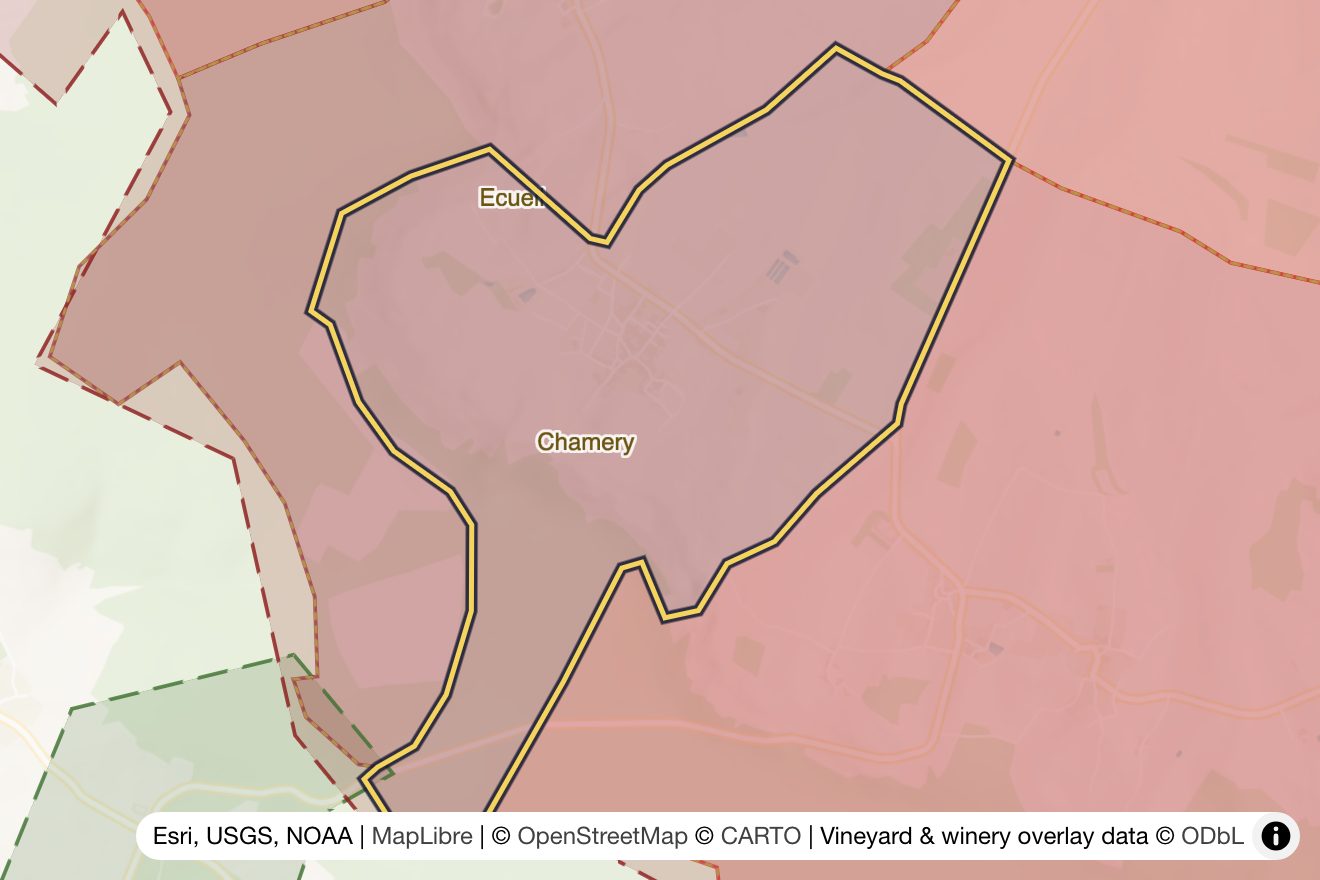
The village's more than 200 hectares of vines straddle two distinct geological zones, creating wines that split the difference between the mineral tension of the Côte des Blancs and the structured power of the greater Montagne de Reims. This is not a subtle distinction. The best parcels here produce Chardonnay with a particular saline edge and Pinot Noir with uncommon freshness for the sector, characteristics that forward-thinking growers are finally learning to exploit.
The Geological Pivot Point
Chalk Meets Clay
Chamery's defining feature is its transitional geology. The village marks where the pure Campanian chalk of the Montagne de Reims's summit begins mixing with Thanetian sands and Sparnacian clays as the slopes flatten northward. This isn't the homogeneous belemnite chalk you'll find in Cramant or Avize. Instead, the upper slopes (particularly those facing south and southeast) reveal pockets of nearly pure chalk, while lower parcels show increasing proportions of clay and sand.
The ratio matters. In the best sites, you're looking at approximately 60-70% chalk to 30-40% clay and sand, enough chalk to provide mineral backbone and water regulation, enough clay to retain nutrients and moderate vine vigor. Compare this to Verzenay, about 14 kilometers east, where chalk comprises closer to 80% of the substrate. The result? Chamery's wines show less immediate power but gain in aromatic complexity and aging potential.
Elevation and Exposure
The village's vineyards range from the foot of the slope to its upper reaches: a span that creates significant mesoclimate variation. The highest parcels, particularly those on the lieu-dit "Les Basses Ronces," sit exposed to northern winds that slow ripening and preserve acidity. These sites typically harvest 5-7 days later than parcels at 120 meters, a delay that proves crucial in warm vintages like 2018 and 2020.
Chamery's gentle slopes face largely north-east, catching morning light while avoiding the intense afternoon heat that can shut down photosynthesis in July and August. This orientation extends the daily photosynthetic window without risking the phenolic bitterness that can develop in south-facing sites during heat spikes. The practical effect: Pinot Noir from these parcels shows riper tannins at lower potential alcohol levels than equivalent sites in Bouzy or Ambonnay.
The Pinot Noir Paradox
Why Chamery's Black Grapes Matter
Chamery plants more Pinot Meunier than any other variety, alongside Chardonnay and Pinot Noir: a varietal breakdown that reflects both historical precedent and modern market demands. The Pinot Noir deserves particular attention because it behaves differently here than elsewhere in the Montagne de Reims.
The conventional wisdom holds that northern Montagne de Reims produces structured, tannic Pinot Noir suitable for blending backbone into multi-village cuvées. Chamery challenges this assumption. The combination of moderate clay content, cool nighttime temperatures, and southeast exposures yields Pinot Noir with red fruit character (cherry, raspberry, cranberry) rather than the darker berry and stone fruit typical of Verzenay or Mailly-Champagne.
The tannin structure differs too. Where Verzenay Pinot shows immediate grip and requires years to integrate, Chamery's version offers finer-grained tannins that resolve more quickly. This makes the village's fruit particularly valuable for rosé production, several major houses source from Chamery specifically for rosé de saignée programs, though they rarely advertise the fact.
The Meunier Question
Meunier, Chamery's most planted variety, tells an economic story. Pinot Meunier thrives in cooler sites with frost risk, conditions that describe Chamery's lower-elevation parcels perfectly. The variety buds later than Pinot Noir, providing insurance against spring frost, and ripens earlier, avoiding autumn rains. For growers selling fruit to négociants, Meunier offers yield security that Pinot Noir cannot match.
But Meunier's presence also reflects Chamery's historical identity as a fruit-supplying village rather than a prestige cru. The variety commands lower prices per kilogram than Pinot Noir or Chardonnay, making it less attractive for growers pursuing quality-first strategies. As more Chamery producers bottle their own wines, expect Meunier percentages to decline, several domaines have already begun top-grafting Meunier parcels to Chardonnay.
Chardonnay's Northern Expression
Minerality Versus Fruit
Chamery's Chardonnay occupies a stylistic middle ground between the citrus-driven wines of Trépail (about 18 kilometers east-southeast) and the richer, more fruit-forward expressions of Villers-Allerand (7 kilometers southwest). The key differentiator is chalk depth and purity.
In parcels where chalk reaches within 30-40 centimeters of the surface, particularly on the lieu-dit "Les Hauts de Chamery", Chardonnay develops the saline, iodine-like minerality associated with great Côte des Blancs sites. These wines show restraint in youth: green apple, lemon zest, wet stone, occasionally a struck-match reduction. They require 3-4 years on lees to reveal their complexity.
Lower-elevation parcels with greater clay influence produce rounder, more immediately accessible Chardonnay. Think ripe pear, white flowers, and brioche rather than citrus and flint. These wines lack the tension of chalk-driven Chardonnay but offer textural richness that works well in multi-village blends seeking mid-palate weight.
The best producers vinify these geological zones separately, using chalk-site fruit for blanc de blancs or prestige cuvées and clay-site fruit for entry-level blends. This is basic terroir management, but it remains surprisingly uncommon in Chamery, where many growers still blend all their Chardonnay together.
Climate Realities: Frost and Phenology
The Northern Limit Challenge
Chamery's position at 49.2°N latitude places it near the viable northern limit for Chardonnay cultivation. The village receives approximately 1,650 hours of sunshine annually, about 100 hours less than Aÿ or Épernay, 12 kilometers south. This deficit manifests in slower phenological development and later harvest dates, typically 3-5 days behind the Marne Valley villages.
The frost risk is real and increasing. Spring frost events in 2016, 2017, and 2021 damaged 15-30% of Chamery's potential crop, with lower-elevation parcels suffering most severely. Unlike Chablis, where aspersion systems and smudge pots have become standard, most Chamery growers lack sophisticated frost protection infrastructure. The economics don't support the investment, when you're selling fruit at €6.50 per kilogram rather than producing Grand Cru Chablis at €40 per bottle, spending €15,000 per hectare on frost protection makes little sense.
Some growers have adopted passive strategies: later pruning to delay bud break, maintaining grass cover to reduce radiative cooling, planting Meunier in frost-prone zones. These approaches provide marginal protection but cannot prevent catastrophic damage when temperatures drop below -5°C during bud break.
Climate Change Benefits
The warming trend documented across Champagne since 1990 has disproportionately benefited northern villages like Chamery. Average growing season temperatures have increased approximately 1.2°C over three decades, effectively shifting Chamery's climate profile closer to what Aÿ experienced in the 1980s.
This warming has practical effects: more consistent ripening, reduced need for chaptalisation (now rarely required in Chamery outside catastrophic vintages), and improved phenolic maturity in Pinot Noir. The 2018, 2019, and 2020 vintages (all warm to hot) produced some of the finest fruit in Chamery's modern history, with natural potential alcohol reaching 11-11.5% without excessive loss of acidity.
The risk, of course, is that continued warming will eliminate Chamery's freshness advantage, homogenizing its wines with warmer southern sectors. We're not there yet. Chamery's 2020s still show better acid retention than equivalent Aÿ fruit from the same vintage.
Key Producers and Approaches
Domaine Perspective
Chamery hosts approximately 35 grower-producers, most working 3-8 hectares of vines. Few have achieved significant recognition outside the region: the village lacks a Jérôme Prévost or Ulysse Collin to champion its terroir to sommeliers and collectors. This remains Champagne's quiet corner, where families have sold fruit to houses for generations and only recently begun exploring domaine bottling.
Eric Rodez, based in Ambonnay, makes a Blanc de Blancs from Ambonnay Chardonnay. Rodez uses this fruit specifically for its freshness and minerality, blending it with richer Ambonnay Chardonnay to create tension and balance. This approach (using Chamery as a freshness component in multi-village blends) represents how many houses employ the village's fruit.
The Négociant Reality
Most Chamery fruit never sees a domaine label. The village supplies fruit to major houses including Moët & Chandon, Lanson, and Taittinger, who value its consistent quality and moderate pricing. Chamery Chardonnay typically sells for €6.30-€6.80 per kilogram, compared to €7.50-€8.00 for Premier Cru Trépail fruit and €8.50-€9.50 for Grand Cru Côte des Blancs. For houses producing millions of bottles annually, this price differential matters enormously.
The quality-to-price ratio makes Chamery fruit attractive for entry-level and mid-tier cuvées, precisely the wines that generate profit margins for large houses. You won't find Chamery mentioned on labels, but there's a decent chance your €35 bottle of Brut NV contains some.
Specific Parcels and Lieux-Dits
One documented Chamery lieu-dit is La Pucelle, the source of a Premier Cru Pinot Noir cuvée from Perseval-Farge.
Les Basses Ronces (upper southeast slopes, 160-180m elevation): The village's most consistent source of quality Chardonnay. Pure chalk subsoil, excellent drainage, cool mesoclimate. Fruit from this lieu-dit shows pronounced minerality and requires extended aging to resolve its youthful austerity.
Les Hauts de Chamery (southeast-facing mid-slopes, 140-160m): Mixed plantings of Pinot Noir and Chardonnay on chalk with moderate clay influence. More accessible fruit character than Basses Ronces, with better integration of mineral and fruit elements. Several growers produce single-parcel cuvées from these vines.
Les Gros Monts (south-facing lower slopes, 120-140m): Warmer mesoclimate, higher clay content, primarily Pinot Noir plantings. Fruit from this sector shows riper character with darker berry notes, closer to Bouzy in style than to typical northern Montagne de Reims expressions. Houses favor this fruit for rosé production.
Sous le Mont (northern exposure, 110-130m): The village's coolest, latest-ripening parcels. High frost risk limits plantings, but the site produces exceptionally fresh Chardonnay in warm vintages. Underutilized and undervalued: a potential source of distinctive fruit as climate continues warming.
Wine Characteristics and Styles
What Chamery Tastes Like
Chamery Champagnes (when you can find them as single-village bottlings) display several consistent characteristics:
Aromatic profile: White flowers (acacia, hawthorn), citrus (lemon, grapefruit), green apple, wet stone, saline notes. Less overtly fruity than Marne Valley villages, less austere than pure Côte des Blancs. Oak influence remains rare, most producers favor stainless steel or neutral foudres to preserve the village's delicate aromatics.
Palate structure: Medium body with bright acidity (typically 7-8 g/L total acidity in finished wine). Fine, persistent mousse. Moderate dosage (5-8 g/L for Brut bottlings) works best. Chamery's natural freshness doesn't require zero-dosage treatment to show tension. The mid-palate shows characteristic salinity, a marine quality that distinguishes Chamery from fruitier villages.
Aging potential: Blanc de blancs from chalk-dominant sites can age 8-12 years, developing honeyed complexity while retaining freshness. Pinot Noir-based cuvées peak earlier, typically 5-8 years from harvest. The wines rarely achieve the extreme longevity of Grand Cru Champagnes, but they offer excellent drinking in their middle age when primary fruit and developed complexity coexist.
Style Variations
Blanc de Blancs: The purest expression of Chamery terroir. Look for bottlings that specify parcel origin and emphasize chalk-site fruit. These wines need time, minimum 4 years from disgorgement to show their character. Expect citrus, minerality, and saline length rather than richness or power.
Pinot Noir-dominant blends: More immediately accessible, with red fruit character and fine tannins (in rosé or lightly extracted blanc de noirs). These wines work well young but lack the aging potential of Chardonnay-based cuvées. Best consumed within 5-7 years of disgorgement.
Rosé de saignée: Chamery's Pinot Noir makes particularly elegant rosé, lighter in color and more delicate in structure than Bouzy or Ambonnay rosés. The best examples show strawberry, raspberry, and subtle spice rather than darker berry or kirsch notes. Under-appreciated and worth seeking out.
Comparison to Neighboring Villages
Chamery vs. Trépail
Trépail (Premier Cru, 5km east) shares Chamery's northern position but sits higher (180-280m elevation) on purer chalk. Trépail Chardonnay shows more immediate mineral impact (think crushed oyster shell and lime zest) while Chamery offers more fruit complexity and textural richness. Trépail commands higher prices (both for fruit and finished wine) but doesn't always deliver proportionally better quality.
The key difference: Trépail's extreme chalk purity creates wines of brilliant tension but sometimes harsh youth. Chamery's clay influence provides mid-palate texture that makes the wines more approachable young. Choose Trépail for maximum minerality and aging potential; choose Chamery for balance and drinkability.
Chamery vs. Villers-Marmery
Villers-Marmery (Premier Cru, about 18km east-southeast) represents another northern Chardonnay specialist, but with crucial differences. Villers-Marmery's east-facing slopes receive less direct sunlight than Chamery's southeast exposures, resulting in even later ripening and higher natural acidity. The village produces some of Champagne's most austere blanc de blancs, wines that can taste almost Chablis-like in their steely minerality.
Chamery occupies a middle ground: fresher than Marne Valley villages, richer than Villers-Marmery, less mineral than Trépail. This positioning makes Chamery fruit versatile for blending but potentially less distinctive as a single-village expression. The village's challenge is articulating its identity in a region obsessed with extremes.
Chamery vs. Verzenay
Verzenay (Grand Cru, about 14km east) provides useful contrast for understanding Chamery's Pinot Noir. Verzenay's pure chalk and warmer mesoclimate produce powerful, structured Pinot Noir with dark fruit character and firm tannins: the archetype of Montagne de Reims red fruit. These wines demand extended aging to integrate their components.
Chamery's Pinot Noir takes a different path: lighter color extraction, red rather than black fruit, finer tannins, earlier approachability. Verzenay fruit might anchor a prestige cuvée; Chamery fruit adds freshness and elegance to multi-village blends. Neither approach is superior, they serve different purposes and price points.
The Unclassified Question
Chamery's Place in the Cru System
Champagne's échelle des crus (growth scale) classified villages from 1911-1985 based on historical fruit prices and political negotiation rather than objective terroir assessment. Chamery is rated 90%, which places it among the Premier Crus.
The implications are significant. Growers who invest in lower yields and careful farming receive minimal price premium from négociant buyers.
The Classification Paradox
Here's the paradox: Chamery's low profile may actually benefit quality-focused consumers. Domaine-bottled Chamery typically costs €25-€35 per bottle, less than better-known Premier Cru offerings at €40-€55. The quality gap doesn't justify the price difference. You're paying for actual terroir rather than historical designation.
As more consumers recognize this value proposition, expect Chamery prices to rise. The village represents one of Champagne's last remaining opportunities to access serious terroir-driven wine at reasonable cost. This window won't remain open indefinitely.
Viticulture and Winemaking Trends
Sustainable Practices
Chamery has seen gradual adoption of sustainable viticulture practices, though the village lags behind more progressive regions like the Aube. Approximately 15% of Chamery's vineyard area is now farmed organically or biodynamically, low by Burgundy standards, respectable for Champagne.
The main barrier is economic: organic farming reduces yields 15-25% compared to conventional methods, a loss that growers selling fruit at €6.50/kg struggle to absorb. For domaine producers bottling their own wine, the economics work better, organic certification commands retail premiums that offset yield reductions.
Herbicide use has declined significantly. Most growers now maintain grass cover in mid-rows, plowing only under-vine zones. This approach reduces erosion on sloped parcels while improving soil structure and water infiltration. Some producers have adopted biodynamic preparations (500 and 501) without pursuing full certification: a pragmatic middle path.
Vinification Evolution
Winemaking in Chamery has remained relatively conservative compared to cutting-edge grower-Champagne regions. Most producers still favor:
- Stainless steel fermentation (temperature-controlled, neutral)
- Full malolactic fermentation (for stability and softness)
- Moderate lees aging (30-40 months for standard cuvées)
- Light dosage (5-8 g/L for Brut)
The trend toward oxidative winemaking, wild fermentation, and extended lees aging that defines avant-garde Champagne has barely touched Chamery. This isn't necessarily negative: the village's delicate terroir signatures can be overwhelmed by aggressive winemaking. Restraint suits Chamery.
A few producers experiment with oak: 400-600L demi-muids for reserve wines, typically 3-5 years old to minimize new oak character. The goal is textural complexity rather than overt oak flavor. Results are mixed, oak integration requires careful management, and many Chamery producers lack the experience to execute it well.
Harvest Timing
Optimal harvest timing in Chamery typically falls in mid-to-late September, 3-5 days after southern Montagne de Reims villages. The key decision: prioritize phenolic ripeness (waiting longer) or acid retention (picking earlier). Most producers favor earlier harvest to preserve freshness: a choice that makes sense given Chamery's identity as a freshness component in blends.
Climate change is complicating this calculus. In warm vintages (2018-2020), Chamery fruit reached full phenolic ripeness while maintaining good acidity: an ideal scenario. In cooler vintages (2021), producers faced the classic northern Champagne dilemma: pick underripe fruit with good acid or wait for ripeness and risk dilution from autumn rain.
Recommended Wines to Seek Out
Finding single-village Chamery Champagne requires effort, most production disappears into négociant blends. These bottles merit attention:
Chartogne-Taillet "Couarres" : €45-€55. Demonstrates Chamery's mineral potential when handled with skill. Extended lees aging, partial malolactic, old oak. Age-worthy.
For value-focused consumers, any Chamery grower-producer bottling in the €25-€35 range deserves consideration. The floor quality is high, you're unlikely to encounter truly poor wine from this village. The ceiling may not reach Grand Cru heights, but the price-to-quality ratio favors the consumer.
Food Pairing Considerations
Chamery's freshness and moderate body suit classic Champagne pairings with an emphasis on lighter preparations:
Raw oysters and shellfish: The saline character of chalk-site Chamery Chardonnay mirrors the maritime quality of raw oysters. Skip the mignonette: the wine provides sufficient acidity.
Grilled white fish: Sea bass, turbot, or sole with herb butter. Chamery's delicate fruit won't overwhelm subtle fish flavors, while its acidity cuts through butter richness.
Goat cheese: Young, fresh chèvre from the Loire Valley. The wine's minerality complements the cheese's tangy character. Avoid aged, pungent cheeses that will dominate Chamery's subtle profile.
Chicken or pork in cream sauce: Pinot Noir-based Chamery cuvées work well with richer poultry or pork preparations. The fine tannins (in rosé) or textural depth (in blanc de noirs) match cream-based sauces.
Fried foods: Chamery's bright acidity refreshes the palate between bites of tempura, fried chicken, or pommes frites. This is underutilized pairing territory: the wine's freshness prevents palate fatigue.
Avoid: Heavy red meat, intensely spiced dishes, very sweet desserts. Chamery lacks the body for beef and the residual sugar for dessert pairing. Stay in the wine's natural weight class.
When to Drink: Aging Recommendations
Blanc de Blancs (chalk-dominant parcels):
- 0-2 years post-disgorgement: Austere, closed, mineral-driven. Drink only if you enjoy youthful tension.
- 3-5 years: Opening up, showing fruit complexity alongside minerality. Optimal drinking begins.
- 6-10 years: Peak window. Honeyed notes develop, mousse softens, saline character persists.
- 10+ years: Declining freshness, but best examples hold well. Drink soon.
Pinot Noir-based cuvées:
- 0-2 years: Fresh, fruity, immediately accessible. Enjoy the primary fruit.
- 3-5 years: Peak drinking. Red fruit and developed complexity in balance.
- 6-8 years: Still good but beginning decline. Drink up.
- 8+ years: Past prime for most bottlings.
Rosé:
- 0-3 years: Optimal window. Freshness is the point, don't age unnecessarily.
- 3-5 years: Still drinking well but losing vibrancy.
- 5+ years: Faded. Move on.
These timelines assume proper storage at 12-14°C with minimal light exposure and stable humidity. Disgorgement date matters enormously, always check the back label and calculate drinking windows from disgorgement rather than harvest.
The Verdict: Chamery's Place in Champagne
Chamery occupies an awkward position in Champagne's hierarchy, too far north to compete with Marne Valley richness, too clay-influenced to match Côte des Blancs minerality, too unheralded to command the prices of better-known Premier Crus. This awkwardness is precisely what makes the village interesting.
The best Chamery wines offer something increasingly rare in Champagne: terroir-driven quality at accessible prices. While collectors chase allocations of Selosse and Larmandier-Bernier, intelligent consumers can find comparable craftsmanship in Chamery at half the cost. The wines won't wow you with power or extreme expression, but they deliver balance, drinkability, and genuine sense of place.
As climate continues warming, Chamery's northern position becomes an asset rather than a liability. The village's historical disadvantage (cool temperatures and late ripening) now provides the freshness that southern villages struggle to maintain. This shift hasn't yet translated to higher prices or increased recognition, but it will.
For now, Chamery remains Champagne's quiet corner, where families farm modest holdings and sell most of their fruit to houses. A handful of producers are beginning to articulate the village's terroir through single-village bottlings, but the work is just starting. The next decade will determine whether Chamery becomes a recognized quality source or remains a footnote in Champagne's story.
The terroir deserves better than footnote status. Whether it receives proper recognition depends on producers' willingness to invest in quality-focused viticulture and consumers' ability to look beyond established classifications. The potential is there, waiting in those chalky southeast-facing slopes. Someone just needs to fully realize it.