The Paradox of Proximity
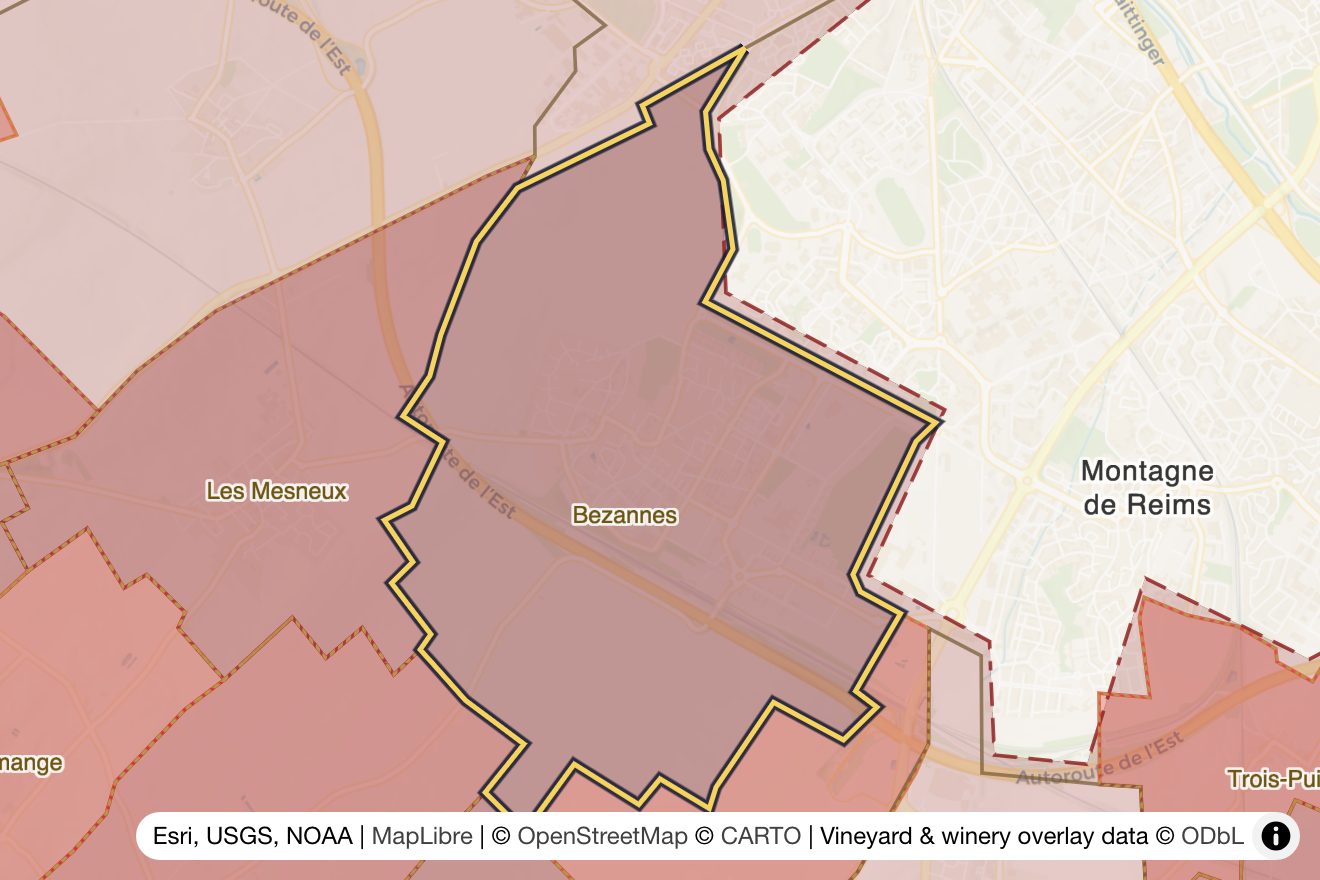
Bezannes occupies a peculiar position in the Champagne hierarchy. Located on the immediate southwestern outskirts of Reims, this Premier Cru commune of the Montagne de Reims sits where urbanization and viticulture collide. The paradox is stark: some Premier Cru vineyard land exists within walking distance of shopping centers and housing developments. This is not a romantic pastoral landscape. Yet the wines emerging from Bezannes demonstrate something crucial about terroir, that geological fundamentals can transcend their surroundings.
The commune has only a few hectares of vines, reportedly all Chardonnay. Unlike the forested slopes of Verzy to the east or the grand cru villages of Mailly-Champagne to the north, Bezannes presents as Champagne's suburban frontier. But dismiss it at your peril. The soils here share fundamental characteristics with more celebrated neighbors, and a handful of growers are proving that mesoclimate and skilled viticulture can overcome the aesthetic disadvantages of proximity to the A4 autoroute.
Geological Foundation: The Belemnite Chalk Story
The bedrock of Bezannes is Campanian chalk, the same formation that underlies much of the Montagne de Reims. This chalk dates to approximately 83-72 million years ago, when the region lay beneath a shallow sea. The chalk's microporous structure, formed from coccolith remains, is what gives it its water-storage capacity.
This matters for vine physiology. The porosity allows for exceptional water regulation: the chalk acts as a reservoir during wet periods and releases moisture gradually during dry spells. Dr. Gérard Seguin's research at the University of Bordeaux established that moderate, well-regulated water availability is more critical to wine quality than soil richness or specific mineral content. Bezannes exemplifies this principle. The chalk here can hold significant water reserves while maintaining good drainage, which helps buffer the vines against both waterlogging and drought.
Topsoil depth over the chalk varies from parcel to parcel. This creates meaningful variation in vine vigor and ripening patterns across relatively short distances, sometimes within a single hectare.
Mesoclimate: The Urban Heat Island Effect
Here's where Bezannes diverges sharply from its neighbors. The proximity to Reims creates a measurable urban heat island effect. This is not insignificant in a region where ripening is often marginal.
The effect manifests differently depending on prevailing wind patterns. Bezannes sits at 90-120 meters elevation, lower than the classic Montagne de Reims villages perched at 150-200 meters. When winds blow from the north, carrying cooler air from the forested heights, the temperature differential narrows. But during calm nights, particularly in August and September, the retained heat from Reims's buildings and pavement radiates outward, creating a warmer envelope over the vineyards.
The extended hang time possible in warmer mesoclimates allows for phenolic ripeness without excessive sugar accumulation: a balance increasingly valuable as climate change pushes alcohol levels higher across Champagne.
The flip side: spring frost risk. The lower elevation and bowl-like topography in certain parcels create cold air pooling.
Viticultural Reality: Managing the Margins
Bezannes faces challenges that Verzenay or Ambonnay never encounter. Soil compaction from historical agricultural use requires active management. Several growers have implemented deep ripping to break up compacted layers at 50-70 cm depth, improving root penetration into the chalk.
Canopy management takes on heightened importance here. The combination of deeper topsoils and urban heat can push vigor beyond optimal levels, particularly in younger plantings. Excessive vigor creates dense canopies with poor air circulation: a recipe for botrytis pressure. The solution involves higher-density planting (8,000-9,000 vines/hectare versus the regional standard of 7,500-8,000) combined with aggressive leaf removal on the morning (east) side to maximize sun exposure and air movement.
Rootstock selection has evolved. Where older plantings used 41B or SO4 almost universally, newer plots incorporate Fercal and Gravesac, rootstocks selected for their ability to penetrate deeper into chalk and their moderate vigor characteristics. This represents a shift from generic regional practice toward site-specific adaptation.
This part-time viticulture doesn't automatically mean lower quality, but it does limit the intensity of vineyard monitoring and intervention possible during critical periods.
The Producer Landscape: Who's Actually Making Wine Here?
This isn't a value judgment: these grapes contribute essential components to wines consumed globally. But it does mean that experiencing Bezannes as a distinct terroir requires some detective work.
Cocteaux's approach emphasizes the Meunier, which thrives in Bezannes's clay-enriched topsoils. The "Carte Blanche" bottling showcases what well-managed Meunier from chalk-based terroir can achieve: red fruit purity (cherry, redcurrant) with a chalky minerality that distinguishes it from Meunier grown on heavier Marne Valley soils. The wines show moderate dosage (7-8 g/L) and relatively short aging on lees (24-30 months), producing an accessible style that nonetheless expresses place.
Méa practices partial malolactic fermentation (40-60% depending on vintage), preserving some malic acidity to counterbalance the riper fruit profile that Bezannes's mesoclimate encourages. The "Tradition Brut" demonstrates the sub-region's ability to produce Pinot Noir with genuine structure: this isn't the ethereal delicacy of Verzenay, but rather a more compact, earth-inflected expression with darker fruit tones (blackberry, plum skin) and a saline finish that speaks to the chalk influence.
Dechelle has practiced organic viticulture since 2012 (certified 2015) and incorporates biodynamic preparations on a trial basis in selected parcels. The results are mixed but instructive. In warmer vintages (2018, 2019, 2020), the organic approach yields wines with impressive aromatic intensity and textural depth. In cooler, wetter years (2021), disease pressure in the lower-elevation sites proved challenging, requiring sulfur and copper applications at the upper limits of organic certification standards.
The reality is that most Bezannes fruit disappears into the supply chains of houses in Reims. It's functional viticulture serving industrial-scale production. Nothing wrong with that, it's the economic engine of Champagne. But it does mean that Bezannes as a recognized terroir remains underdeveloped compared to its geological potential.
Wine Characteristics: What Does Bezannes Actually Taste Like?
When you can isolate Bezannes in the glass (through the handful of grower bottlings or the occasional single-village cuvée from a négociant) certain characteristics emerge consistently.
Aromatic Profile: Less floral than Trépail or Villers-Marmery (the Chardonnay-focused villages), more fruit-forward than the grand cru Pinot Noir villages. Expect orchard fruits (apple, pear) in Chardonnay-based wines, the only kind the commune grows.. The urban heat island effect manifests as slightly riper fruit tones, less green apple, more golden apple; less cranberry, more cherry. This isn't Champagne from a warm climate, but it sits on the warmer end of the Montagne de Reims spectrum.
Texture and Structure: The chalk influence appears most clearly in texture. Bezannes wines show a characteristic chalky grip, not tannin exactly, but a fine-grained mineral texture that coats the palate. Acidity runs moderate to moderately high, lower than high-elevation Chardonnay sites but sufficient for balance and aging potential. The mouthfeel tends toward medium body with good persistence: these aren't ethereal wines, but neither are they heavy.
Minerality Question: The term "minerality" requires careful use. What tasters perceive as mineral character in wine doesn't derive from minerals absorbed from soil: this has been thoroughly debunked by research. However, certain soil types do correlate with specific flavor profiles, likely through their influence on vine water stress, nutrient availability, and microbial populations. In Bezannes, the "minerality" presents as a saline quality on the finish, sometimes accompanied by a flinty or chalky impression. Whether this traces directly to the belemnite chalk or results from the interaction of multiple terroir factors remains unclear. But the sensory experience is real and consistent.
Aging Potential: Limited data exists, given the scarcity of vintage-dated Bezannes bottlings. Anecdotal evidence from the few available examples suggests moderate aging potential, 8-12 years for vintage wines, 3-5 years for NV releases. The wines don't appear to develop the complex tertiary aromas (honey, toast, mushroom) that grand cru Champagnes achieve with extended aging, but they maintain freshness and fruit character well into their second decade.
Bezannes Versus Its Neighbors: Comparative Context
Understanding Bezannes requires positioning it within the Montagne de Reims hierarchy.
Versus Verzenay/Mailly-Champagne (Grand Cru): The grand cru villages sit 40-60 meters higher in elevation with thinner topsoils (20-40 cm) directly over chalk. This creates more immediate water stress, smaller berries, and more concentrated wines. Bezannes produces a softer, more approachable style with less aging requirement. The quality gap exists but isn't as wide as the classification suggests, it's more about style than absolute quality.
Versus Villers-Allerand/Rilly-la-Montagne (Premier Cru): These premier cru neighbors to the west show more forest influence (cooler mesoclimate, more diurnal temperature variation) and slightly more clay in the topsoil. Bezannes reads as warmer and riper, with less herbal character and more forward fruit. The premier cru villages produce more "classic" Champagne profiles; Bezannes offers a modern, fruit-driven alternative.
Versus Prunay: This village lies southeast of Reims, on the far side of the city from Bezannes, but sits further from Reims's urban influence. Prunay wines show cooler aromatics and higher acidity: the difference is subtle but measurable. Think of Bezannes as Prunay with an extra week of hang time.
The Urban Pressure Question: Future Prospects
Let's address the elephant in the room: Bezannes is disappearing. Not immediately, but the trajectory is clear. Current zoning protects remaining vineyard parcels, but political pressure to accommodate Reims's growing population continues.
This creates a peculiar market dynamic. Yet the same land, if rezoned for residential use, could fetch €3,000,000+ per hectare. The economic incentive to exit viticulture is enormous.
Some growers see this as opportunity. If vineyard area contracts, scarcity could drive quality focus and price premiums for the remaining production. Others view it as inevitable decline, why invest in replanting or quality improvements when your children will likely sell to developers?
The pessimistic scenario: Bezannes becomes a historical footnote, absorbed into greater Reims within 30-50 years. The optimistic scenario: a core of committed growers leverage the sub-region's genuine terroir advantages and urban proximity (short commute, access to markets, tourism potential) to establish Bezannes as a recognized quality zone. The middle scenario (slow decline punctuated by occasional quality highlights) seems most likely.
Practical Information: Visiting and Tasting
Bezannes offers limited wine tourism infrastructure compared to traditional Champagne villages. No Michelin-starred restaurants, no luxury hotels. But this creates certain advantages for the curious visitor.
Access: 10 minutes from central Reims by car, accessible via tram (line B to the Gare Champagne-Ardenne TGV terminus in Bezannes). This makes Bezannes ideal for visitors based in Reims who want to see working vineyards without driving to Épernay or the Côte des Blancs.
Appointments: Essential. English language capability varies (assume French is necessary). Tastings are informal, expect to stand in the cellar or winery, not a polished tasting room.
What to Buy: Availability is limited, many cuvées sell out within months of release.
Wines to Seek Out
Beyond the grower-producers mentioned above, certain négociant bottlings occasionally highlight Bezannes fruit:
, valued for its texture and moderate ripeness that bridges the high-acid Côte des Blancs components and riper Montagne de Reims fruit.
Food Pairing Considerations
The moderate structure and fruit-forward character of Bezannes Champagnes suit different culinary applications than more austere grand cru bottlings.
Optimal Pairings:
- Charcuterie and pâté (the chalky texture cuts through fat effectively)
- Roasted chicken or pork (the medium body matches protein weight without overwhelming)
- Soft cheeses (Brie de Meaux, Chaource: the local connection works)
- Mushroom-based dishes (the earthy undertones in Pinot Noir-based cuvées complement fungi)
Avoid: Raw oysters (insufficient acidity/salinity), very spicy Asian cuisine (the wines lack the aromatic intensity to compete), heavy cream sauces (can make the wines seem thin).
, something about the combination of red fruit, moderate acidity, and chalky minerality aligns perfectly with cured pork fat and black pepper.
The Bottom Line
Bezannes will never be Verzenay. It shouldn't try. The sub-region's value lies in demonstrating that terroir fundamentals (geology, mesoclimate, viticultural adaptation) can produce distinctive wines even in aesthetically compromised settings. The urban edge location is a liability for romantic marketing but an asset for understanding what actually matters in viticulture.
Bezannes is classified Premier Cru. For consumers, this translates to reasonable value, you're paying for wine quality, not appellation prestige.
For students of Champagne terroir, Bezannes offers something more valuable: a natural experiment in mesoclimate effects. By comparing Bezannes to nearby villages with similar geology but different thermal environments, you can isolate the impact of temperature on ripening, aromatics, and structure. This is wine education in real-time.
Will Bezannes survive as a wine region? Uncertain. Should you taste it while you can? Absolutely.