The Paradox of Place
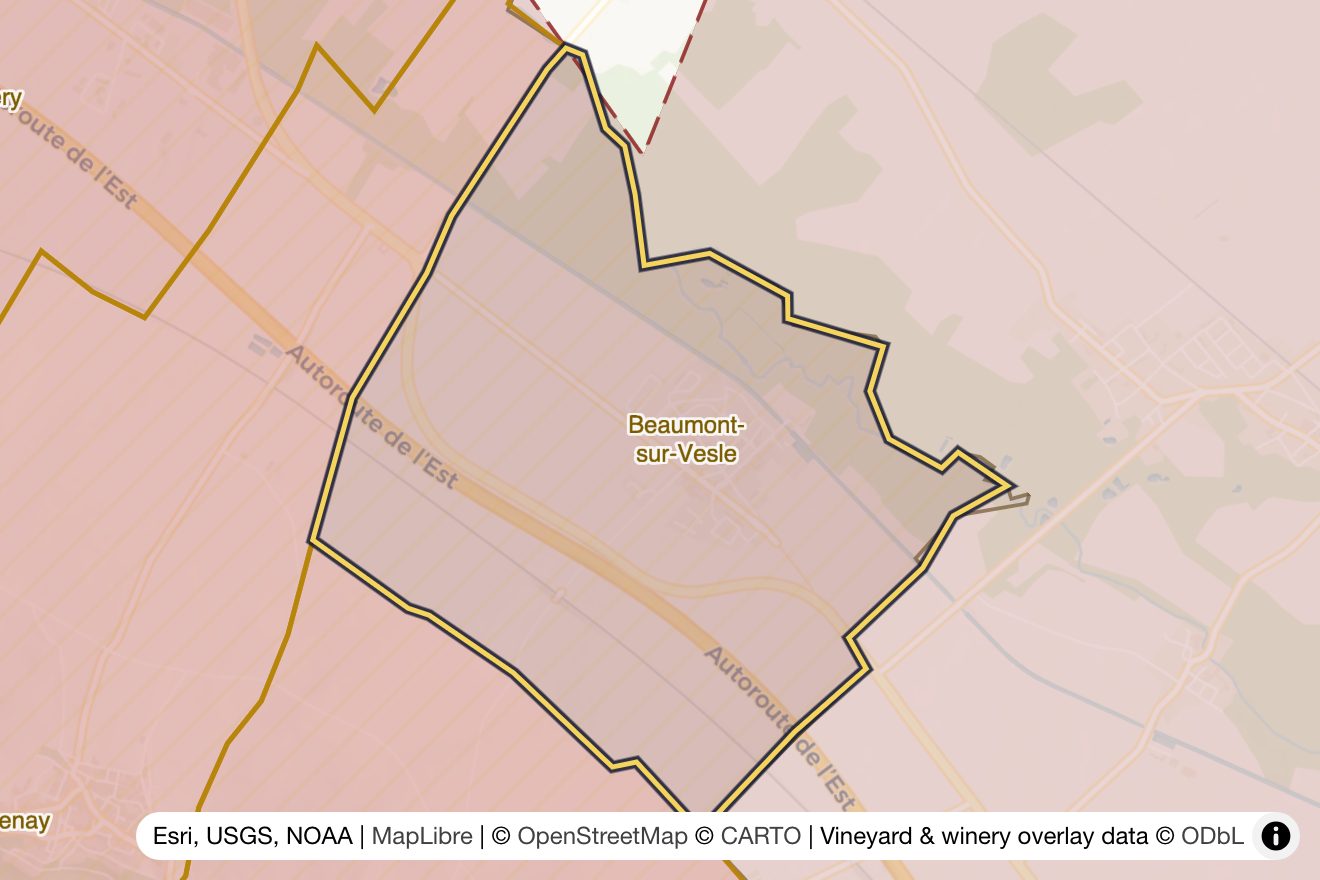
Beaumont-sur-Vesle occupies a curious position in Champagne's hierarchy. It holds Grand Cru status (one of only 17 villages to achieve the maximum 100% rating in the Échelle des Crus) yet remains virtually unknown outside specialist circles. This is not an oversight. Beaumont sits at the extreme northern edge of the Montagne de Reims, set slightly apart from its more famous Grand Cru neighbors, about 3 kilometers from Verzenay. While Verzenay and Mailly-Champagne cluster together on the northern slopes of the mountain, Beaumont stands alone, facing the Vesle River valley and the northern winds that sweep down from Belgium.
The village encompasses approximately 27 hectares of vines, making it one of the smallest Grand Cru villages by planted area. Compare this to Aÿ's 350 hectares or Ambonnay's 387 hectares. Yet size reveals nothing about quality. What Beaumont lacks in surface area, it compensates through geological singularity and microclimate extremes that produce Pinot Noir of striking minerality and uncommon structure.
Geological Foundation: Chalk Above All
The Montagne de Reims is fundamentally a chalk massif: the remnant of ancient Campanian seas that deposited calcium carbonate roughly 72 to 84 million years ago. But not all chalk is created equal. The Belemnite chalk (craie à bélemnites) that underlies Beaumont differs from the older Micraster chalk found lower on slopes and valley floors. Belemnite chalk contains fossilized remains of extinct cephalopods, creating a matrix of exceptional porosity and drainage capacity.
Soil depth over bedrock varies dramatically across Beaumont's vineyard parcels. On the upper slopes, topsoil measures a mere 20-30 centimeters before hitting pure chalk. This is extreme even by Champagne standards. For comparison, the premier cru village of Ludes, just 4 kilometers south, typically shows 40-60 centimeters of soil coverage. The shallow soils force vine roots to penetrate directly into the chalk matrix, creating pronounced mineral extraction that translates to wines of laser-like precision.
The chalk here is not uniform. Pockets of clay-rich loam appear in mid-slope positions, particularly on eastern exposures. These zones produce fuller-bodied Pinot Noir with greater immediate fruit expression, though they lack the aging potential of pure chalk sites. Growers have learned to distinguish between parcels with surgical precision: a knowledge rarely reflected on labels but essential to blending decisions.
Climate: The Northern Extreme
Beaumont-sur-Vesle experiences the coldest mesoclimate of any Grand Cru village in Champagne. This is not speculation. The difference stems from two factors: latitude and exposure.
At about 49.18°N, Beaumont lies in the northern part of the Champagne vineyard. The village's position on the northern rim of the Montagne de Reims means vineyards face predominantly north and northeast, orientations that minimize solar radiation accumulation. While south-facing slopes in Verzenay might accumulate 1,400-1,500 hours of sunlight during the growing season, Beaumont's northern exposures receive 1,200-1,300 hours.
Wind compounds the thermal deficit. The Vesle valley acts as a natural corridor for northern air masses. During spring, cold snaps arrive with little warning, increasing frost risk substantially. The devastating frost of April 2017 hit Beaumont with particular severity, temperatures dropped to -6°C, destroying approximately 40% of potential yield. Verzenay, sheltered by the mountain's bulk, lost only 15%.
Yet this climatic severity is precisely what defines Beaumont's style. Cool temperatures extend the growing season by 7-10 days compared to southern Montagne de Reims villages. Harvest typically occurs in late September, occasionally pushing into early October in cooler vintages. This extended hang time allows phenolic ripeness to develop while maintaining high natural acidity: the essential balance for age-worthy Champagne.
The Pinot Noir Imperative
Beaumont-sur-Vesle is overwhelmingly a Pinot Noir village. Approximately 84% of plantings are dedicated to this variety, with Chardonnay accounting for most of the remainder and Meunier appearing only in trace quantities. This monoculture reflects both terroir suitability and economic reality.
Pinot Noir thrives on Beaumont's chalk-limestone soils in ways that Chardonnay cannot replicate. The variety's relatively early budbreak (typically mid-April) poses frost risk, but the chalk's thermal properties provide modest protection. During clear spring nights, the chalk radiates stored heat, creating a microclimate buffer of 1-2°C. This is often sufficient to prevent catastrophic damage.
The Pinot Noir grown here differs markedly from that of neighboring Grand Crus. Bouzy Pinot Noir, grown on south-facing slopes with greater clay content, tends toward power and vinous weight, wines of 13% alcohol are common in ripe vintages. Beaumont Pinot Noir rarely exceeds 12.5% alcohol even in warm years. The wines emphasize red fruit (cherry, raspberry, redcurrant) over black fruit, with pronounced mineral and saline notes that some tasters describe as "oyster shell" or "wet stone."
Acidity levels tell the story in numbers. Base wines from Beaumont typically show total acidity of 8-9 grams per liter (expressed as tartaric acid), compared to 7-8 g/L in Bouzy or Ambonnay. This extra gram of acid provides the structural backbone for extended aging. Champagnes with significant Beaumont content can develop in bottle for 15-20 years, evolving from taut austerity to complex tertiary notes of toast, mushroom, and forest floor.
Viticultural Challenges and Adaptations
Growing grapes in Beaumont-sur-Vesle requires accepting risk. The village's northern position and exposure make it among the last to ripen in Champagne. In marginal vintages (2013, 2016, 2021) achieving full phenolic maturity becomes problematic. Some growers have responded by adjusting viticultural practices to maximize heat accumulation and minimize disease pressure.
Canopy management takes on critical importance. The traditional gobelet training system, still used in parts of the Aube, is virtually absent here. Instead, growers employ cordon de Royat or Guyot simple systems that allow maximum light penetration and air circulation. Leaf removal on the eastern side of the canopy begins in June, exposing fruit to morning sun while protecting against intense afternoon heat (which, admittedly, rarely poses problems this far north).
Rootstock selection has evolved in response to climate patterns. Historically, 41B (Vitis vinifera 'Chasselas' × Vitis berlandieri) dominated plantings due to its chalk tolerance and vigor control. But 41B shows sensitivity to drought, increasingly relevant as climate change brings more variable precipitation. Recent plantings favor SO4 (Vitis berlandieri × Vitis riparia 'Teleki'), which combines chalk adaptation with better drought resistance. The shift is gradual; rootstock replacement occurs over decades, not years.
Organic and biodynamic viticulture remains rare in Beaumont, practiced by fewer than 5% of growers. The humid continental climate and disease pressure make fungal management challenging without synthetic inputs. Mildew and botrytis can devastate yields in wet years. The 2016 vintage saw widespread mildew damage across the Montagne de Reims; Beaumont's northern exposure and limited air drainage exacerbated the problem.
Lieux-Dits: Parsing the Terroir
Unlike Burgundy, where lieu-dit names appear regularly on labels, Champagne's tradition of blending across multiple sites has obscured vineyard-level distinctions. But the parcels exist, recorded in cadastral maps and known intimately to local growers.
The Producer Landscape: Small Holdings, Big Houses
Beaumont-sur-Vesle contains no major Champagne houses. The village's vineyard area is small, roughly 27 hectares. This fragmentation is typical of Champagne but particularly pronounced in smaller Grand Cru villages.
The majority of growers sell their grapes to négociants rather than producing wine themselves. Beaumont fruit commands premium prices, typically 7.50-8.00 euros per kilogram for Pinot Noir, compared to 5.00-6.00 euros for premier cru villages. The Grand Cru designation guarantees this price floor, providing economic stability even in difficult vintages.
Several grower-producers merit attention for their commitment to expressing Beaumont's terroir:
Egly-Ouriet is an Ambonnay grower with Grand Cru parcels in Ambonnay, Bouzy and Verzenay, and Premier Cru vines in Vrigny. Francis Egly pioneered low-intervention winemaking in Champagne during the 1980s, eschewing malolactic fermentation and minimizing sulfur additions. His "Les Vignes de Vrigny" is a Premier Cru Meunier cuvée from Vrigny. The wines are vinified in small oak barrels (10-15% new), adding textural complexity without masking terroir expression.
Jérôme Prévost farms in Gueux; his "La Closerie Les Béguines" is a near-100% Meunier cuvée from a single Gueux vineyard. Prévost's approach emphasizes single-vintage, single-variety expression, unusual in Champagne's blending culture. The style is controversial, some critics find it too oxidative, while others praise its individuality.
Ulysse Collin (Olivier Collin) is based in Congy, with vineyards in Congy and the Côte de Sézanne. Collin practices meticulous viticulture, including manual plowing, organic treatments, and severe yield restriction (often below 8,000 kg/ha, compared to the regional average of 12,000 kg/ha). His "Les Maillons" is a single-vineyard Pinot Noir from the Côte de Sézanne. Dosage is minimal (2-3 g/L), allowing the terroir's salinity and mineral character to dominate.
Most Beaumont grapes, however, flow to major houses. The fruit typically enters prestige cuvées where its high acidity and mineral profile provide structural support. Pol Roger's "Cuvée Sir Winston Churchill" is made only from Grand Cru Pinot Noir and Chardonnay, but the house does not disclose its villages or percentages.
The Blending Question: Beaumont's Role in Grand Marques
Why do major houses value Beaumont fruit so highly when its cool-climate character might seem austere or angular? The answer lies in blending philosophy and aging potential.
Champagne production is fundamentally an exercise in blending, across vintages, villages, and varieties. The goal is consistency: producing a recognizable house style year after year despite vintage variation. This requires access to wines with different characteristics that can be combined to achieve balance.
Beaumont provides what blenders call "structure and spine." Its high-acid, mineral-driven Pinot Noir acts as a framework around which softer, fruitier components can be built. A typical prestige cuvée might combine Beaumont's austerity with Aÿ's power, Bouzy's vinosity, and Cramant's elegance. The result is greater than the sum of parts: a wine that balances immediate appeal with long-term development potential.
The importance of Beaumont fruit increases in warm vintages. When climate conditions push ripeness levels higher and acidity lower, as in 2003, 2015, or 2018, Beaumont's naturally cooler mesoclimate preserves the freshness that other sites lose. Blenders prize this insurance policy against climate extremes.
Wine Characteristics: Tasting Beaumont
Describing Beaumont-sur-Vesle's wines requires distinguishing between young and aged expressions. The transformation over time is more dramatic than in warmer Grand Cru sites.
Youth (0-5 years after disgorgement): Beaumont-dominant Champagnes show pronounced tension in youth. The aromatics emphasize white flowers (acacia, hawthorn), citrus zest (lemon, grapefruit), and green apple. Red fruit appears but remains tightly wound, tart cherry and cranberry rather than ripe strawberry. The mineral component is unmistakable: chalk dust, wet stone, saline notes that some tasters describe as "sea spray." The palate is linear and driving, with acidity that can seem aggressive if the wine lacks sufficient dosage or bottle age. Finish is long but austere, leaving the mouth watering for food.
Middle age (5-10 years): With time, the angularity softens. The citrus notes evolve toward preserved lemon and orange peel. Red fruit gains complexity, cherry compote, raspberry, hints of pomegranate. The mineral character remains but integrates better with the fruit. Toasted brioche and almond notes emerge from autolysis (the breakdown of yeast cells during aging on lees). The acidity, while still prominent, feels balanced rather than sharp. The wines enter a drinking window where they show both freshness and development.
Maturity (10+ years): Fully mature Beaumont Champagnes display tertiary complexity. The aromatics shift toward mushroom, forest floor, truffle, and tobacco. Fruit becomes more subtle, dried cherry, fig, quince. Oxidative notes (hazelnut, toffee) may appear, depending on disgorgement date and storage conditions. The texture gains weight and creaminess as acidity integrates fully. The mineral backbone persists, providing structure even as other elements evolve. These wines demonstrate why Beaumont commands Grand Cru status: the capacity for extended aging and graceful development.
Vintage Variation: When Beaumont Shines
Beaumont-sur-Vesle's performance varies significantly by vintage character. The village excels in warm years and struggles in cold, wet seasons.
Outstanding vintages: 2002, 2008, 2012, 2015, 2018. These years combined adequate warmth for ripening with preserved acidity. The 2008 vintage particularly favored Beaumont: a cool growing season with a warm, dry September allowed extended hang time without loss of freshness. Champagnes from 2008 with significant Beaumont content are approaching their peak now (2024) and will continue developing through 2030.
Challenging vintages: 2013, 2016, 2021. Cool, wet conditions prevented full phenolic ripeness. The wines show green, herbaceous notes and lack the fruit density to balance their structure. Many growers sold their 2013 crop to négociants for blending into non-vintage cuvées rather than risk quality in vintage-dated wines.
Variable vintages: 2010, 2014, 2017. Success depended on individual site selection and harvest timing. Growers with well-exposed parcels in Les Grandes Vignes or Les Crayères produced good wine; those in cooler sites struggled.
Climate Change: Beaumont's Future
Rising temperatures are reshaping Champagne's viticultural landscape. Average annual temperatures have increased approximately 1.2°C since 1980. Harvest dates have advanced by 10-14 days. Alcohol levels in base wines have risen from 9.5-10% in the 1980s to 10.5-11% today.
For Beaumont-sur-Vesle, climate change presents both opportunities and risks. The village's historically cool mesoclimate is warming toward the regional average. This could improve ripening consistency and reduce vintage variation, potentially elevating Beaumont from a blending component to a standalone terroir worthy of single-village bottlings.
But warming also threatens the high-acid profile that defines Beaumont's character. If temperatures continue rising, the village risks losing its distinctiveness, converging toward the rounder, softer style of southern Montagne de Reims sites. Some growers are experimenting with later-ripening clones and rootstocks to preserve freshness in a warming climate.
The frost risk paradox complicates predictions. Warmer average temperatures advance budbreak, exposing young shoots to spring frosts that still occur. The 2017 frost devastated Beaumont despite occurring in a warming climate. Climate change may actually increase frost vulnerability even as it raises average temperatures.
Food Pairing: Beaumont's Culinary Affinities
Beaumont-sur-Vesle's high-acid, mineral-driven style demands food pairings that complement rather than compete with its intensity.
Shellfish: The saline, mineral character makes Beaumont Champagnes natural partners for oysters, particularly Gillardeau or Marennes-Oléron varieties. The wine's acidity cuts through the oyster's brininess while the mineral notes create harmonic resonance. Scallops, either raw or lightly seared, work equally well.
White fish: Dover sole, turbot, or sea bass prepared simply (grilled, steamed, or poached) allow Beaumont's terroir to shine. Avoid heavy sauces; a squeeze of lemon and good olive oil suffice.
Aged cheeses: The paradox of pairing Champagne with cheese finds resolution in Beaumont's structure. Comté aged 24-36 months, with its nutty complexity and crystalline texture, mirrors the wine's mineral character. Avoid soft, creamy cheeses that coat the palate and obscure the wine's precision.
Charcuterie: Beaumont's acidity cuts through fatty cured meats effectively. Jambon de Paris, rillettes, or pâté de campagne create satisfying contrasts. The wine's red fruit notes complement the meat's savory depth.
Vegetables: Roasted or grilled vegetables (asparagus, fennel, artichokes) match Beaumont's vegetal undertones and mineral profile. A salad of bitter greens (endive, radicchio) with a light vinaigrette works surprisingly well.
Visiting Beaumont: Practical Considerations
Beaumont-sur-Vesle offers limited tourist infrastructure compared to more famous Champagne villages. At least one grower-producer, Paul Sadi, offers on-site sales in the village. Visitors must arrange appointments directly with grower-producers, and many prefer to conduct business in French.
The village's primary attraction is its rural authenticity. Unlike Épernay or Reims, Beaumont remains an agricultural community where viticulture functions as livelihood rather than spectacle. The landscape (rolling chalk hills, isolated vineyard parcels, sweeping views toward the Vesle valley) rewards those seeking contemplative engagement with terroir rather than luxury tourism.
Reims lies 15 kilometers south, providing accommodation and dining options. The drive through the Montagne de Reims Natural Regional Park offers perspectives on Champagne's geological and viticultural diversity.
Conclusion: The Case for Beaumont
Beaumont-sur-Vesle occupies an anomalous position in Champagne's geography and culture. Geographically isolated, climatically extreme, and largely unknown to consumers, it nonetheless holds Grand Cru status and commands premium prices for its fruit. This apparent contradiction resolves when one understands Champagne's blending tradition and the specific role that Beaumont's terroir plays within it.
The village produces Pinot Noir of singular character, high-acid, mineral-driven, structured for aging. These are not wines of immediate gratification. They require patience, both in the cellar and in the glass. But for those willing to engage with Champagne as terroir expression rather than mere celebration, Beaumont offers rewards that more famous villages cannot replicate.
As climate change reshapes viticulture across France, Beaumont's cool mesoclimate may prove increasingly valuable. The village represents a northern extreme that could become tomorrow's ideal. Whether growers and houses will recognize this potential, and whether they will choose to highlight Beaumont's terroir through single-village bottlings rather than anonymous blending, remains to be seen.
For now, Beaumont-sur-Vesle remains Champagne's quiet secret: a Grand Cru in name and quality, if not yet in reputation.