Overview
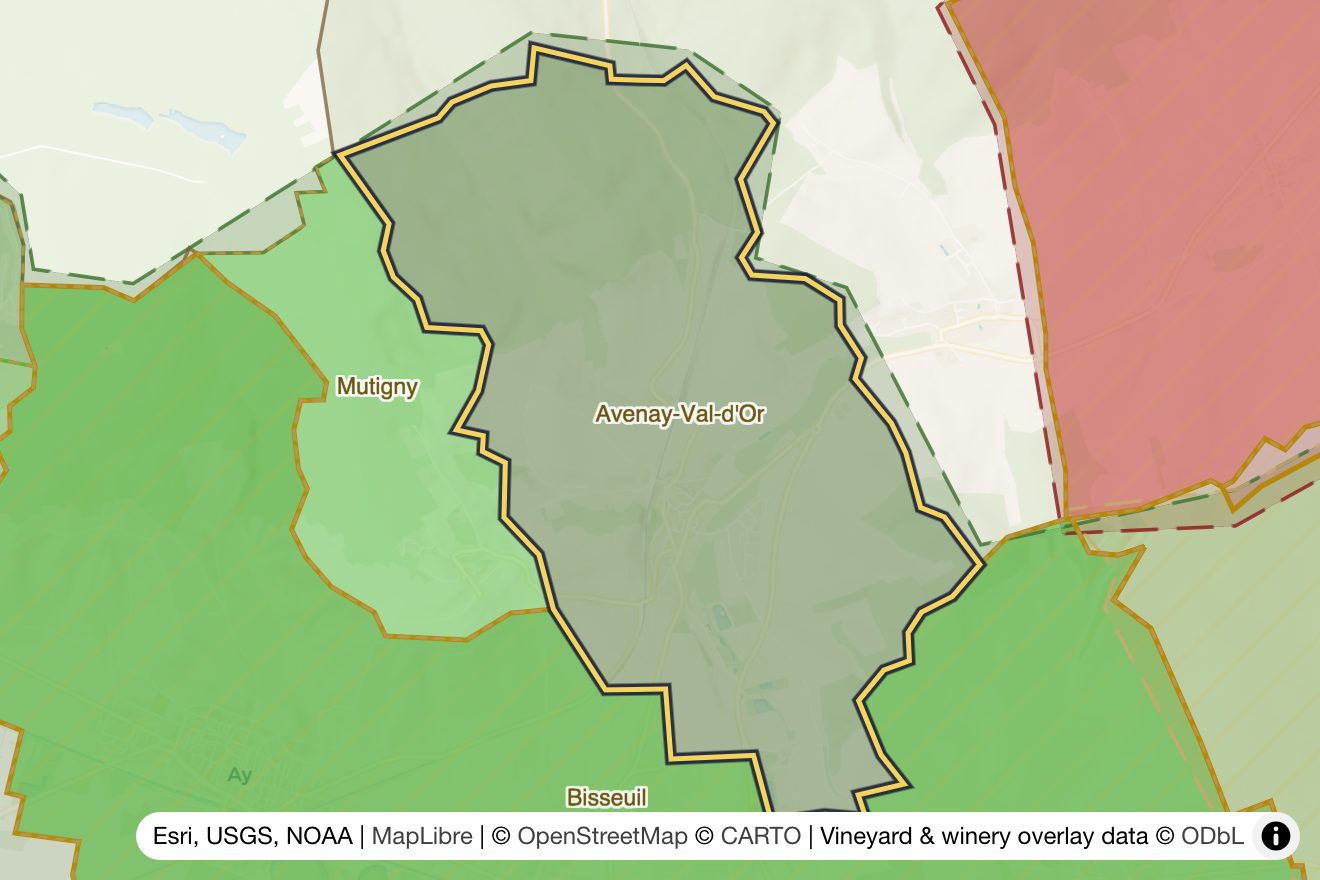
Avenay-Val-d'Or is a premier cru village of the Champagne appellation in the Marne department, set in the valley of the Livre, a stream that descends from the Montagne de Reims toward the Marne between Aÿ and Louvois. The commune belongs to the Grande Vallée de la Marne sector and carries roughly 237 hectares of vines, planted about 77 percent to Pinot Noir, 12 percent to Chardonnay and 10 percent to Meunier. It was rated 93 percent on the échelle des crus, a level it shares with Champillon, Cumières, Hautvillers and Mutigny.
History
The village grew around the Benedictine abbey of Saint-Pierre d'Avenay, a royal foundation established around 660 by Saint Berthe. The abbey church was consecrated in 1186 after a fire, was burned by Huguenot forces in 1567, and lost most of its buildings to another fire in 1754; the community of nuns was dispersed in 1792 during the Revolution, and furnishings from the abbey passed to the parish church of Saint-Trésain, which holds the relics of Berthe. Avenay was a recognized name in the era of Champagne's still wines: the seventeenth-century essayist Charles de Saint-Évremond praised the wines of Avenay. The commune, previously plain Avenay, took the name Avenay-Val-d'Or by decree of 28 May 1951, distinguishing it from the Avenay in Calvados.
The village cooperative, the Coopérative Vinicole Le Val d'Or, was founded in 1948. The commune also holds an unusual place in Franco-American wine history: Albert J. Ricciuti, a Baltimore-born translator with Patton's Third Army who passed through the village in 1944, returned to marry Paulette Révolte in 1963 and ran the Ricciuti-Révolte estate, becoming commonly cited as the first American to produce Champagne; their son continues the house as Champagne J.C. Ricciuti.
Terroir & Climate
The vineyards climb both flanks of the Val d'Or, the side valley cut by the Livre on the southern side of the Montagne de Reims, giving predominantly southeast- and southwest-facing exposures above the slope that runs down to Mareuil-sur-Aÿ. Soils are deep clay-limestone over the chalk subsoil of the region, a profile suited to Pinot Noir. The climate is that of the central Marne, a cool regime combining oceanic and continental influences, with a mean annual temperature near 11 degrees Celsius and rainfall around 700 millimetres; the valley setting combines sheltered mid-slopes with frost-prone lower ground.
Grape Varieties & Wine Styles
Pinot Noir dominates at about three quarters of the surface, in line with the Grande Vallée de la Marne, with Chardonnay and Meunier sharing the remainder. Fruit rated 93 percent commanded premier cru pricing under the échelle, and wines made entirely from grapes of villages rated 90-99 percent may carry the premier cru mention. The village's Pinot Noir supplies structured, black-fruited base wines for house blends; resident growers bottle Pinot Noir-led bruts, rosés and blanc de noirs under the village name, with smaller amounts of Chardonnay entering blends and occasional varietal cuvées.
Notable Producers
Marc Augustin farms nine hectares across Avenay-Val-d'Or and Vertus, certified biodynamic by Demeter, on an estate that joins two long-established Champagne winemaking families. Champagne J.C. Ricciuti continues the former Ricciuti-Révolte house. Other resident growers include Gaston Révolte, William Saintot, Jean Marniquet and Crucifix Père & Fils, alongside the Coopérative Vinicole Le Val d'Or, which is affiliated with Union Champagne. Houses owning vineyards in the commune include Bollinger, Henriot, Moët & Chandon, Mumm, Philipponnat and Veuve Clicquot.
What to Know
Avenay-Val-d'Or sits in the premier cru belt surrounding the grand crus of the Grande Vallée and southern Montagne de Reims: Aÿ lies to the west, Tours-sur-Marne to the south and Louvois up the valley to the northeast, with premier cru Mutigny on the shoulder between Avenay and the Marne. The 93 percent rating placed it in the middle of the premier cru range before the échelle ceased to govern grape pricing, and most of its Pinot Noir still moves through contracts with the major houses. Village-labeled wines are largely Pinot Noir-driven and follow the Grande Vallée profile: fuller and riper than Montagne de Reims north-slope Pinot Noir, without carrying the grand cru premium of neighboring Aÿ.