Overview
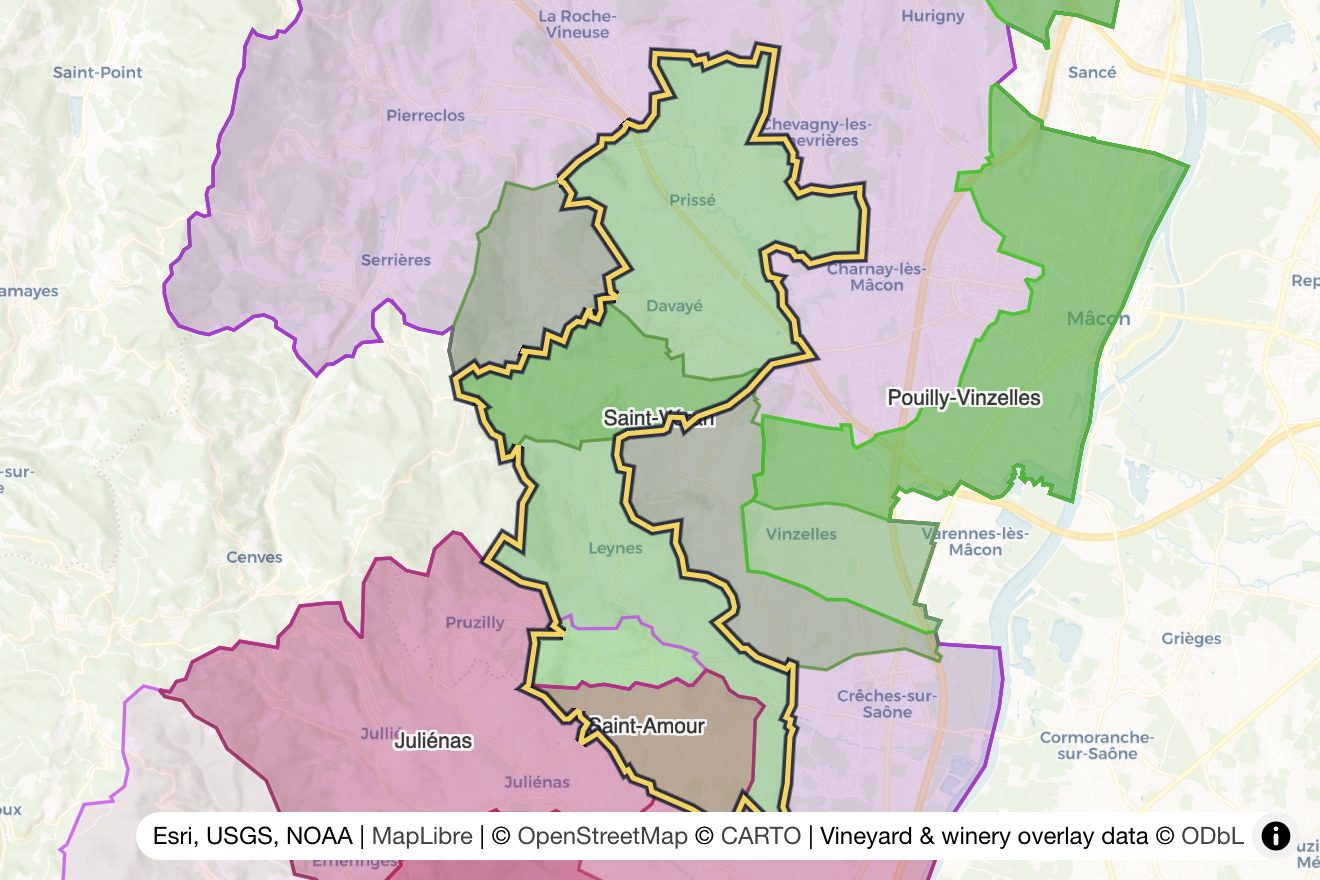
Saint-Véran is a white wine appellation of the southern Mâconnais, roughly 700 hectares of Chardonnay in two sectors that bracket Pouilly-Fuissé to its north and south. Created in 1971, it occupies the quality step between Mâcon-Villages and Pouilly-Fuissé, and its best limestone slopes, particularly around Davayé and Prissé, produce wine that presses hard on its senior neighbor at a distinctly junior price.
History
The appellation was assembled in 1971 from villages whose wine had sold as Beaujolais Blanc or Mâcon despite Pouilly-Fuissé-adjacent terroir; the name adapts the village of Saint-Vérand, its terminal d dropped. Its two-lobed map, Davayé and Prissé in the north, Leynes, Chânes and neighbors in the south where Burgundy shades into Beaujolais granite country, reflects that administrative origin. Quality investment from Mâconnais growers and negociants since the 1990s has raised the appellation's profile, and a premier cru classification dossier has followed the region-wide movement begun at Pouilly-Fuissé.
Terroir & Climate
The northern sector shares the limestone-marl slopes of the Solutré-Vergisson formation, east and southeast exposures at 250 to 400 metres; the southern sector mixes limestone with the sandier, granite-influenced soils of the Beaujolais border. The Mâconnais's sunny, southern-Burgundian climate ripens Chardonnay generously, with the northern limestone giving the appellation's most mineral wines.
Grape Varieties & Wine Styles
Saint-Véran is Chardonnay alone. The style is classic southern Mâconnais: ripe orchard and citrus fruit, floral and almond notes, medium to full body with fresh balance, vinified in tank and used barrels in varying proportions. Northern-sector bottlings run tighter and stonier, southern ones rounder. Most wines drink best within two to six years; top lieux-dits from serious growers hold longer.
Notable Producers
Domaine Corsin, Domaine des Deux Roches, Olivier Merlin, Daniel et Julien Barraud, Verget and the Bret Brothers work the appellation at reference level, alongside strong cooperative production at Prissé; Château de Beauregard and Pouilly-Fuissé estates bottle Saint-Véran from adjacent parcels.
What to Know
Saint-Véran's practical role is Pouilly-Fuissé value: the northern communes share the same hills. Labels rarely flag the north-south split, so producer and lieu-dit carry the information. The appellation is unrelated to Saint-Amour, the Beaujolais cru adjoining its southern lobe, though several growers work both.