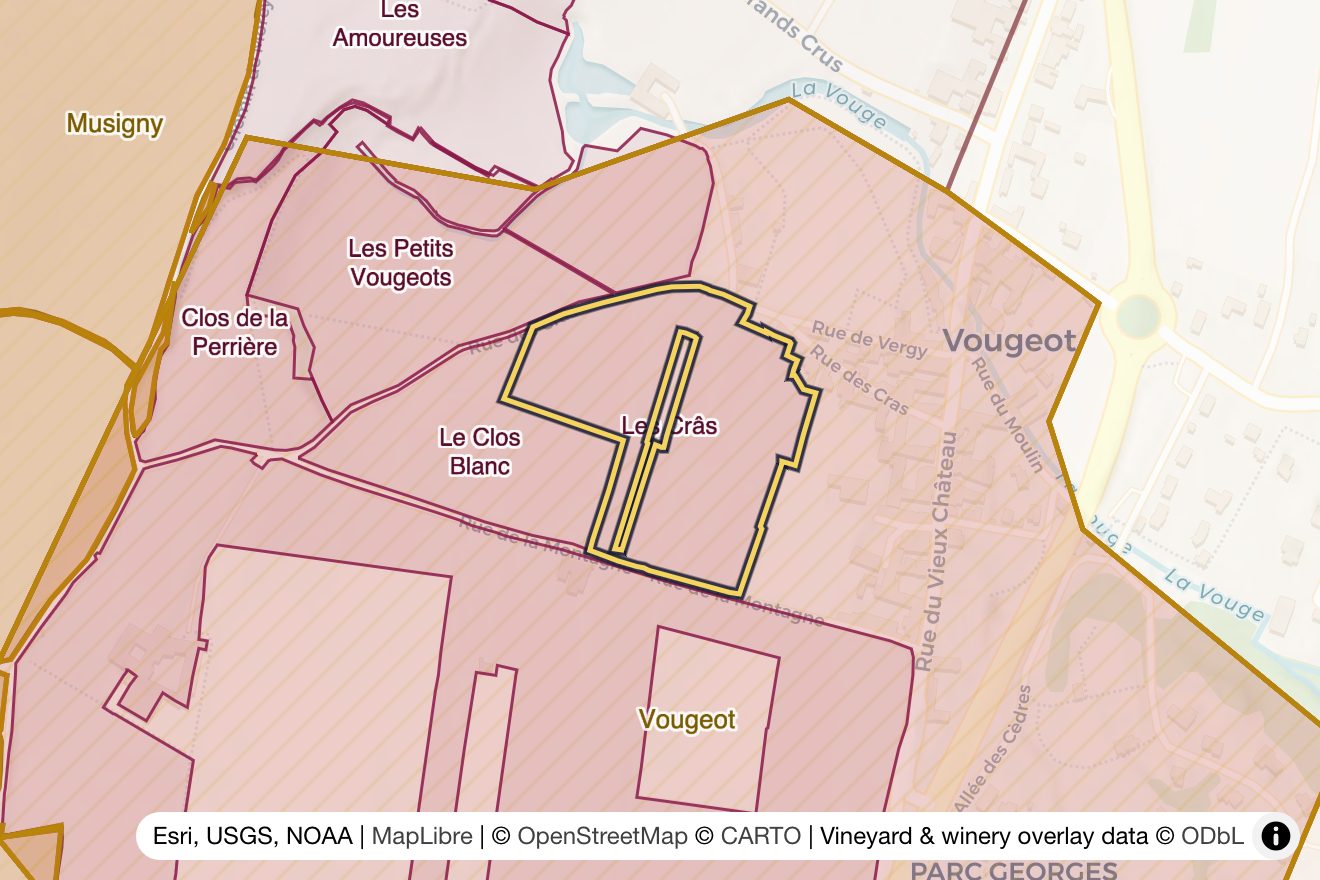
Where It Sits
Les Crâs runs along the outside of the northern wall of the Clos de Vougeot, level with the central section of the grand cru, at 240 to 250 metres. It is the easternmost and lowest of Vougeot's four premiers crus, on comparatively flat ground reaching to the edge of the village itself, with Le Clos Blanc immediately upslope to the west, Les Petits Vougeots to the north and Bertagna's Clos de la Perrière monopole beyond that. The commune boundary with Chambolle-Musigny is a short distance further on, which puts Musigny and Les Amoureuses looking down on the site from above.
Being outside the wall is the whole classification story. The ground here is not measurably worse than the lower reaches of the Clos, but the Cistercian enclosure fixed a line in the Middle Ages that the 1936 appellation decrees simply inherited, and Les Crâs fell on the premier cru side of it.
Stone Under Thin Soil
The name is the usual Burgundian shorthand for broken rock, shared with Beaune's Aux Cras, Meursault's Les Cras and Chambolle's own Les Cras: crai, crais and crâs all describe stony, calcareous ground over hard bedrock. Growers describe the profile consistently even when they disagree on wording. Domaine Bertagna reports weak soil directly over hard white limestone. Domaine de la Vougeraie describes silt with fine and coarse sand, high in limestone and draining exceptionally freely. François Legros calls it calcareous and marly with a fine texture over rocky subsoil. The common thread is a shallow, quick-draining cover with the rock never far below, which on flattish low-slope ground is what keeps the site from behaving like village land.
Six Pieces, One Vineyard
Measured on the delimitation, Les Crâs comes to 3.63 hectares recorded in six separate parcels, which sounds far more fragmented than it is. One block of around 3.4 hectares is the vineyard; the other five range from roughly a fifth of a hectare down to sixty square metres, the sort of offcuts left behind by a road, a track edge or an old boundary. Trade sources quoting around 3.7 hectares for the climat are describing the same ground.
Ownership is unusually concentrated for a Burgundian premier cru. Domaine de la Vougeraie farms 1.43 hectares, close to two-fifths of the whole, split between two named holdings it lists as Les Crâs Vigne Blanche (0.76 ha) and Les Crâs (0.67 ha), planted between 1983 and 1995 at 10,000 vines per hectare from 40 per cent massal selection, certified organic since 1999 and biodynamic since 2001. Domaine Bertagna, based in the village, holds about 0.6 hectares of Pinot Noir plus a separate Chardonnay parcel. Mongeard-Mugneret and François Legros both bottle it, and the climat's total output is small enough that no single vintage circulates widely.
Red, and One of Burgundy's Rarest Whites
Vougeot is one of the very few appellations in the Côte de Nuits where white is permitted at premier cru level, and the declared area reflects it: of 12.48 hectares of premier cru recorded in 2007, 9.44 were for red and 3.04 for white. Most of that white comes from Le Clos Blanc, but Bertagna plants 0.55 hectares of Chardonnay in Les Crâs and bottles it as Vougeot 1er Cru Blanc Les Cras, a wine made in quantities small enough that importers describe it as one of the rarest whites in France. It is picked by hand, pressed gently and raised twelve to sixteen months in French oak with about a quarter new, and it runs to ripe stone fruit and honey rather than tension.
The reds are the serious proposition. Bertagna destems fully, ferments with indigenous yeast after a cold soak and raises the wine fifteen to eighteen months with half new oak, producing a bottle that opens on mint, liquorice and undergrowth and finishes taut and firmly structured. Across producers the climat gives a Vougeot with more grip and less flesh than its position at the foot of the slope would suggest, which is what the stone underneath is for.