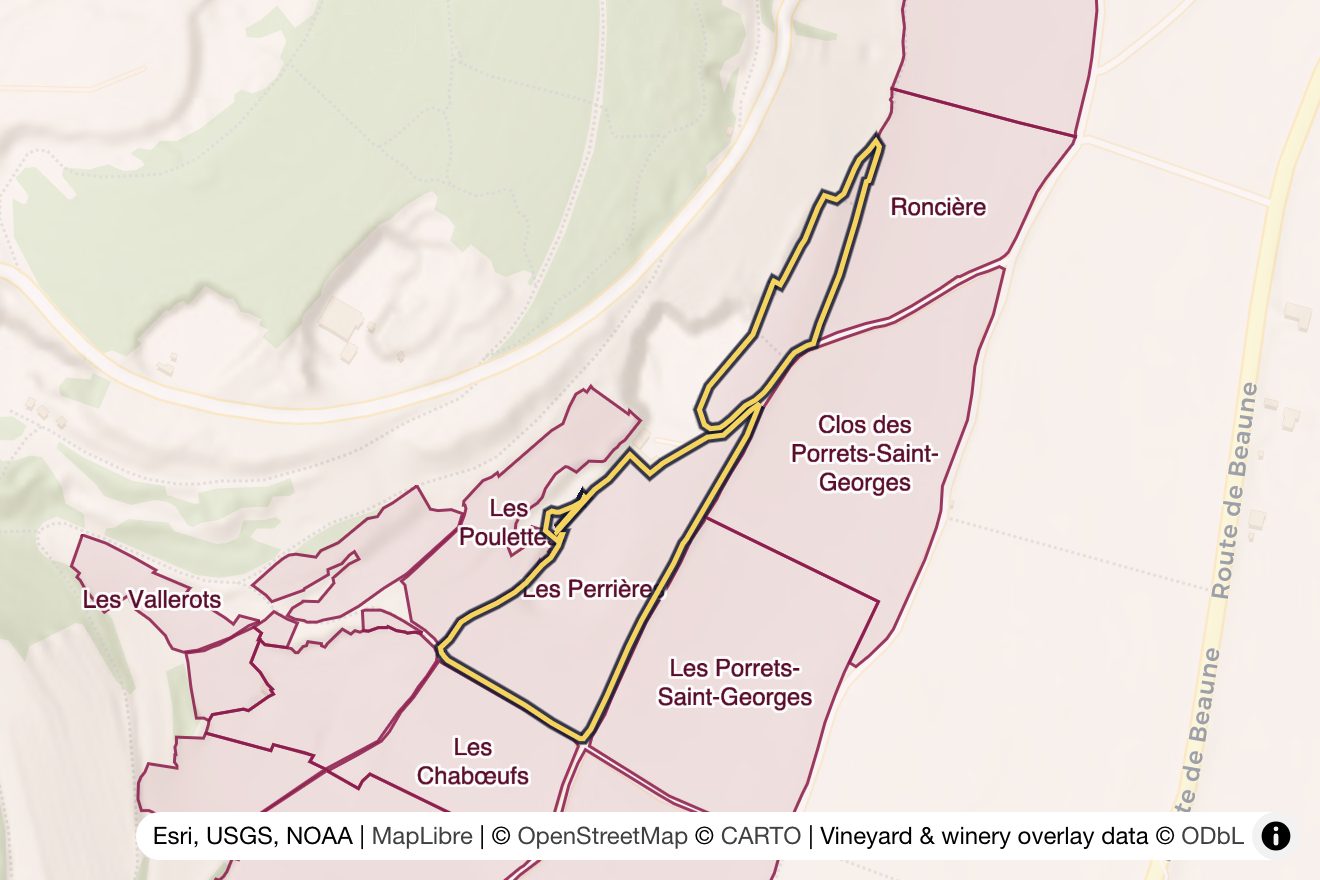
Six parcels, two of which matter
Burgundy climats are frequently not single blocks. Centuries of inheritance, road cutting, quarry workings, buildings and successive boundary revisions leave a delimited name scattered across several detached pieces, and Les Perrières is a clear case. One parcel of 2.44 hectares holds the bulk of the vineyard. A second piece of 0.84 hectares lies detached to the north and slightly lower. The remaining four fragments total under five hundred square metres between them: slivers of headland and boundary, not plantable vineyard in any meaningful sense.
That arithmetic explains a persistent discrepancy in the literature. The figure most often published for Les Perrières is around 2.5 hectares, which corresponds closely to the main block alone rather than to the full delimitation. Planted surface is smaller again, since not every square metre inside a boundary carries vines.
The neighbours are informative. The main block sits directly above Les Porrets-Saint-Georges and directly below Les Poulettes, with Les Chabœufs and Clos des Porrets-Saint-Georges touching its edges and Les Cailles a matter of metres away; Les Vaucrains lies about a hundred metres off. The detached northern piece behaves differently, abutting Roncière on one side and village-classified Nuits-Saint-Georges land on the other, with Les Pruliers close by. A grower with vines in both pieces is farming two rather different positions on the hill under one label.
Stone first, soil second
Perrière is old French for a quarry, from pierre, and the derivation is literal here rather than decorative. Underground limestone workings adjoin the vineyard, and the white oolite extracted around Nuits went into village walls, the church of Saint-Symphorien, and the thin stone laves once laid on local roofs. Some of that extraction continues today.
The site faces east to southeast between roughly 250 and 275 metres, on a gradient noticeably steeper than the vineyards immediately around it. The soil is shallow and heavily loaded with limestone fragments, sitting over white oolite that gives way at depth to the Comblanchien and Prémeaux limestones characteristic of this stretch of the Côte.
The viticultural consequence is precocity. Loose stone drains completely and stores daytime heat, and Les Perrières ripens ahead of its neighbours, to the point that growers here treat a late harvest date as a risk rather than an insurance policy. Méo-Camuzet, which bottles the climat through its négoce arm from vines planted in the 1950s, notes small berries with frequent millerandage and rows planted north to south instead of the east-west orientation usual in the sector, an unusual configuration that changes how sunlight tracks across the canopy through the day.
The growers
Holdings here are necessarily tiny. Domaine Robert Chevillon farms about 0.6 hectares of roughly fifty-year-old vines. Domaine Forey Père & Fils holds 0.42 hectares planted between 1937 and 1942, vines now well past their eighth decade. Domaine Jean Chauvenet works about a quarter of a hectare. Domaine Henri Gouges owns 0.41 hectares planted not to Pinot Noir but to Pinot Gouges, the white-berried mutation Henri Gouges identified in his vines in the 1930s and propagated from the Clos des Porrets nursery; the wine is bottled as a white premier cru. Négociant and domaine bottlings from Méo-Camuzet, François Legros, Jean-Claude Boisset, Edouard Delaunay and Patriarche account for much of the rest. Four named growers alone cover most of the plantable surface, which is a useful reminder of scale: a good vintage of Les Perrières amounts to a few thousand bottles across all hands.
In the glass, the site reads as precision rather than power. Nuits south of the town is often characterised as the muscular end of the commune, but Les Perrières sits apart from the tannic weight of Les Saint-Georges and Les Vaucrains, giving red fruit, citrus peel and a fine chalky grip, with the stony austerity showing early and softening with a few years in bottle.
The name repeats, so check the commune
Perrières and its variants recur across Burgundy wherever stone was cut: Meursault, Beaune, Puligny-Montrachet, Pommard and Gevrey-Chambertin all carry a version, and the Meursault site in particular dominates search results for the name. The confusion runs inside Nuits-Saint-Georges as well. En la Perrière Noblot is a separate premier cru about two and a half kilometres north of the town, mostly classified at village level with only a fraction ranked 1er cru. Gouges labels its white in the singular as La Perrière, which is a holding within the Les Perrières climat rather than a cru of its own. Any tasting note, hectare figure or soil description worth trusting should name the commune before it names the stone.