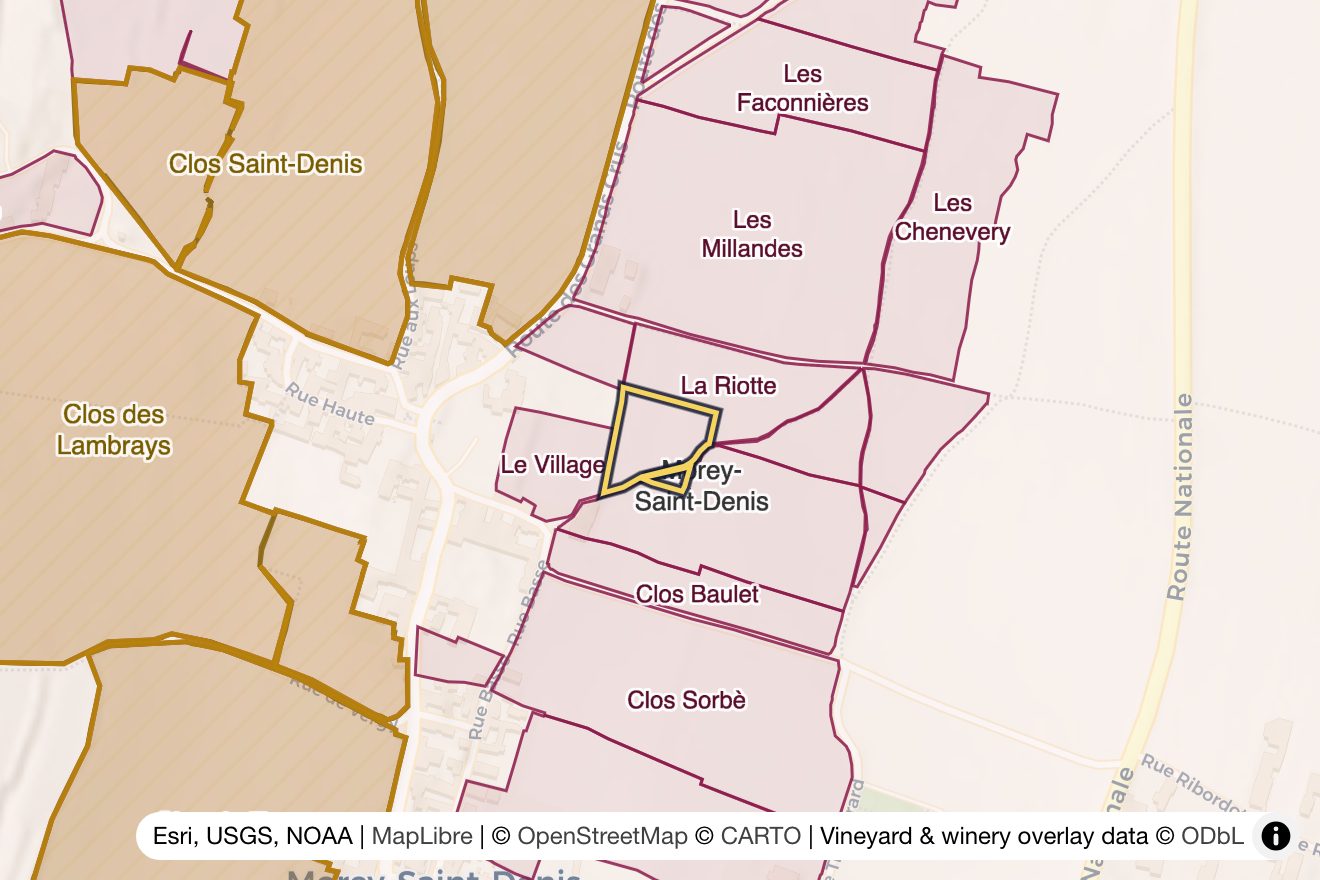
The site
Measured from the delimitation, the climat covers 0.50 hectares in three pieces. A single block of 0.465 hectares does essentially all the work; the other two are slivers of roughly 340 and 40 square metres, artefacts of boundary lines rather than plantable vineyard. For scale, the next smallest premier crus in the commune, Le Village and Clos Baulet, are each over 0.8 hectares, and Monts Luisants is more than ten times its size.
Its centre falls at about 47.1987 north, 4.9647 east, at roughly 270 metres, squarely mid-slope. The southern corner of the Clos de la Roche delimitation stops less than a hundred metres to the north-west. La Riotte adjoins on the north-east side and Les Blanchards lies directly below to the south, with Clos Baulet about 40 metres away and Les Millandes about 60. Terrain modelling gives a fall of roughly eight percent to the east-south-east, gentle even by Morey standards. Patrick Essa places Gruenchers immediately above Les Blanchards on ground a little stonier than its neighbour, in a mid-slope pocket well sheltered from the wind that funnels out of the combe.
Two names for the same stones
The etymology splits. One line runs through the Burgundian dialect word grève, from the Latin grava, meaning gravel, small stones and fine scree, which would make Gruenchers a plain description of stony ground and would tally with the extra stoniness Essa notes on the site. The other reads it as walnut, or a hard nutshell. Stéphane Magnien has taken the second reading and built a label on it: his premier cru cuvée is called Aux Petites Noix.
Why it almost never appears alone
That cuvée is the practical answer to where Gruenchers fruit goes. Magnien blends the climat with Clos Baulet, both mid-slope, both on the deeper, clay-heavier ground found lower down in Morey, working with a high proportion of very old pinot tordu vines and giving the wine less pigeage than his other reds precisely because the clay already delivers weight. He has said the two parcels might be separated one day, though on current volumes there is no commercial case for it.
The silence elsewhere is telling. Bill Nanson, who has profiled the village in detail, records never having seen a standalone Morey Gruenchers. Berry Bros lists it by name and surface among the commune's other premier crus and offers no description of the site at all. A single-climat Gruenchers from Morey is, in practice, not a category.
One trap is worth flagging. Chambolle-Musigny has a Les Gruenchers of its own a little over a kilometre south, sitting below Bonnes-Mares and bottled by Dujac, Fourrier, Felettig and others. Effectively every bottle labelled Gruenchers in circulation is that one, not this one.