The Name
Romanée is a recurring Burgundian toponym, read by most French place-name scholarship as marking proximity to a Roman road or to Roman-period occupation rather than to any medieval owner. Three unrelated Burgundian sites carry it: the grand cru at Vosne, a lieu-dit at Chassagne-Montrachet, and this premier cru at Gevrey. The shared word implies no shared pedigree, and confusion with the Vosne monopole is a persistent nuisance for the growers here.
Shape, Parcels and Position
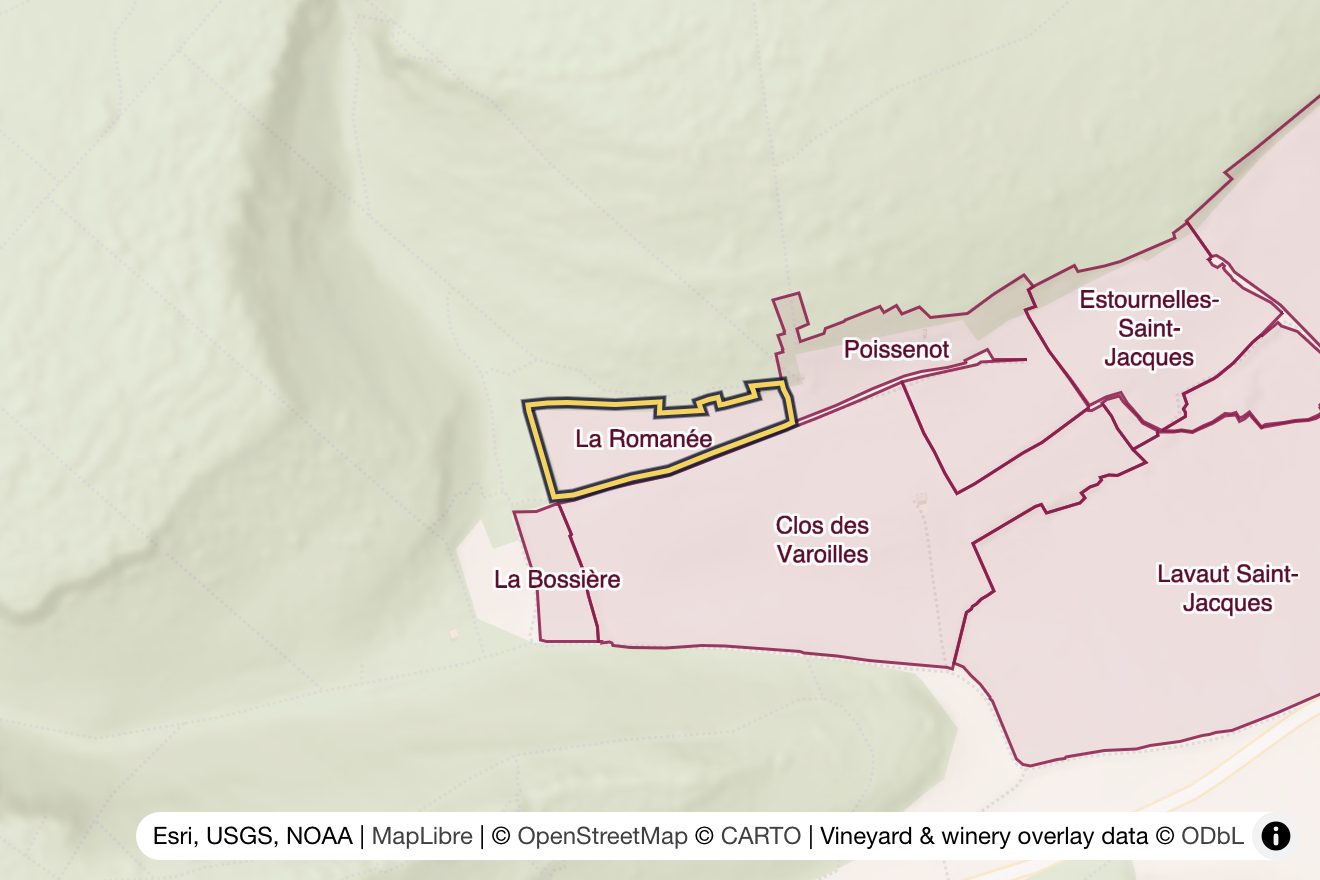
The climat measures 1.07 hectares across four mapped parcels, but the parcel count flatters the fragmentation. One continuous ribbon accounts for 1.04 of those hectares, running 215 metres east to west and only about 92 metres north to south. The other three pieces are strips of 0.005 to 0.009 hectares, a few metres wide, strung along the block's upper boundary and reading as headland and track rather than plantable vine. In practice this is a single long band, not a scatter.
It is a contour band, and it sits high. The vines run between roughly 353 and 366 metres, and the whole ribbon holds close to 360 metres along its length. Behind it, to the north, the escarpment climbs to about 400 metres within 130 metres and past 450 metres within 400: bare limestone and woodland, the edge of the Combe Lavaux nature reserve. Below to the south the ground eases off to around 350 metres where La Bossière and the Clos des Varoilles begin. La Romanée is therefore the last vine before the trees, and among the westernmost of the Gevrey premier crus. Clos Saint-Jacques lies 650 metres east and considerably lower; the grand cru band sits more than 100 metres below in altitude.
The orientation is due south, which is not the Côte d'Or norm. The escarpment here is cut by lateral valleys, and La Romanée curls into the mouth of the Combe Chaudron, a side combe that opens onto the slope roughly 900 metres to the west-north-west. Full southern exposure buys ripening; the combe gives it back, funnelling cool air down onto the site and widening the day-to-night swing. That trade is the single most useful thing to know about the wine.
Soil
The soil is pale and thin. The current owners describe it as marne blanche, a flaky white marlstone, heavily loaded with stone and sitting on limestone bedrock; the previous proprietors put the working depth at about 50 centimetres before the rock. Reports from the estate also note an old spring within the parcel. The stone content matters at this altitude, since it stores the day's heat and releases it overnight against exactly the cooling the combe provides. The neighbouring Clos des Varoilles, by the same account, carries deeper soil and larger stones, which is the geological reason the two monopoles taste as different as they do.
Ownership and the Wine
La Romanée has been worked as a monopole by a single house throughout the modern era. Domaine des Varoilles was founded in 1964 by Denis Chéron alongside the Naigeon family, who sold their shares in 1990 to the Swiss importers Gilbert Hammel and Charles Rolaz. From the 2020 harvest Philippe Chéron folded des Varoilles together with the family's Nuits-Saint-Georges estate Misset-Chéron under a new name, Domaine du Couvent, and the wines are now vinified and bottled at Nuits. The six-hectare Clos des Varoilles proved too large for the reorganised team and went out on fermage to Prieuré-Roch from the same vintage; La Romanée stayed in-house. Records at the estate trace the parcel to the twelfth century and the monks of Cluny, with replanting in the 1960s after a period when it was split between Chardonnay and Pinot Noir. The estate's American importer describes it as a walled parcel.
The vines are now past sixty years old. Fruit is hand-picked, destemmed, given a short cold soak, fermented on indigenous yeast in temperature-controlled cement and raised about fifteen months in barrel with roughly a fifth new oak. Volumes are tiny: the 2020 produced nine barrels, a little over 2,000 litres from just over a hectare.
The wine trades Gevrey's usual power for line. Gilbert Hammel called it the more elegant of the two monopoles, wider in aroma and silkier in texture than the Clos des Varoilles, which answers with depth. Critics have reached for the same vocabulary from vintage to vintage: red and black fruit cut with spice and violet, crushed stone, a saline and mineral finish, tannins that are firm without drying. Burghound scored both the 2015 and 2016 at 92 points, calling the latter finer if less powerful, with minerality carrying a sleek and lingering close. For a Gevrey premier cru, restraint rather than muscle is the point, and the altitude and the white marl are where it comes from.