The Name, and Two Ways to Get It Wrong
A combe is the dry transverse valley that cuts back into the escarpment; Chambolle itself is built at the mouth of one. A combotte is its diminutive, and the word attaches to the softened, shallower ground where such a valley loses its shape rather than to anything steep or dramatic. The description fits the site.
Two confusions follow the name. The first is local: Chambolle has both an Aux Combottes and a Les Combottes, and several reference sites treat the two as interchangeable or as one nested inside the other. The cahier des charges homologated by the decree of 14 November 2011 does not. It lists them as separate entries in the same alphabetical run, alongside Aux Beaux Bruns, Aux Echanges, Les Chatelots and the rest. The second confusion is regional: Gevrey-Chambertin also has an Aux Combottes premier cru, a considerably larger and far more famous site wedged between Latricières-Chambertin and Clos de la Roche. A good deal of the tasting material circulating under the bare name Aux Combottes belongs to Gevrey, not to Chambolle.
Position, Parcels and Ground
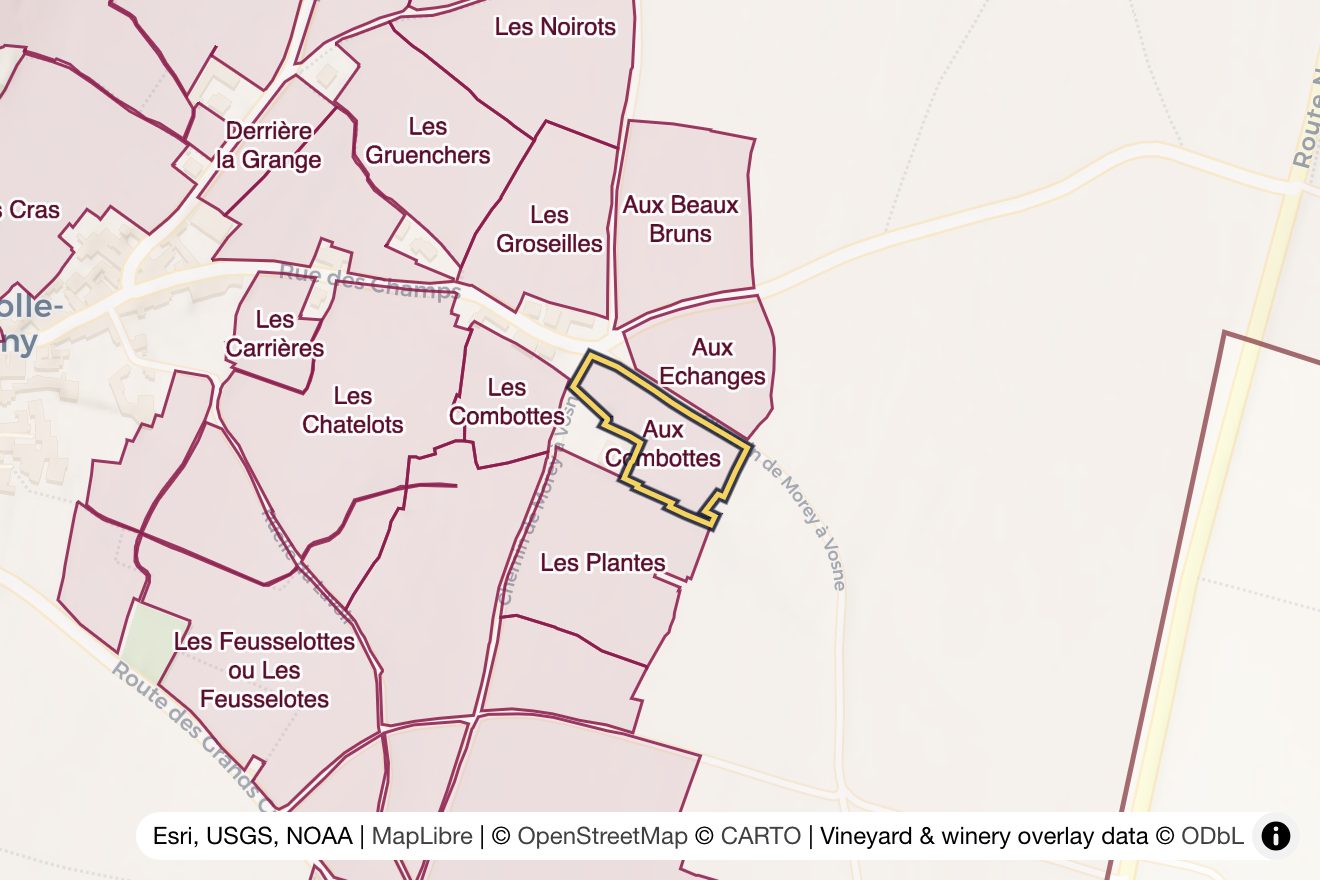
The delimitation puts Aux Combottes at 0.83 hectares across two parcels, centred at roughly 47.1856 N, 4.9608 E. The parcel count needs qualifying rather than dramatising: one block carries essentially the whole surface, about 0.81 hectares, and the second entry is a narrow strip of a couple of hundred square metres crossing it. In working terms this is a single vineyard whose boundary survey happens to split in two, not a climat scattered across the commune in the way that Les Plantes (seven parcels) or Les Feusselottes (nine) genuinely are.
Its neighbours locate it exactly. Les Combottes lies immediately upslope to the west-north-west, about 130 metres away. Aux Echanges adjoins to the north-north-east, barely 80 metres off; Les Plantes runs south-south-west; Aux Beaux Bruns sits just to the north; Les Groseilles is close by to the north-north-west, and the northern edge of Les Charmes is a short walk south. What that list makes plain is how low Aux Combottes sits. The centre of Les Fuées is more than 500 metres away to the north-west, and Bonnes-Mares begins some 700 metres to the north-north-west on distinctly higher ground. Aux Combottes belongs to the bottom tier of Chambolle's premiers crus, hard against the north-eastern edge of the village.
The appellation's regulatory terroir description accounts for what that means underfoot. At Chambolle the front of the Côte is built of Bajocian and Bathonian limestones, with the very compact Comblanchien limestone forming the structural spine, and a bed of Bajocian marl slipping into the sequence low on the hillside where it shows as a slight terrace. Out of the mouth of the combe spreads a debris cone of stony, freely drained material. The slope deposits themselves are thin and very stony at the top of the hill, becoming finer-grained and thicker at the piedmont, a few decimetres to a metre. Delimited parcels run between 250 and 350 metres of altitude; Aux Combottes sits at the bottom of that range, on the fan and the piedmont rather than the slope proper. Roumier, describing its 0.2747 hectare parcel in Les Combottes immediately upslope, characterises the ground as the bed of an old torrent out of the combe, with large stones, clay and pebbles over clay-limestone rock, at around 260 metres and facing east on a gentle grade. Aux Combottes is the same story a little further out and a little deeper.
Who Bottles It
Ghislaine Barthod is the name to know. Her 5.86 hectare domaine in Chambolle produces an unusually long run of premier cru bottlings, and Aux Combottes is the newest and the smallest of them: her US importer records simply that she recently added a small parcel there to round out the estate's holdings, and notes that it accounts for the least wine of any of her traditionally bottled cuvées. Merchant listings describe her holding as a tiny slice of the climat. R. Dubois et Fils also lists an Aux Combottes. Volumes elsewhere are negligible, and much of the climat's fruit is likely to disappear into blends rather than surface under the name.
The importer's own assessment is refreshingly unpuffed: prettiness that is very Chambolle, without the mineral intensity and poise of the village's greatest crus. That reads as an honest account of a piedmont site. Expect a light-framed, openly perfumed wine, red-fruited and floral, with flesh and early charm coming from the deeper soil rather than the tension that the mid-slope delivers. Chambolle premier cru of this type drinks well from roughly six to fifteen years, and Aux Combottes belongs at the earlier end of that span.