Santenots, Volnay 1er Cru: The Volnay That Grows in Meursault
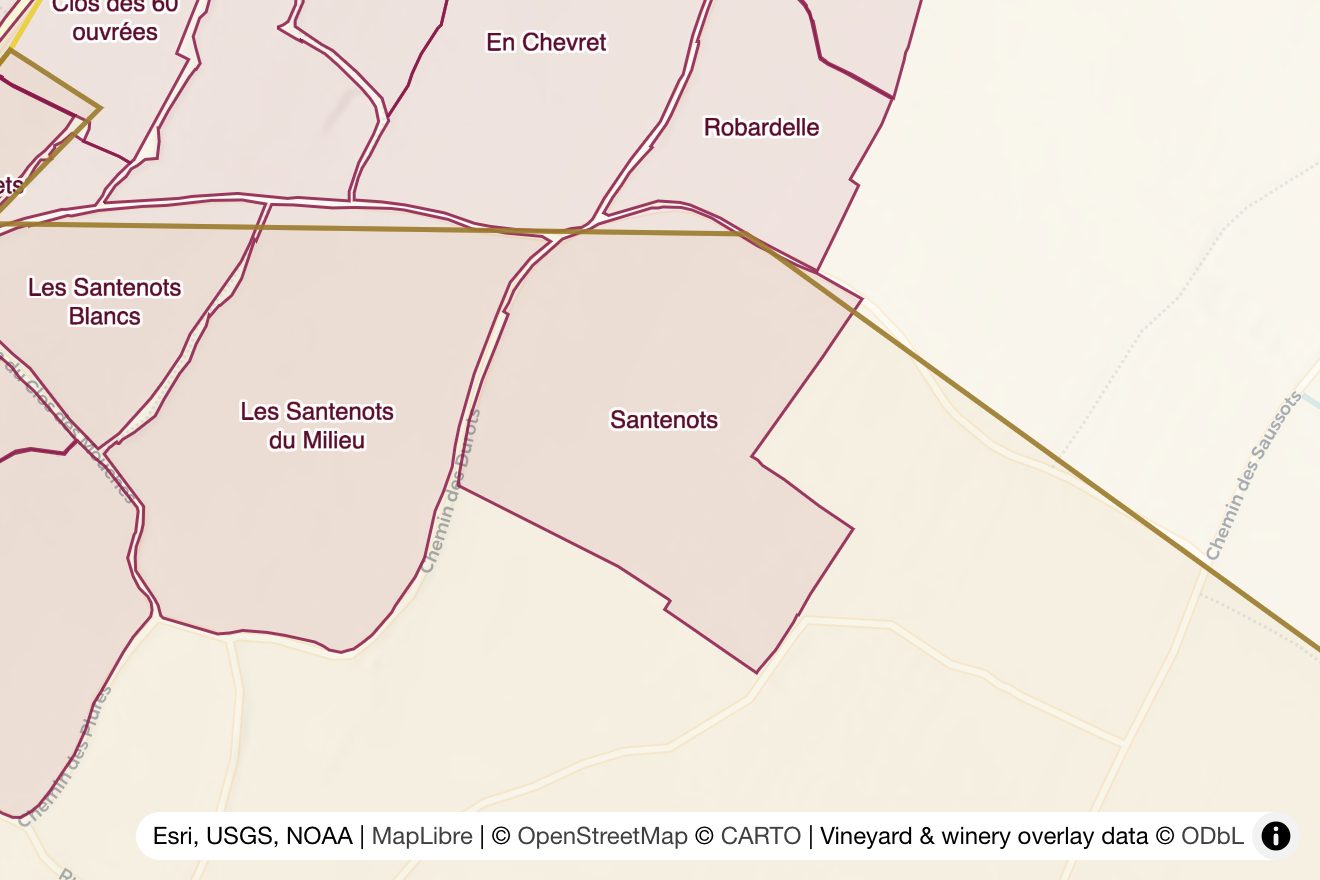
Santenots is the best-known anomaly on the Côte de Beaune's appellation map. Not one vine of it stands in Volnay. The entire climat lies inside the commune of Meursault, immediately south of the boundary, and the name on the label is decided by the colour of the grape rather than the address of the vine.
One Climat, Two Appellations
Both appellations were recognised in 1937, Meursault by decree of 31 July. INAO's own description of Volnay premier cru Santenots defines its geographic area as the territory of the commune of Volnay plus a small part of the commune of Meursault; French sources put that Meursault portion at 29 hectares 7 ares 31 centiares.
The mechanism is visible in the Meursault cahier des charges (originally homologated by decree 2011-1689 of 28 November 2011 and since amended). Most Meursault premier cru climat names are approved for still white or still red: Charmes, Perrières, Genevrières, Les Cras, Les Caillerets, Les Gouttes d'Or, Le Porusot. Three climats of the Santenots sector are approved for white alone: Les Santenots Blancs, Les Santenots du Milieu and Les Plures. Red wine grown on those parcels consequently has no Meursault name available to it, and leaves as Volnay 1er Cru Santenots. The commercial logic long predates the paperwork, since red Volnay has always sold more easily than red Meursault, but the legal route is that narrow list of white-only climats.
The name itself is unresolved. Burgundian toponymy offers two candidates: the Latin sentes, meaning thorn scrub, or the Gaulish sentu, meaning path, the same root proposed for Santenay and a reference to the tracks that dropped from Auxey-Duresses toward the Roman road. Neither is documented.
The Family of Santenots
Five names circulate for the sector, with sizes commonly published as Les Plures 10.44 hectares, Les Santenots Dessous 7.64, Les Santenots du Milieu 6.79, Les Santenots Blancs 2.91 and Clos des Santenots 1.21. Those total almost 29 hectares, which reconciles with the official figure. Only three of the five, however, are INAO climat denominations. Santenots Dessous is a customary and cadastral name rather than a registered one; Clos des Santenots is Domaine Jacques Prieur's monopole, enclosed inside Santenots du Milieu.
The delimitation mapped here bears the arithmetic out. The block carried as Volnay 1er Cru Santenots measures 7.64 hectares, centred at 4.7824 E, 46.9894 N, and sits directly downslope, to the east, of Santenots du Milieu. The du Milieu polygon measures 8.04 hectares, which is 6.79 plus the 1.21 of Clos des Santenots contained within it; Santenots Blancs measures 2.93 against a published 2.91. The 7.64-hectare block is therefore the lower tier of the sector, the ground generally called Santenots Dessous.
Its three parcels are lopsided in the usual way: one body of 7.60 hectares, plus fragments of roughly 4 ares and a third of an are lying 126 and 151 metres off. The parcel count reflects cadastral tidying, not a scattered vineyard.
Slope, Rock and Soil
The sector faces east and runs from roughly 220 to 280 metres, with this block occupying the bottom of that range, closest to the plain. Bedrock is Bathonian limestone, harder than the rock under Volnay's own hillside premiers crus: the Middle Jurassic beds that sink away beneath Volnay rise again around Meursault and continue south to Santenay. Over that hard floor the soil is shallow and conspicuously red with iron, and it carries more clay than the Volnay slope does.
That is the whole explanation for the style. Volnay's reputation for perfume rests on active limestone high on the hill; Santenots trades some of that lift for clay, and clay gives weight.
Growers and Style
Domaine des Comtes Lafon is the dominant name, with close to 3.8 hectares of Santenots du Milieu and a long run of benchmark bottlings. Jacques Prieur holds the Clos des Santenots monopole. Beyond those two the list is long, and includes Louis Jadot, Henri Boillot, Benjamin Leroux, Nicolas Rossignol, Roblet-Monnot (in Les Plures), Bernard Moreau, Bernard et Thierry Glantenay, Georges Joillot, Y. Clerget, Buisson-Charles (27 ares planted in 1954), Pierre Morey, Albert Bichot and Vincent Girardin.
Within the sector the hierarchy is settled. Santenots du Milieu is treated as the peak, and its wines are often described as intense and brooding. The lower tiers, Dessous and Plures, sit on richer soil and give wines of more weight and impact, less finesse and more push; Winehog, tasting Y. Clerget from the Dessous ground, rates it above its reputation.
Across the sector the profile is consistent: dark cherry and plum, violet and lavender, a firm frame, a coating richness that no hillside Volnay offers, and tannins that stop well short of Pommard's. These are wines to keep. A decade is the minimum for the serious bottlings, and the best of them run considerably further.