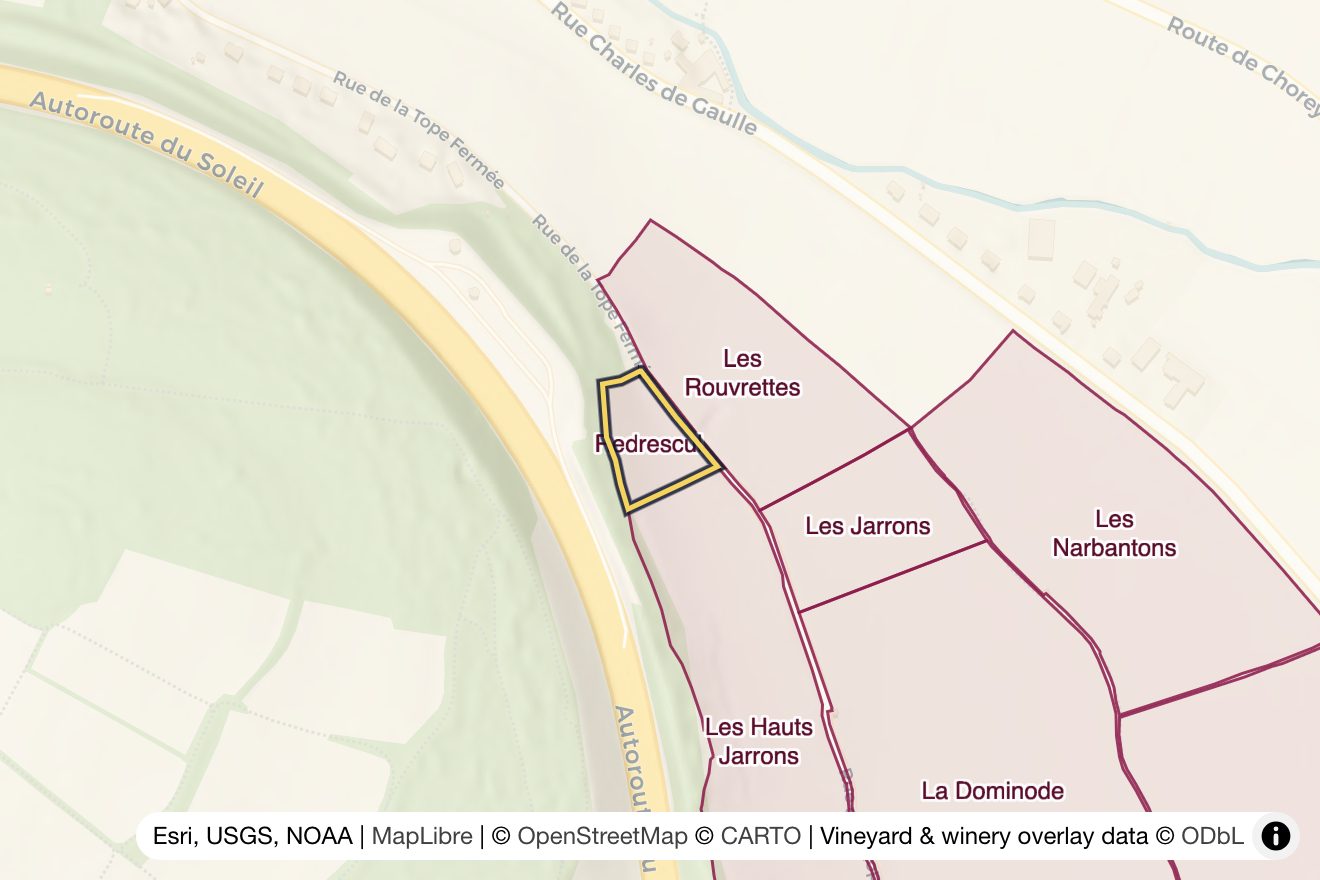
Savigny-lès-Beaune, Côte de Beaune, Burgundy
Overview & Location
Redrescul stands as one of the distinguished Premier Cru vineyards within the commune of Savigny-lès-Beaune, positioned strategically in the heart of Burgundy's Côte de Beaune. This climat occupies a privileged location on the eastern-facing slopes above the village of Savigny-lès-Beaune, a few kilometers north of Beaune itself. The vineyard sits within the broader Savigny-lès-Beaune appellation, which encompasses some 350 hectares of vineyards spread across a distinctive valley formation that creates one of Burgundy's most unique amphitheater-like configurations.
The geographical context of Redrescul places it within the northern sector of the Côte de Beaune, where the limestone escarpment begins its gentle descent toward the plains of the Saône River valley. This positioning provides the climat with optimal exposure to morning sunlight while benefiting from the protective influence of the higher slopes that rise behind it. The vineyard forms part of the complex mosaic of Premier Cru sites that characterize Savigny-lès-Beaune's reputation for producing wines of exceptional finesse and minerality.
Within the commune's classification hierarchy, Redrescul represents one of the smaller but highly regarded Premier Cru designations, contributing to Savigny-lès-Beaune's total of 22 Premier Cru climats. The vineyard's location places it in close proximity to other distinguished sites such as Aux Gravains and Aux Guettes, creating a concentration of quality that has established this sector as particularly noteworthy among Burgundy enthusiasts and collectors.
Size
The Redrescul climat encompasses approximately 0.65 hectares (1.6 acres), making it one of the more intimate Premier Cru designations within Savigny-lès-Beaune. This modest size reflects the precision of Burgundy's classification system, where individual climats are delineated based on specific terroir characteristics rather than arbitrary boundaries. The compact nature of Redrescul allows for remarkably consistent soil composition and microclimate conditions throughout the vineyard, contributing to the homogeneous quality that defines wines from this site.
The limited surface area of Redrescul means that total annual production is only a few hundred cases, depending on vintage conditions. This scarcity has contributed to the vineyard's reputation as a boutique source of exceptional Burgundy, with bottles often commanding premium prices among collectors who recognize the distinctive character that emerges from this specific terroir.
Terroir & Geology
The geological foundation of Redrescul reflects the classic Jurassic limestone formations that define the Côte de Beaune's exceptional terroir. The vineyard sits upon the Bathonian stage limestone, specifically the Comblanchien formation, which provides the fundamental structural element for the soil profile. This hard limestone bedrock lies relatively close to the surface, typically at depths ranging from 40 to 80 centimeters, creating excellent drainage while maintaining sufficient water retention during periods of drought.
The soil is chalky and gravelly limestone. This clay component provides essential water retention capabilities while contributing to the wine's characteristic structure and longevity. Interspersed throughout the soil profile are fragments of limestone scree and small stones, which enhance drainage and contribute to the vineyard's excellent heat retention properties.
The slope characteristics of Redrescul are particularly favorable, with a steep gradient, among the steepest in the village, that cannot be worked by tractor. The vineyard faces predominantly east-northeast, capturing the beneficial morning sunlight while avoiding the potentially damaging intense afternoon heat that can compromise fruit quality during hot vintage years. This orientation proves especially advantageous for Chardonnay cultivation, allowing for gradual warming of the vines while maintaining the fresh acidity that characterizes fine Burgundy.
Elevation within Redrescul ranges from approximately 280 to 310 meters above sea level, positioning the vineyard within the optimal altitudinal band for Premier Cru quality in this section of the Côte de Beaune. This elevation provides sufficient thermal variation between day and night temperatures to promote flavor concentration while preserving the delicate aromatics that distinguish fine Chardonnay.
Climate & Microclimate
The climatic conditions within Redrescul benefit from the broader continental climate of Burgundy while exhibiting specific microclimate characteristics that distinguish it from surrounding vineyards. The vineyard experiences the typical seasonal variations of the Côte de Beaune, with cold winters, moderate springs, warm summers, and extended autumns that provide ideal conditions for slow, complete ripening of Chardonnay.
The microclimate within Redrescul is significantly influenced by its position within Savigny-lès-Beaune's distinctive valley configuration. The vineyard benefits from excellent air circulation, which helps prevent fungal diseases while moderating temperature extremes. Morning fog occasionally settles in the lower portions of the climat during autumn, creating conditions that can enhance botrytis development when desired, though this is relatively rare given the site's good drainage and air movement.
Wind patterns play a crucial role in Redrescul's microclimate, with gentle breezes flowing down from the higher slopes helping to maintain air circulation throughout the growing season. These air currents prove particularly beneficial during the critical ripening period, preventing stagnant conditions that could compromise fruit quality while ensuring gradual, even maturation of the grape clusters.
Rainfall distribution within the climat follows the regional pattern, with most precipitation occurring during winter and spring months. The vineyard's excellent drainage characteristics, combined with its eastern exposure, ensure that excess moisture is quickly eliminated while sufficient water retention in the clay-rich soils sustains the vines during summer dry periods.
Viticulture
Redrescul is planted exclusively to Chardonnay and makes only white wine, unusual for a Premier Cru in Savigny-lès-Beaune, a village dominated by red. The vineyard's terroir characteristics (particularly the limestone-clay soil composition and favorable exposure) provide optimal conditions for this noble Burgundian variety.
Vine age within Redrescul varies among the different parcels, with some sections containing vines planted in the 1960s and 1970s, while other areas have been more recently replanted with carefully selected Chardonnay clones. The average vine age across the climat stands at approximately 35-40 years, providing the ideal balance between vigor and concentration that produces wines of exceptional complexity and depth.
Planting density follows traditional Burgundian practices, with approximately 10,000-12,000 vines per hectare arranged on a steep slope where all vineyard work is done by hand. This high-density planting encourages competition among individual vines, naturally limiting yields while concentrating flavors and aromatic compounds in the resulting fruit.
Viticultural practices within Redrescul emphasize sustainable approaches that respect the vineyard's natural ecosystem while maximizing fruit quality. Canopy management focuses on achieving optimal balance between leaf area and fruit load, with careful attention to cluster thinning when necessary to ensure complete ripening.
Site-specific challenges within Redrescul include managing the vigor that can result from the clay component in the soils, particularly during wet vintage years. Producers must carefully monitor canopy growth and implement appropriate shoot positioning and leaf removal techniques to maintain proper fruit exposure and air circulation. The vineyard's slope also requires careful erosion management, with many producers maintaining grass cover between rows to prevent soil loss during heavy rainfall events.
Wine Character & Style
Wines from Redrescul exhibit a distinctive character that reflects the specific terroir characteristics of this Premier Cru climat. The limestone-clay soil composition imparts a mineral backbone that provides structure and aging potential, while the favorable exposure and microclimate contribute to aromatics of exceptional complexity and finesse.
The aromatic profile of Redrescul Chardonnay typically shows white fruit, nuts, lemon and a stony note. As the wines mature, secondary aromatics develop, including nutty notes and the distinctive limestone minerality that marks fine Côte de Beaune Chardonnay.
On the palate, Redrescul wines demonstrate remarkable elegance and balance, with medium body and fine acidity that reflect the refined nature of the terroir. The clay component in the soils contributes to the wine's textural richness and aging potential, while the limestone foundation provides the mineral tension that creates complexity and length on the finish.
Structural qualities include well-integrated acidity that maintains freshness while supporting the wine's evolution over time. Alcohol levels typically range from 12.5-13.5%, reflecting the moderate climate and the emphasis on elegance over power that characterizes the finest Savigny-lès-Beaune wines.
The textural elements of Redrescul wines are particularly noteworthy, exhibiting a combination of finesse and substance that distinguishes them from lighter Côte de Beaune sites while avoiding the power and concentration that might mask the subtle terroir expression. The wines demonstrate excellent mid-palate density with a lingering finish that showcases the mineral complexity derived from the limestone terroir.
Comparison to Surrounding Crus
Redrescul's character differs notably from the neighboring Premier Cru sites within Savigny-lès-Beaune, each of which expresses unique terroir characteristics despite their geographical proximity. Compared to Aux Gravains, located slightly higher on the slope, Redrescul is white, whereas Aux Gravains is known chiefly for red wine.
The distinction between Redrescul and Aux Guettes, another nearby Premier Cru, is primarily that Redrescul is a white Chardonnay site and Aux Guettes chiefly a red Pinot Noir site. Aux Guettes wines tend toward greater minerality and linear structure, reflecting the more limestone-dominated soil composition of that climat.
When compared to La Dominode, positioned on the opposite side of the Savigny valley, Redrescul demonstrates greater finesse and elegance, while La Dominode wines often exhibit more robust structure and concentration. This difference reflects the varying soil compositions and exposures that characterize Savigny-lès-Beaune's diverse terroir landscape.
Within the broader context of Côte de Beaune Premier Crus, Redrescul is a white Chardonnay site, unlike the red premiers crus of Volnay. However, its white wines are not comparable to the red styles of Pommard and Volnay.
Notable Producers
Redrescul is a monopole owned entirely by Domaine Doudet (Doudet-Naudin), which bottles it as Savigny-lès-Beaune 1er Cru En Redrescul.
These producers have developed intimate knowledge of the vineyard's characteristics and have refined their viticultural and winemaking approaches to maximize the expression of this specific terroir.
Production methods vary among the different producers, with the sole producer, Domaine Doudet, destemming the grapes, fermenting under temperature control and ageing the wine in French oak. Despite these methodological differences, the underlying terroir character of Redrescul remains clearly identifiable across the various producer interpretations.
The small production quantities from individual parcels within Redrescul mean that most producers' allocations are extremely limited, with wines typically available only through direct domaine purchases or specialized Burgundy importers. This scarcity has contributed to the climat's reputation as a insider's selection among knowledgeable Burgundy collectors.
Historical Background & Classification
The Redrescul climat has been recognized for viticultural excellence for several centuries, with historical documents referencing the quality of wines from this specific site dating back to the 18th century. The vineyard's name likely derives from local dialect terms related to its slope characteristics or exposure, though the precise etymology remains subject to scholarly debate.
The formal classification of Redrescul as a Premier Cru occurred with the establishment of the Appellation d'Origine Contrôlée system in 1936, when Burgundy's first appellations were being codified; the Savigny-lès-Beaune appellation itself was recognised in 1937. The vineyard earned Premier Cru status based on its demonstrated ability to produce wines of superior quality and distinctive character over many decades of documented excellence.
Historical reputation of Redrescul within the Savigny-lès-Beaune hierarchy has remained consistently high, with 19th and early 20th-century wine literature frequently mentioning the climat among the commune's most distinguished sites. This historical recognition reflects the long-standing appreciation for the unique terroir characteristics that distinguish Redrescul from surrounding vineyards.
The vineyard's boundaries were precisely delineated during the detailed mapping process that accompanied AOC establishment, ensuring that the specific geological and exposure characteristics that define Redrescul's terroir were preserved within the official designation. These boundaries have remained unchanged since the original classification, reflecting the precision with which Burgundy's climat system identifies distinct terroir units.
Aging Potential & Quality Level
Wines from Redrescul demonstrate exceptional aging potential, typically reaching optimal drinking condition after 8-10 years of cellaring while continuing to evolve and improve for 15-20 years or more in favorable vintage conditions. The limestone-clay soil composition provides the structural foundation necessary for extended aging, while the climate and exposure characteristics ensure sufficient acidity to support long-term development.
The evolution trajectory of Redrescul wines follows the classic pattern of fine Burgundian Pinot Noir, with initial fruit-focused aromatics gradually giving way to more complex secondary and tertiary characteristics. During the first 5-7 years after vintage, the wines typically display vibrant white fruit, lemon and stony notes. As maturation continues, nutty notes and mineral complexity emerge, creating wines of remarkable sophistication and depth.
Quality consistency within Redrescul has remained remarkably high across different vintage conditions, reflecting both the inherent advantages of the terroir and the skill of the producers who work with fruit from this climat. Even in challenging vintage years, Redrescul wines typically maintain their characteristic elegance and mineral structure, though concentration and aging potential may vary with seasonal conditions.
The quality level achieved by Redrescul places it among the most respected Premier Cru sites within Savigny-lès-Beaune, with wines regularly receiving critical acclaim and commanding prices that reflect their exceptional character and limited availability. Wine critics and collectors consistently recognize Redrescul as producing wines that rival the finest Premier Crus throughout the Côte de Beaune, establishing its reputation as one of Burgundy's outstanding small climat designations.
Long-term cellaring recommendations suggest that Redrescul wines benefit from patient aging, with the most complex and rewarding expressions emerging after at least a decade of proper cellar storage. The wines' excellent balance and integrated structure ensure graceful evolution even in extended aging scenarios, making them excellent candidates for serious collectors seeking Burgundies capable of multi-decade development.