Overview
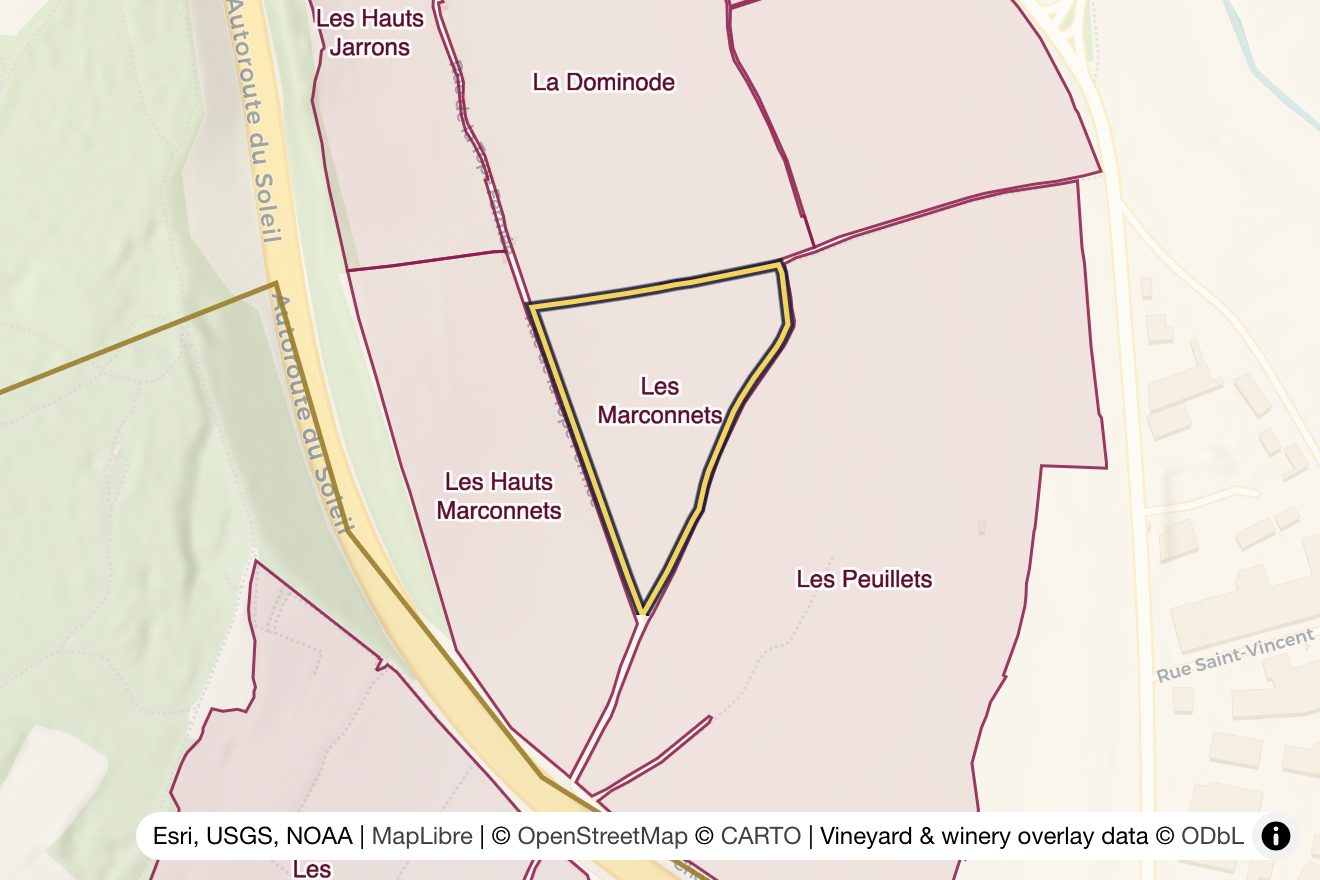
Les Marconnets is a premier cru climat of the Savigny-lès-Beaune appellation in the Côte de Beaune, one of the commune's 22 classified premier cru climats. It occupies the steep, east-facing flank at the southern edge of Savigny, on the right bank of the Rhoin stream, where the commune meets Beaune. The climat is planted to Pinot Noir and is contiguous with a Beaune premier cru of the same name across the commune boundary; the A6 autoroute crosses the hillside here. Savigny-lès-Beaune as a whole covers roughly 350 hectares of vines.
History
Savigny-lès-Beaune received its appellation d'origine contrôlée in 1937, and the premier cru framework that classified Les Marconnets dates from 1943. The modern landmark event for this corner of the appellation is the construction of the A6 autoroute, inaugurated in 1970 at the Savigny-lès-Beaune rest area by President Georges Pompidou. The road as built crosses the Marconnets hillside. Plantings in the climat span several generations: Domaine de la Vougeraie's oldest vines date from 1929-1930, and Domaine Simon Bize's parcel was planted in 1973.
Terroir & Climate
The climat lies on the Beaune-facing hillside below Mont Battois, with an east to southeast exposure on a slope that steepens toward the top. Soils are sandy and pebbly, notably rich in iron in the upper layers, with clayey silt that is only slightly calcareous; the base of the slope becomes more purely limestone, and sections of the vineyard carry deep sandy soil. Deep sandy soil holds little water, and cool vintages are said to suit the Bize parcel best. The separate climat of Les Hauts Marconnets sits higher on the same hill, where marl, chalk and limestone dominate.
Grape Varieties & Wine Styles
Les Marconnets is planted to Pinot Noir and produces red Savigny-lès-Beaune Premier Cru. The wines are among the firmer expressions of the appellation: structured, with solid tannin and dark red fruit, built for medium to long aging rather than early drinking. Simon Bize describes its Marconnets as a rich, meaty wine suited to cellaring. In neighboring Les Hauts Marconnets, the marl and chalk soils have led Chanson to plant Chardonnay, an exception within a commune dominated by red wine.
Notable Producers
Domaine Simon Bize et Fils farms 0.60 hectares planted in 1973, vinified with whole clusters and raised 18 months in barrel. Domaine de la Vougeraie farms 1.83 hectares across four plots under biodynamic viticulture. Maison Louis Latour produces a négociant bottling from vines averaging 35 years of age. Domaine Chanson farms 2.1 hectares of Chardonnay in the adjacent Les Hauts Marconnets.
What to Know
Two appellations sell wine labeled Marconnets: Savigny-lès-Beaune Premier Cru Les Marconnets and Beaune Premier Cru Les Marconnets. The Beaune climat covers 9.4 hectares at the northern extremity of Beaune's premier cru slope and is a separate appellation. Within Savigny, buyers should also distinguish Les Marconnets from Les Hauts Marconnets, a separate classified climat higher on the hill that includes white plantings. Savigny's vineyards divide into two flanks on either side of the Rhoin; Les Marconnets belongs to the Beaune side, which generally yields sturdier, slower-maturing wines than the Vergelesses side facing it.