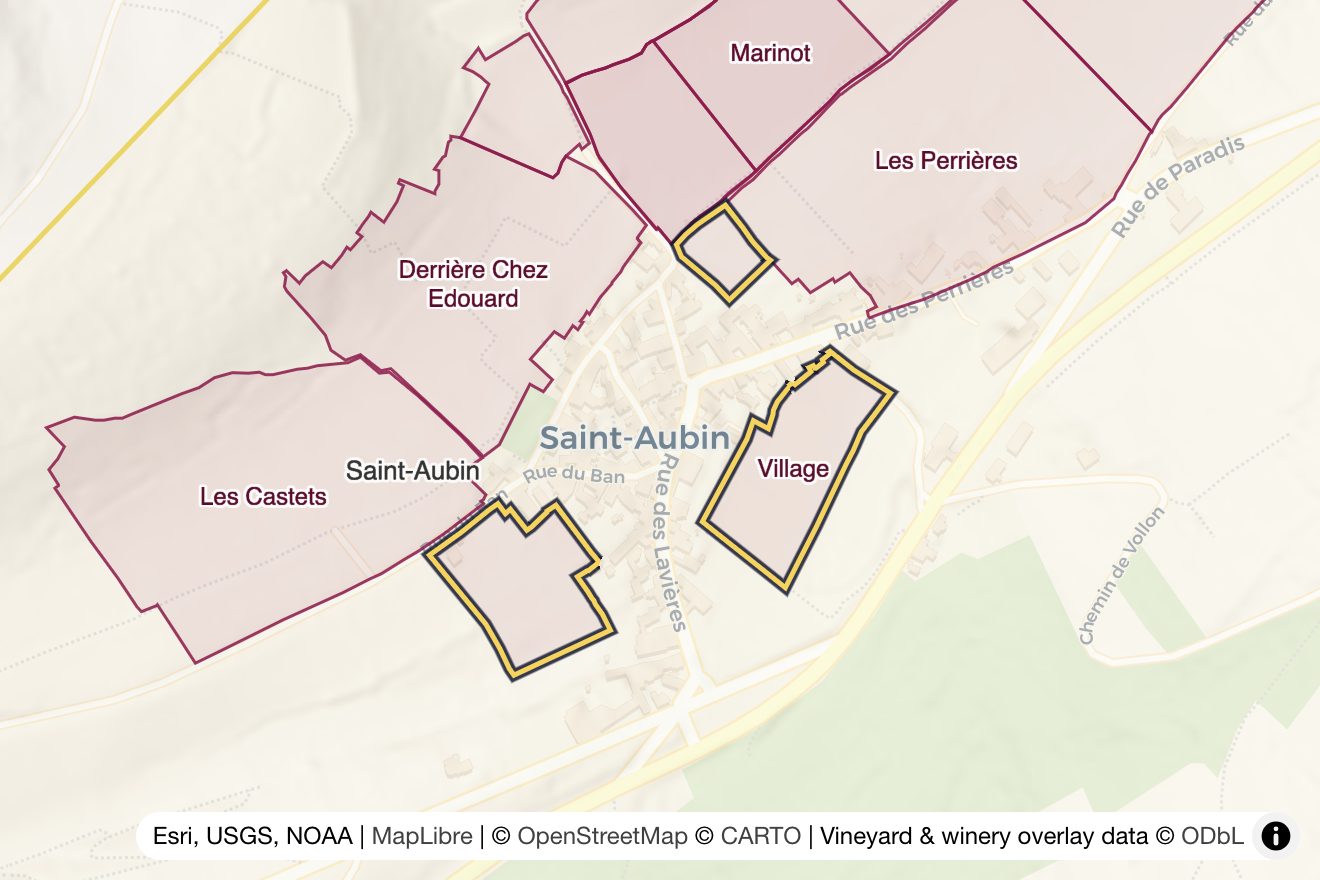
Overview & Location
Saint-Aubin itself occupies a unique position within the Côte de Beaune, situated in a side valley behind Puligny-Montrachet and Chassagne-Montrachet, forming part of the limestone amphitheater that characterizes this section of Burgundy's golden slope. The commune benefits from its proximity to these renowned white wine appellations while maintaining its own distinct character and terroir expression. Village, as one of Saint-Aubin's Premier Crus, sits in the appellation's top classification tier, showcasing the potential of this often-overlooked corner of the Côte de Beaune.
The climat's positioning within Saint-Aubin places it in direct geological and climatic continuity with some of Burgundy's most celebrated vineyard sites, yet it maintains characteristics that are uniquely its own. The vineyard's location on the mid-slope provides optimal exposure while benefiting from the protective influence of the surrounding topography, creating conditions that favor the production of wines of remarkable finesse and complexity.
Size
Premier Cru Village encompasses an area well short of Saint-Aubin's largest Premier Cru climats, such as En Remilly and La Chatenière. The vineyard's relatively generous size allows for some variation in terroir expression across different parcels, contributing to the complexity and nuance found in wines from this site.
The climat's boundaries are clearly delineated within the INAO classification system, with precise geographical limits that have been established through centuries of viticultural observation and legal codification. These boundaries encompass parcels that share fundamental geological and topographical characteristics while allowing for subtle variations that individual producers can exploit to create distinctive expressions of the site's terroir.
Terroir & Geology
The geological foundation of Premier Cru Village reflects the complex limestone substrata that characterizes the Côte de Beaune, with specific formations that distinguish it from neighboring sites. The vineyard sits on the Callovian and Oxfordian (Middle to Upper Jurassic) limestones and marls that underlie Saint-Aubin's slopes, with stony limestone soils that provide excellent drainage while retaining sufficient moisture for vine nutrition during drier periods.
The soil profile varies across the climat but generally consists of brown limestone soils with moderate clay content, and the topsoil depth varies, with shallower soils on the upper portions of the slope and deeper accumulations toward the base. This variation in soil depth contributes to differences in vine vigor and fruit concentration across the vineyard.
The underlying bedrock features fissured limestone that allows for deep root penetration while providing natural drainage that prevents waterlogging during heavy rainfall periods. Scattered throughout the soil profile are fossil fragments and limestone debris that contribute to the mineral complexity evident in wines from this site. The presence of iron-oxide deposits in certain sections adds subtle color variations to the soil and influences the wine's mineral expression.
The vineyard lies on a slope, providing optimal drainage while maintaining sufficient soil retention to support healthy vine growth. This moderate slope angle allows for effective mechanization where desired while ensuring that water runoff doesn't erode the precious topsoil. The aspect is predominantly southeast to south-southeast, providing excellent morning sun exposure while avoiding the most intense afternoon heat during summer months.
The climat lies within Saint-Aubin's vineyard band, which starts at about 300 meters above sea level, positioning it in the optimal zone for both Chardonnay and Pinot Noir cultivation. This elevation provides sufficient cooling influence to maintain acidity while ensuring adequate heat accumulation for full phenolic ripeness.
Climate & Microclimate
Premier Cru Village benefits from a favorable mesoclimate that combines the general continental climate characteristics of the Côte de Beaune with site-specific modifications created by local topography. The vineyard's southeast-facing orientation ensures optimal sun exposure during crucial morning hours, allowing for gentle warming of the vine canopy and promotion of photosynthetic activity.
The slope's position provides natural air drainage, preventing the accumulation of cold air and reducing frost risk during vulnerable spring periods. The surrounding topography creates a natural amphitheater effect that moderates temperature extremes while maintaining sufficient diurnal temperature variation to preserve acidity and promote aromatic development in the grapes.
Annual precipitation typically ranges from 700-800mm, with the vineyard's limestone soils and sloped position providing excellent natural drainage. The site's exposure and elevation create a microclimate that is slightly warmer than higher elevation sites but cooler than valley floor positions, resulting in an extended growing season that favors gradual ripening and flavor development.
Wind patterns in the area are generally favorable, with prevailing westerly winds providing ventilation that reduces humidity and disease pressure while avoiding excessive desiccation. The forest boundary above the vineyard provides some protection from harsh north winds while allowing beneficial air circulation.
The microclimate's characteristics make it particularly well-suited for Chardonnay production, though Pinot Noir also performs admirably in favorable parcels. The extended growing season and moderate temperatures allow for the retention of natural acidity while achieving full phenolic ripeness, resulting in wines with excellent aging potential and aromatic complexity.
Viticulture
Premier Cru Village is planted primarily to Chardonnay, with some parcels dedicated to Pinot Noir, reflecting the dual nature of Saint-Aubin as an appellation capable of producing both white and red wines of Premier Cru quality. The vineyard's terroir characteristics make it particularly well-suited for Chardonnay, which represents the majority of plantings and produces the most celebrated wines from this site.
Vine age across the climat varies considerably depending on the producer and parcel, with older and younger plantings side by side, providing an optimal balance between vine maturity and productive vigor. Older vine sections produce wines of particular concentration and complexity, while younger plantings contribute freshness and energy to the overall expression.
Planting density typically ranges from 10,000-12,000 vines per hectare, following traditional Burgundian practices that promote competition among vines and encourage deep rooting. The specific density often depends on the slope angle and soil depth, with higher densities employed on deeper soils and more moderate densities on shallow, rocky sections.
Viticultural practices in Village emphasize sustainable and traditional approaches, with most producers employing minimal intervention techniques that allow the terroir to express itself fully. Pruning follows the Guyot system primarily, with some producers using cordon training in specific parcels where vine age and vigor permit.
Canopy management is critical given the site's favorable growing conditions, with careful leaf removal timed to optimize sun exposure while preventing excessive grape exposure that could lead to sunburn or premature ripening. Green harvesting is practiced selectively, with yields typically maintained at 45-55 hectoliters per hectare for Chardonnay and slightly lower for Pinot Noir.
Site-specific challenges include managing vigor in deeper soil sections while ensuring adequate nutrition in shallower areas. The limestone soils can occasionally exhibit chlorosis in wet years, requiring careful attention to rootstock selection and soil management. Harvest timing is crucial, as the site's favorable exposition can lead to rapid sugar accumulation in warm years, potentially at the expense of acidity if not carefully monitored.
Wine Character & Style
Wines from Premier Cru Village display a distinctive character that combines the mineral precision expected from limestone terroir with the richness and complexity that mark the finest expressions of Saint-Aubin. Chardonnay from this climat typically exhibits a beautiful golden-tinged color with excellent clarity and brilliance, suggesting both concentration and elegance.
The aromatic profile of Village Chardonnay is notably complex, featuring primary fruit aromas of white peach, citrus zest, and green apple, complemented by distinctive mineral notes that reflect the limestone terroir. With bottle age, these wines develop beautiful secondary aromas including honey, hazelnut, and subtle spice notes, while maintaining their essential freshness and precision.
On the palate, wines from Village demonstrate excellent structure with a backbone of mineral-driven acidity that provides both immediate appeal and long-term aging potential. The texture is typically medium to full-bodied with a silky mouthfeel that speaks to the quality of the terroir and careful winemaking. The limestone influence is evident in the wine's crystalline precision and lengthy, mineral-laden finish.
The Pinot Noir produced from select parcels within Village displays characteristics that are distinctly different from the Chardonnay while sharing the site's fundamental mineral signature. These reds typically show bright ruby color with excellent transparency, aromatic profiles featuring red cherry, raspberry, and subtle earth notes, and palates that emphasize elegance over power.
What particularly distinguishes wines from Village is their ability to combine immediate accessibility with serious aging potential. The wines rarely display the austere minerality of some limestone sites, instead offering a harmonious integration of fruit, mineral, and structural elements that makes them appealing in youth while promising graceful evolution over 8-15 years for white wines and 10-20 years for the finest reds.
The site's terroir imparts a distinctive signature that experienced tasters can identify: a combination of citrus-tinged freshness, limestone minerality, and a subtle richness that speaks to the favorable exposition and soil depth. This signature remains consistent across different producers while allowing for stylistic interpretation.
Comparison to Surrounding Crus
Within Saint-Aubin's constellation of Premier Cru sites, Village occupies a distinctive position that differentiates it from neighboring climats through subtle but important terroir variations.
The contrast with Sur le Sentier du Clou is particularly instructive, as that climat's higher elevation and different exposition result in wines of greater austerity and slower development, whereas Village offers more immediate appeal while retaining serious aging potential. The difference reflects the nuanced terroir variations that make Burgundy so fascinating and complex.
When compared to La Chatenière, another significant Saint-Aubin Premier Cru, Village typically produces wines with more pronounced mineral character and greater structural precision, reflecting differences in soil composition and microclimate. La Chatenière wines often show more opulent fruit expression, while Village maintains a more restrained, terroir-driven profile.
En Remilly, located on different geological substrata, produces wines with distinctly different aromatic profiles and structural characteristics compared to Village. The limestone influence in Village creates wines with greater longevity and more complex mineral expression, while En Remilly often shows more immediate fruit appeal with different aging trajectories.
Saint-Aubin lacks Grand Cru sites, but the commune's best Premier Cru wines can compete favorably with Premier Cru sites in neighboring Puligny-Montrachet and Chassagne-Montrachet, offering similar complexity and aging potential at more accessible price points. The comparison reveals Village's exceptional value proposition within the broader Côte de Beaune hierarchy.
Notable Producers
Several distinguished producers craft exceptional wines from Premier Cru Village, each bringing their own interpretation to this remarkable terroir. Domaine Hubert Lamy is among Saint-Aubin's leading estates. Their approach emphasizes minimal intervention winemaking that allows the terroir's natural characteristics to shine, producing wines of remarkable purity and longevity.
Marc Colin et Fils is a leading Saint-Aubin producer. Their winemaking style emphasizes extended lees contact and judicious use of oak, resulting in wines with excellent texture and complexity while preserving the site's essential mineral character.
Domaine Jean-Claude Bachelet produces Village wines that exemplify the site's potential for creating profound, age-worthy Chardonnay. Their old-vine parcels yield wines of particular concentration and complexity, demonstrating how vine age can amplify the terroir's natural gifts.
Domaine Henri Prudhon is a Saint-Aubin producer. Their approach results in wines that are immediately appealing while possessing the structural foundation for extended cellaring.
Domaine Gérard Thomas is a Saint-Aubin producer whose Les Murgers des Dents de Chien shows the commune's freshness while maintaining its distinctive mineral signature.
Each producer's interpretation of Village reflects different philosophical approaches to winemaking while sharing a common respect for the site's terroir characteristics. The variations in style demonstrate the climat's complexity and its ability to support multiple valid interpretations of its essential character.
Historical Background & Classification
Premier Cru Village has been recognized as a site of exceptional quality for centuries, with documented vineyard cultivation in Saint-Aubin spanning many centuries. The climat's name itself reflects its historical importance within the community of Saint-Aubin, suggesting its central role in the commune's viticultural identity.
The Saint-Aubin appellation was recognized in 1937, and Village was later listed alongside other climats within the commune as deserving Premier Cru status. This classification reflected centuries of empirical observation regarding the site's consistent ability to produce wines of superior quality and distinctive character.
The site's reputation survived the challenges of phylloxera, world wars, and changing market conditions, testament to its fundamental quality and the dedication of generations of vignerons.
The delimitation of Village's boundaries involved careful analysis of soil types, exposition, and historical performance, ensuring that the Premier Cru classification encompassed only those parcels capable of producing wines worthy of the designation. This process, overseen by INAO, established the precise legal boundaries that define the climat today.
Throughout its history, Village has maintained its reputation as a reliable source of high-quality wines, even during periods when Saint-Aubin as a whole was overshadowed by its more famous neighbors. This consistency has contributed to growing recognition of the site's exceptional value proposition within the broader Burgundy landscape.
Aging Potential & Quality Level
Wines from Premier Cru Village demonstrate exceptional aging potential that rivals many more famous sites within the Côte de Beaune. Chardonnay from this climat typically reaches its first drinking plateau at 3-5 years after vintage, when the initial primary fruit characteristics have integrated with mineral and structural elements to create harmonious, complex wines.
The evolution trajectory for Village Chardonnay typically shows continued development over 8-12 years, with the finest examples capable of aging gracefully for 15 years or more. During this evolution, the wines develop increasing complexity while maintaining their essential freshness and mineral precision, a testament to the quality of the terroir and the natural acidity preserved during vinification.
Pinot Noir from Village follows a different but equally impressive aging curve, typically showing best between 5-10 years after vintage when tannins have softened and secondary aromas have developed. Exceptional vintages can continue evolving for 15-20 years, developing the complex tertiary characteristics that mark truly distinguished Burgundy.
Quality consistency within Village is remarkably high, with vintage variation typically affecting style more than fundamental quality. Even in challenging years, the site's favorable exposition and excellent drainage help maintain wine quality, while exceptional vintages produce wines that can compete with much more expensive sites.
The climat's limestone terroir provides the structural foundation necessary for extended aging, with the mineral acidity acting as a preservative that maintains freshness while allowing flavor development. This combination of longevity potential and drinking pleasure makes Village wines particularly attractive to both collectors and enthusiasts seeking age-worthy Burgundy at reasonable prices.
Market recognition of Village's quality continues to grow as consumers discover the exceptional value offered by this distinguished Premier Cru site, suggesting that its historical reputation for excellence will continue into the future.