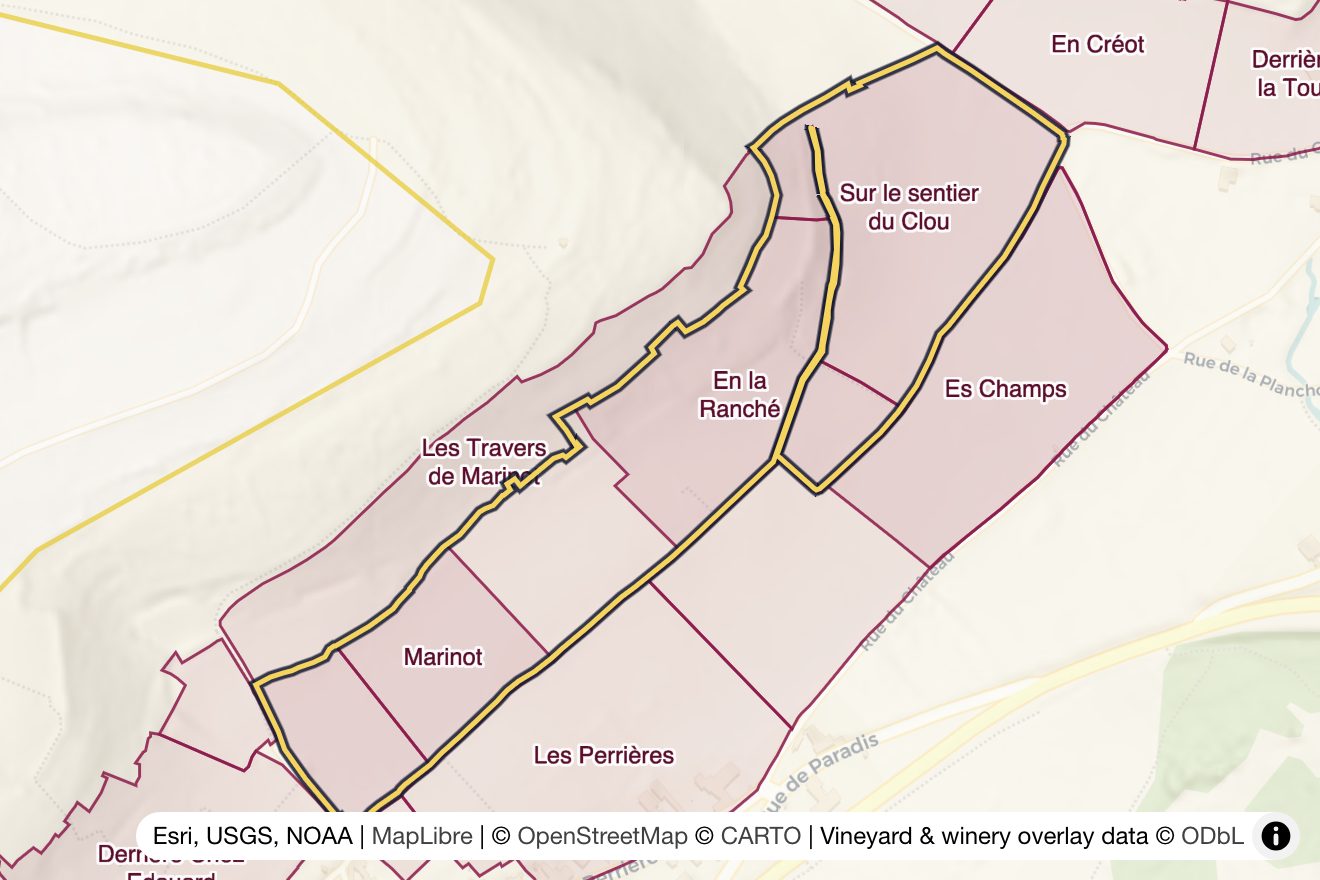
Overview & Location
The vineyard is positioned on the eastern slopes above the village of Saint-Aubin, forming part of the amphitheater-like configuration of vineyards that characterizes this appellation. Saint-Aubin itself occupies a unique position in the Côte de Beaune hierarchy, often described as the "hidden jewel" of the region due to its proximity to the Grand Cru vineyards of its illustrious neighbors while maintaining relatively accessible pricing and exceptional quality potential.
Sur le Sentier du Clou specifically lies in the northern section of Saint-Aubin's Premier Cru vineyards, creating a natural continuation of the geological formations that define the most prestigious sites in neighboring communes. This positioning allows the climat to capture many of the same terroir characteristics that have made Chassagne-Montrachet and Puligny-Montrachet world-renowned, while expressing its own distinct personality shaped by subtle but significant variations in elevation, exposure, and soil composition.
Size
Sur le Sentier du Clou encompasses several hectares, making it a moderately sized Premier Cru within Saint-Aubin's portfolio. This size places it among the mid-range Premier Cru vineyards in the commune, neither as expansive as some of the larger climats nor as restrictively small as the most exclusive parcels. The vineyard's dimensions allow for meaningful diversity in microclimates and soil variations across different sections, contributing to the complexity that can be achieved in wines from this site.
The relatively contained size of the vineyard means that it is divided among a limited number of producers, each typically holding parcels ranging from a few rows to several hectares. This concentrated ownership structure often leads to more focused vineyard management and allows individual producers to develop intimate knowledge of their specific sections of the climat, resulting in wines that can express subtle variations within the broader terroir profile of Sur le Sentier du Clou.
Terroir & Geology
The geological foundation of Sur le Sentier du Clou represents a classic expression of Côte de Beaune terroir, built upon the Jurassic limestone formations that define Burgundy's greatest vineyards. The bedrock consists primarily of Bathonian and Bajocian limestone, dating back approximately 165-170 million years, providing the mineral backbone that characterizes wines from this climat.
The soil profile reveals fascinating complexity across different sections of the vineyard. The upper portions feature shallow topsoils over fractured limestone, creating excellent drainage while forcing vine roots to penetrate deeply into the rock below. This geological stress contributes to the mineral intensity and longevity potential found in wines from these sections. Moving down the slope, the soil deepens slightly, incorporating more clay content mixed with limestone fragments and fossilized marine sediments.
Clay content varies notably across the vineyard, differing between the upper and lower sections. This variation significantly influences the style and character of wines produced from different parcels. Higher clay content areas tend to produce wines with greater structure and aging potential, particularly beneficial for Pinot Noir, while the more limestone-dominant sections often yield wines of exceptional elegance and mineral precision.
The slope characteristics of Sur le Sentier du Clou are particularly favorable, with gradients ranging from 8-15% across different sections. This moderate but consistent slope ensures excellent drainage while preventing excessive erosion, allowing for sustainable soil development over centuries. The aspect is predominantly east-southeast, providing optimal morning sun exposure while offering some protection from the harsh afternoon heat that can stress vines during warm vintages.
Elevation ranges from approximately 280 to 350 meters above sea level, positioning the vineyard in the sweet spot for both Pinot Noir and Chardonnay cultivation. This elevation provides sufficient cooling influence to maintain acidity and elegance while ensuring adequate warmth for proper phenolic ripening. The geological formation includes occasional outcrops of harder limestone that create natural terraces, contributing to the site's drainage characteristics and adding to the mineral complexity available to vine roots.
Climate & Microclimate
Sur le Sentier du Clou benefits from a continental climate moderated by its position within the Côte de Beaune's protected valley system. The climat experiences the classic Burgundian pattern of cold winters, warm summers, and crucial diurnal temperature variations that allow for extended ripening periods while maintaining natural acidity in the grapes.
The vineyard's east-southeast exposure creates a particularly favorable microclimate, capturing the gentle morning sun that gradually warms the vine canopy and promotes even bud break in spring. This orientation provides protection from the prevailing westerly winds while avoiding the intense afternoon heat that can lead to excessive alcohol levels and loss of aromatic complexity. The morning sun exposure is crucial for drying dew and preventing fungal pressure, a constant concern in Burgundy's humid climate.
Temperature moderation comes from several sources within the microclimate. The elevation provides natural cooling, with temperatures typically running 1-2°C cooler than vineyards at the valley floor. The limestone soils contribute to temperature regulation, absorbing heat during the day and releasing it slowly at night, creating more gradual temperature transitions that benefit grape development.
Air circulation across Sur le Sentier du Clou is generally excellent due to the slope and exposure, reducing the risk of frost damage in spring and promoting healthy vine development throughout the growing season. The vineyard sits high enough to benefit from air drainage that prevents cold air from pooling, yet remains protected from the strongest winds that can damage vine canopies.
Rainfall patterns interact favorably with the vineyard's terroir, as the well-draining limestone soils prevent waterlogging during wet periods while the clay components provide sufficient water retention during dry spells. This natural water regulation system allows vines to maintain consistent growth patterns without the dramatic stress cycles that can compromise grape quality.
Viticulture
Sur le Sentier du Clou is planted to both Pinot Noir and Chardonnay, reflecting Saint-Aubin's versatility in producing exceptional wines from both varieties. The proportion varies among different producers, but typically Chardonnay represents approximately 60-70% of plantings, with Pinot Noir comprising the remainder. This distribution reflects both the terroir's natural affinity for white grape varieties and market demand patterns.
Vine age across the climat varies significantly, with some parcels containing vines planted in the 1940s and 1950s, while others feature more recent plantings from the 1980s and 1990s. The older vines, particularly those exceeding 40 years of age, consistently produce the most complex and age-worthy wines, their deep root systems accessing mineral layers unavailable to younger plantings. Many producers maintain a careful replanting schedule to preserve sections of old vines while ensuring vineyard continuity.
Planting density typically ranges from 10,000 to 12,000 vines per hectare, following traditional Burgundian practices that promote competition among vines while ensuring adequate sunlight penetration for ripening. The spacing reflects the moderate slope and soil depth, allowing for mechanization where appropriate while maintaining the density necessary for quality concentration.
Viticultural practices in Sur le Sentier du Clou emphasize sustainable and increasingly organic approaches. Many producers have eliminated or dramatically reduced herbicide use, instead employing mechanical cultivation and cover crops to maintain soil health. Canopy management focuses on achieving optimal leaf-to-fruit ratios through careful pruning, debudding, and selective leaf removal.
Harvest timing represents one of the most critical decisions for Sur le Sentier du Clou producers. The climat's favorable exposure and drainage typically allow for extended hang time, enabling producers to achieve full phenolic ripeness while maintaining natural acidity levels. Chardonnay is usually harvested in mid to late September, while Pinot Noir may continue into early October depending on vintage conditions.
Site-specific viticultural challenges include managing the varying clay content across different parcels, which can affect vine vigor and ripening patterns. Producers must adapt their canopy management and yield control practices to account for these variations. The limestone content, while beneficial for wine quality, can make certain vineyard operations more challenging due to the rocky soils.
Wine Character & Style
Wines from Sur le Sentier du Clou express a distinctive personality that combines the mineral precision of great Côte de Beaune terroir with the approachable elegance that characterizes the finest Saint-Aubin Premier Crus. The climat produces wines of notable consistency while allowing for meaningful expression of vintage variation and winemaking philosophy.
Chardonnay from Sur le Sentier du Clou typically displays exceptional mineral clarity, with a distinctive limestone-driven backbone that provides structure and aging potential. The aromatics often feature precise citrus notes (lemon zest, lime, and occasionally grapefruit) complemented by white stone fruits including pear, apple, and sometimes white peach. Oak integration, when employed, tends to be seamless, contributing subtle vanilla and spice notes without overwhelming the inherent fruit character.
The mineral profile of Sur le Sentier du Clou Chardonnay is particularly distinctive, showing wet stone, crushed shells, and occasionally flint-like characteristics that reflect the limestone-rich terroir. These mineral notes become more pronounced with age, often developing into complex saline and iodine characteristics that speak to the ancient marine origins of the soil.
Textural elements in the Chardonnay include a characteristic tension between richness and precision. The wines possess sufficient weight and concentration to satisfy those seeking substantial white Burgundy while maintaining the acid structure and mineral drive that promote long aging. The mouthfeel often exhibits a distinctive chalkiness that coats the palate without heaviness, creating wines of remarkable persistence and complexity.
Pinot Noir from Sur le Sentier du Clou expresses the variety's potential for elegance and complexity within the Saint-Aubin terroir. The wines typically show red fruit characteristics (cherry, raspberry, and strawberry) often accompanied by floral notes including violet and rose petal. The clay components in the soil contribute to structure and tannin development, creating wines with excellent aging potential while maintaining approachability in their youth.
The aromatic complexity of Sur le Sentier du Clou Pinot Noir often includes earthy undertones (forest floor, mushroom, and wet leaves) that develop with age into more complex tertiary characteristics. Spice notes, including black pepper, cinnamon, and clove, frequently appear and become more integrated with cellaring.
Structurally, the Pinot Noir demonstrates the terroir's ability to produce wines of substance without heaviness. Tannins are typically fine-grained and well-integrated, providing structure for aging while allowing the wine's fruit and mineral characteristics to shine. Acidity levels are generally well-balanced, supporting both food compatibility and long-term cellaring potential.
Comparison to Surrounding Crus
Sur le Sentier du Clou occupies a distinctive position within Saint-Aubin's Premier Cru hierarchy, expressing characteristics that distinguish it from neighboring climats while sharing fundamental terroir similarities with the broader appellation. Compared to Les Murgers des Dents de Chien, perhaps Saint-Aubin's most celebrated Premier Cru, Sur le Sentier du Clou typically produces wines of greater immediate approachability while sacrificing little in terms of aging potential or complexity.
The contrast with La Chatenière, another highly regarded Saint-Aubin Premier Cru, reveals Sur le Sentier du Clou's tendency toward greater mineral precision and limestone expression. While La Chatenière often shows more obvious richness and power, particularly in Chardonnay, Sur le Sentier du Clou emphasizes finesse and terroir transparency. This difference likely reflects variations in soil depth and clay content between the two sites.
When compared to En Remilly, Sur le Sentier du Clou consistently demonstrates greater aging potential and structural complexity. En Remilly produces charming, accessible wines that peak relatively early, while Sur le Sentier du Clou develops more slowly and can improve for decades in favorable vintages.
The relationship to Premier Crus in neighboring Chassagne-Montrachet and Puligny-Montrachet reveals interesting parallels and contrasts. Sur le Sentier du Clou Chardonnay often shows similarities to certain Chassagne-Montrachet Premier Crus, particularly in its mineral drive and aging trajectory, though typically with less immediate power and concentration. The comparison to Puligny-Montrachet Premier Crus highlights Sur le Sentier du Clou's emphasis on mineral precision over overt richness.
While Saint-Aubin contains no Grand Cru vineyards, the wines are often compared with those of the neighboring Montrachet villages. This relationship has led some critics to describe the finest Sur le Sentier du Clou wines as offering "Grand Cru character at Premier Cru prices."
Notable Producers
Several distinguished producers craft wines from Sur le Sentier du Clou, each bringing their own interpretation to this expressive terroir. Domaine Joseph Colin, Domaine Henri Prudhon and Domaine Antoine Jobard are among the producers that bottle this climat.
Domaine Marc Colin maintains smaller holdings within Sur le Sentier du Clou but produces wines of remarkable intensity and precision. Their approach emphasizes minimal intervention winemaking that allows the terroir to speak clearly, resulting in wines that showcase the mineral complexity and aging potential of the site. The Colin family's meticulous attention to harvest timing and gentle extraction techniques produces wines that consistently rank among the finest expressions of this climat.
Several smaller producers and négociant houses also source fruit from Sur le Sentier du Clou, though the quality and consistency of these bottlings can vary significantly depending on the specific parcels involved and winemaking approaches employed. The limited size of the vineyard means that total production remains relatively small, contributing to the wines' exclusivity and collectibility.
Historical Background & Classification
The history of Sur le Sentier du Clou reflects the broader development of Saint-Aubin as a recognized quality wine region within Burgundy's complex appellation system.
The name "Sur le Sentier du Clou" translates approximately to "on the path of the nail," though the specific historical origin of this designation remains somewhat unclear. Local tradition suggests it may reference an ancient boundary marker or pathway that crossed the vineyard, while other interpretations point to geological features that resembled nail-like formations.
Recognition of the site's quality potential developed gradually over centuries, with wines from this climat gaining regional reputation during the 18th and 19th centuries. However, like many Saint-Aubin vineyards, Sur le Sentier du Clou remained relatively obscure compared to the famous sites in neighboring communes, despite producing wines of comparable quality.
The formal classification of Sur le Sentier du Clou as a Premier Cru occurred in 1970, as part of the broader recognition of Saint-Aubin's vineyard hierarchy within the Burgundy appellation system. This classification represented the culmination of decades of quality demonstration and advocacy by local producers who recognized the terroir's exceptional potential.
The relatively recent Premier Cru classification means that Sur le Sentier du Clou lacks the centuries-old reputation of some Burgundy sites, but this has also contributed to more accessible pricing and greater experimentation with winemaking approaches. Modern producers have been able to develop the site's reputation based purely on wine quality rather than historical prestige.
Aging Potential & Quality Level
Sur le Sentier du Clou produces wines with exceptional aging potential, particularly the Chardonnay bottlings, which can develop and improve for 15-20 years or more in favorable vintages. The limestone-rich terroir provides the mineral backbone necessary for long-term cellaring, while the natural acidity levels ensure that the wines maintain freshness and vitality throughout their evolution.
Chardonnay from this climat typically shows its best between 5-12 years after vintage, though the finest examples can continue improving well beyond this range. Early development focuses on the integration of oak influences and the emergence of secondary aromatics, while extended aging reveals the full mineral complexity and tertiary characteristics that define great white Burgundy.
The aging trajectory of Sur le Sentier du Clou Chardonnay follows a classic pattern: initial fruit-forward character gives way to more complex nutty and honeyed notes around year 3-5, followed by the development of profound mineral characteristics and increasing textural complexity. Wines that receive extended lees aging during production often show even greater longevity potential.
Pinot Noir from Sur le Sentier du Clou generally peaks earlier than the Chardonnay, typically showing its best between 3-10 years after vintage. However, wines from exceptional vintages and low-yielding old vines can continue developing for 15 years or more. The aging process reveals increasing complexity in both aromatics and texture, with primary fruit characteristics evolving into more complex earthy and spice-driven profiles.
Quality consistency across vintages is generally high, reflecting both the favorable terroir characteristics and the skill of the producers working with this climat. Even challenging vintages typically produce wines of notable quality, though with different aging trajectories and peak drinking windows. The site's excellent drainage and favorable exposure help mitigate vintage variation while allowing for clear expression of yearly climatic differences.
The quality level of Sur le Sentier du Clou wines places them firmly within the upper tier of Saint-Aubin Premier Crus, capable of competing favorably with many wines from more prestigious appellations. This quality-to-price ratio has contributed to growing recognition among knowledgeable collectors and critics, suggesting that the climat's reputation will continue to develop as more consumers discover its exceptional wines.