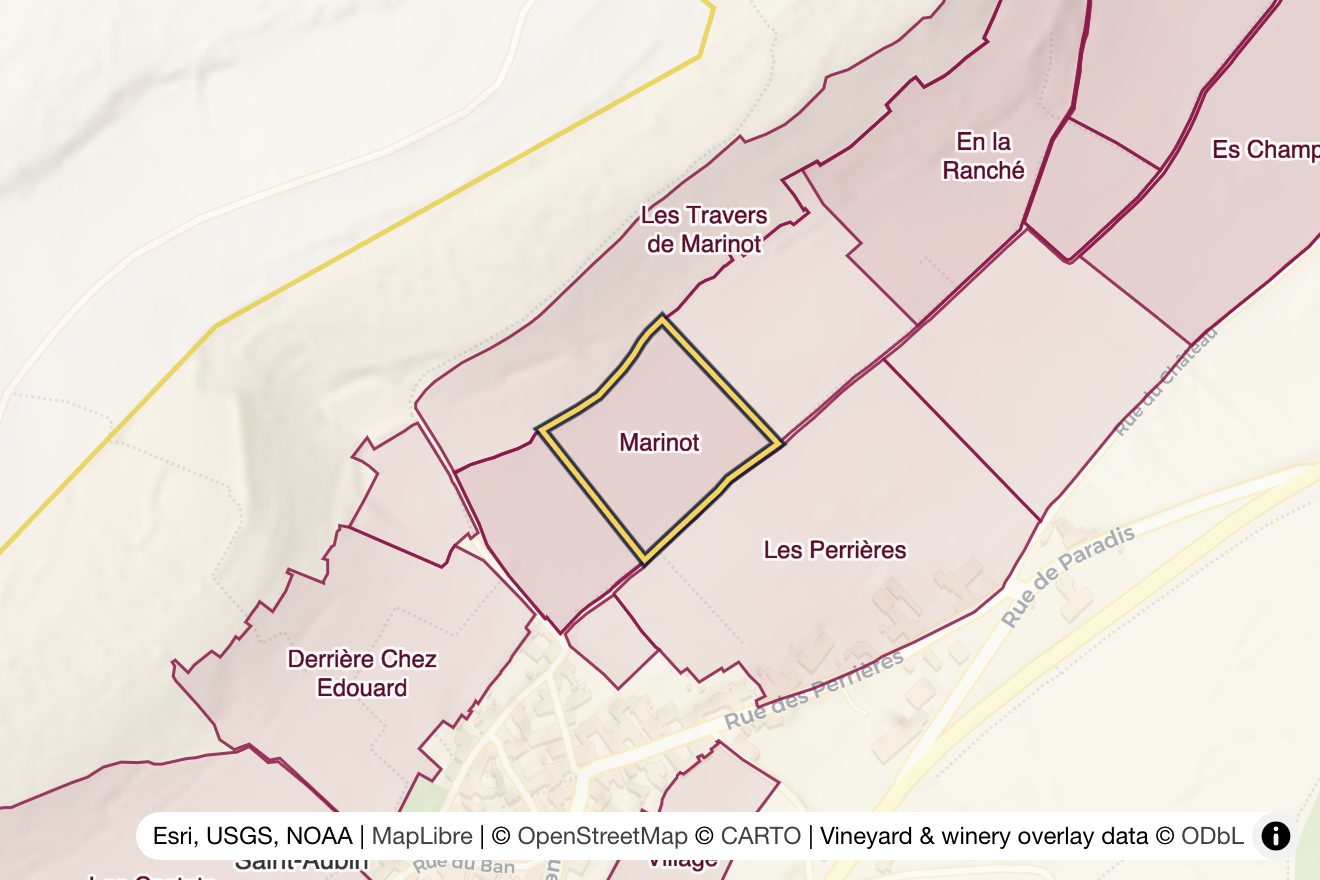
Overview & Location
The Marinot climat sits in the northern sector of Saint-Aubin's Premier Cru holdings, positioned strategically to capture optimal sun exposure while benefiting from the commune's unique geological foundation. This vineyard forms part of the broader amphitheater of slopes that characterizes the Côte de Beaune, where the Jurassic limestone bedrock creates the foundation for some of Burgundy's most celebrated terroirs.
Within Saint-Aubin's portfolio of Premier Cru sites, Marinot occupies a particularly interesting position, sharing geological characteristics with some of the commune's most esteemed vineyards while maintaining its own distinct personality. The vineyard's location places it within the geological continuity that extends from the grand cru vineyards of Montrachet, though at a higher elevation and with different exposition characteristics that create its unique terroir signature.
Size
The Marinot Premier Cru encompasses approximately 3.2 hectares (7.9 acres), making it a moderately sized climat within Saint-Aubin's Premier Cru hierarchy. This relatively intimate scale is typical of Burgundy's vineyard classification system, where individual terroir expressions are preserved through precise delimitation of superior sites.
The vineyard's compact size contributes to its terroir homogeneity, as the entire climat benefits from similar geological, topographical, and climatic conditions. This consistency allows for a more unified expression of site character, though individual producers' parcels within Marinot can still display subtle variations based on exact positioning, vine age, and viticultural practices.
Terroir & Geology
Marinot's geological foundation rests upon the classic Jurassic limestone formations that define the Côte de Beaune's finest sites. The vineyard sits on Bathonian and Bajocian limestone, with the bedrock consisting primarily of hard limestone overlaid with varying depths of clay-limestone soils. This geological structure provides both excellent drainage and mineral complexity that translates directly into wine character.
The soil composition in Marinot shows a heterogeneous mix of limestone debris, clay, and iron-rich elements. The clay content varies throughout the vineyard, typically ranging from 15-25%, providing sufficient water retention during dry periods while maintaining the drainage characteristics essential for quality viticulture. The limestone component, which dominates the soil profile, contributes the mineral backbone that defines great Burgundian terroirs.
The vineyard faces primarily east and southeast, with slopes ranging from 8-12% gradient. This orientation provides excellent morning sun exposure while offering some protection from the harsh afternoon heat during summer months. The elevation ranges from approximately 280-320 meters above sea level, positioning Marinot higher than many of the grand cru sites in neighboring communes while maintaining the benefits of hillside viticulture.
Geological analysis reveals the presence of fossilized marine materials within the limestone matrix, remnants of the ancient Tethys Sea that once covered this region. These fossil inclusions contribute additional mineral complexity and are believed to influence the distinctive saline minerality often found in wines from this climat. The soil depth varies across the vineyard, with deeper soils in the lower sections transitioning to thinner, rockier soils toward the upper slopes.
Climate & Microclimate
Marinot benefits from a continental climate modified by oceanic influences, typical of the Côte de Beaune but with specific microclimate characteristics shaped by its elevation and exposition. The vineyard's eastern exposure ensures early morning warming, which promotes photosynthesis and helps achieve optimal ripeness even in challenging vintages.
The elevation of Marinot creates a distinct microclimate compared to lower-lying vineyards in the region. Temperatures tend to be 1-2 degrees Celsius cooler than those found in the grand cru sites of Montrachet, resulting in a longer growing season and enhanced retention of natural acidity in the grapes. This temperature differential becomes particularly significant during the crucial ripening period from August through October.
Wind patterns play a crucial role in Marinot's microclimate. The vineyard benefits from good air circulation, which helps prevent fungal diseases and creates more consistent ripening conditions. The breezes that flow through the valley help moderate extreme temperatures and contribute to the development of aromatic complexity in the grapes.
Precipitation patterns in Marinot follow the regional norm, with approximately 750mm of annual rainfall. However, the vineyard's elevation and slope orientation can create variations in water stress patterns throughout the growing season. The limestone-based soils provide excellent drainage during wet periods while offering sufficient water retention during dry spells, creating relatively consistent growing conditions from year to year.
Viticulture
Marinot is planted exclusively to Chardonnay, reflecting Saint-Aubin's reputation for producing exceptional white wines that rival those from more famous neighboring communes. The vineyard's terroir characteristics make it particularly well-suited to this noble variety, which responds excellently to the limestone-rich soils and favorable microclimate conditions.
Vine age in Marinot varies considerably among different parcels and producers, with some sections containing vines over 40 years old while others feature more recently replanted areas. The older vine sections, particularly those planted in the 1970s and 1980s, tend to produce wines with greater depth and mineral complexity, as the established root systems have penetrated deep into the limestone bedrock.
Planting density typically ranges from 10,000-12,000 vines per hectare, following traditional Burgundian practices that promote competition among vines and encourage deep root development. The training systems employed are predominantly Guyot simple, with some producers utilizing Guyot double in specific parcels where vine vigor requires additional shoot distribution.
Viticultural practices in Marinot have evolved significantly over recent decades, with most producers now following sustainable or organic farming principles. The vineyard's elevation and good air circulation make it less susceptible to certain fungal diseases, allowing for reduced chemical interventions. However, the limestone soils can be prone to chlorosis in certain years, requiring careful attention to vine nutrition and rootstock selection.
Site-specific challenges include managing water stress during dry vintages, as the well-draining limestone soils can lead to vine stress if precipitation is insufficient. Additionally, the vineyard's exposition makes frost protection crucial during spring, with several producers employing various frost protection measures including heaters and wind machines.
Wine Character & Style
Wines from Marinot display a distinctive character that bridges the gap between the power of great white Burgundy and the elegance that defines Saint-Aubin's style. The Chardonnay produced from this climat typically shows exceptional mineral precision, with a characteristic limestone-driven backbone that provides structure and aging potential.
Aromatically, Marinot wines often display citrus notes of lemon and lime zest, complemented by white flower characteristics including acacia and hawthorn. With age, these wines develop more complex aromatics including honey, beeswax, and subtle oxidative notes that add depth without overwhelming the terroir expression. The mineral component manifests as a distinctive wet stone or chalk-like quality that becomes more pronounced with cellar aging.
On the palate, Marinot wines demonstrate excellent balance between richness and freshness. The natural acidity, preserved by the vineyard's elevation and eastern exposure, provides a vibrant framework that supports both immediate drinking pleasure and long-term aging potential. The texture is typically medium-bodied with a distinctive mineral tension that creates length and complexity on the finish.
The limestone terroir contributes a specific salinity that distinguishes Marinot from other Saint-Aubin Premier Crus. This mineral character provides structure without heaviness, creating wines that are both intellectually satisfying and gastronomically versatile. The finish often displays a characteristic bitter almond note that is typical of great Chardonnay grown on limestone soils.
Vintage variation in Marinot tends to be less extreme than in some other Burgundy sites, thanks to the vineyard's favorable exposition and soil characteristics. Even in challenging vintages, the wines maintain their essential character while reflecting the specific conditions of each year.
Comparison to Surrounding Crus
Within Saint-Aubin's Premier Cru hierarchy, Marinot occupies a distinctive position that sets it apart from neighboring climats. Compared to Les Frionnes, located on similar slopes but with slightly different soil composition, Marinot wines tend to show greater mineral precision and aging potential, with less immediate fruit expression but more profound depth.
When compared to En Remilly, another esteemed Saint-Aubin Premier Cru, Marinot displays more restraint and classical structure. En Remilly's wines often show more opulent fruit character and earlier drinking appeal, while Marinot requires more patience to reveal its full complexity. The limestone influence is more pronounced in Marinot, creating wines with greater longevity potential.
Relative to the Premier Cru Sur le Sentier du Clou, Marinot shows more consistency across vintages and producers. The geological homogeneity of Marinot creates more predictable wine styles, whereas Sur le Sentier du Clou can vary more significantly based on specific parcel location within the climat.
Comparing Marinot to the grand cru sites in neighboring Puligny-Montrachet and Chassagne-Montrachet reveals both similarities and distinctions. While lacking the ultimate concentration and complexity of sites like Montrachet or Bâtard-Montrachet, Marinot wines share the limestone-driven minerality and aging potential that define great white Burgundy. The primary differences lie in intensity and complexity rather than fundamental character, making Marinot an excellent introduction to the terroir expressions found in the region's most celebrated sites.
Notable Producers
Several distinguished producers hold parcels in Marinot, each bringing their own interpretation to this distinctive terroir. Domaine Hubert Lamy is widely regarded as one of Saint-Aubin's finest producers.
Domaine Marc Colin et Fils is a leading Saint-Aubin producer. The Colin family has a long history in Saint-Aubin.
Domaine Jean-Claude Bachelet et Fils is a traditional Saint-Aubin producer.
Several smaller producers and négociant houses also work with Marinot fruit, creating stylistic diversity within the climat's production. These variations demonstrate how different winemaking approaches can highlight various aspects of the terroir while maintaining the fundamental characteristics that define Marinot's identity.
Historical Background & Classification
Marinot's history as a recognized superior site extends back several centuries, though detailed documentation becomes more precise from the 18th century onward. Historical records indicate that this vineyard was recognized for producing wines of superior quality well before the modern classification system was established.
The climat holds Premier Cru status under the INAO classification of Saint-Aubin's vineyards, first set out in 1943 and updated in 1970. This classification recognized what local vignerons had long understood: that Marinot possessed terroir characteristics capable of producing wines significantly superior to the commune's village-level sites.
The name "Marinot" likely derives from local dialectical terms related to the vineyard's position or historical ownership, though the exact etymology remains somewhat unclear. Historical tax records from the 19th century show consistent recognition of Marinot as a premium site within Saint-Aubin, with land values reflecting its superior status.
During the phylloxera crisis of the late 19th century, Marinot was among the first Saint-Aubin sites to be replanted, indicating the local recognition of its value. The choice of rootstocks and clonal selection during this replanting period influenced the vineyard's development and contributed to establishing the modern character of wines from this climat.
The 20th century saw gradual improvements in viticultural practices and winemaking techniques that allowed Marinot to fully express its potential. The classification as Premier Cru formalized what generations of local vignerons had recognized and helped establish Marinot's reputation in broader wine markets.
Aging Potential & Quality Level
Marinot demonstrates exceptional aging potential for a Saint-Aubin Premier Cru, with well-made examples capable of developing positively for 10-15 years or more in appropriate cellaring conditions. The wine's natural acidity and mineral structure provide the foundation necessary for extended aging, while the limestone terroir contributes preservative qualities that help maintain freshness over time.
Young Marinot wines often show restraint and require 2-3 years after vintage to begin revealing their complexity. The primary fruit characteristics gradually integrate with the mineral elements, creating more sophisticated flavor profiles that justify the vineyard's Premier Cru status. Peak drinking typically occurs between 5-10 years after vintage, though exceptional examples can continue developing for considerably longer periods.
Quality consistency in Marinot has improved significantly over recent decades as producers have gained better understanding of the site's requirements and potential. Modern viticultural practices, combined with more precise winemaking techniques, have reduced vintage variation and elevated average quality levels across all producers working with this terroir.
The limestone-rich terroir contributes to quality consistency by providing natural buffering against extreme vintage conditions. Even in challenging years, Marinot maintains its essential character and produces wines worthy of its Premier Cru classification, though the specific expression may vary based on seasonal conditions.
Temperature-controlled fermentation and careful oak management have become standard practices among quality-focused producers, allowing the terroir characteristics to express themselves more clearly while adding complementary complexity. The result has been wines that better represent Marinot's unique position within Saint-Aubin's terroir hierarchy and justify the vineyard's growing reputation among serious Burgundy enthusiasts.
Investment in vineyard management and cellar technology among Marinot producers has elevated quality levels to the point where the best examples compete favorably with Premier Cru sites from more famous communes, offering exceptional value for consumers seeking authentic terroir expression at accessible price points.