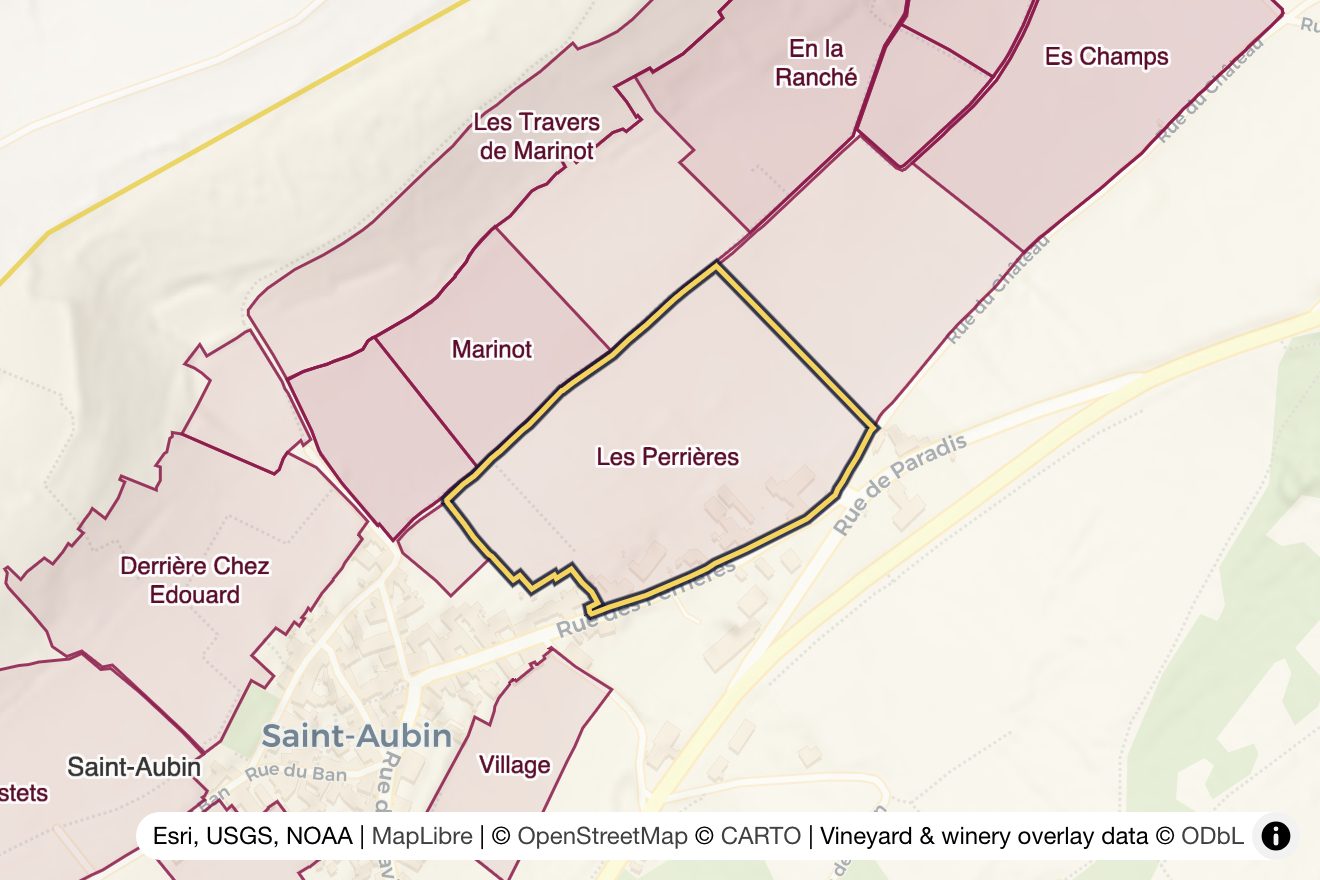
Overview & Location
The vineyard's location is particularly significant within Burgundy's complex geographical tapestry. Situated in a side valley behind the Montrachet hill, Saint-Aubin exists in what might be considered a transitional zone, where the limestone-rich soils that favor Chardonnay cultivation begin to give way to the clay and iron-rich terroirs more suited to Pinot Noir. Les Perrières produces mainly white wine from Chardonnay, with a little red from Pinot Noir, though it is the former that has earned the vineyard its stellar reputation.
The Premier Cru sits at elevations ranging from 280 to 320 meters above sea level, positioned on slopes that face predominantly east and southeast. This orientation is crucial to the vineyard's success, providing optimal morning sun exposure while protecting the vines from the potentially damaging effects of excessive afternoon heat. The vineyard's east to southeast facing slope, in the Frionnes area, creates a unique mesoclimate that contributes significantly to the distinctive character of wines produced here.
Size
Les Perrières is a small Premier Cru climat. This substantial size allows for considerable diversity within the climat itself, with different parcels expressing varying characteristics based on their specific exposition, elevation, and soil composition. The vineyard is divided among numerous proprietors, with holdings ranging from small family domaines controlling less than a hectare to larger négociant houses with more substantial parcels.
However, this size also necessitates careful vineyard management and precise winemaking to ensure consistency across different parcels while respecting the unique characteristics of individual plots.
The climat is planted mainly to Chardonnay, with a little Pinot Noir. This distribution reflects both historical precedent and optimal terroir matching, with the cooler, higher-elevation eastern-facing slopes typically reserved for Chardonnay, while the slightly warmer, lower-elevation parcels are often planted to Pinot Noir.
Terroir & Geology
The geological foundation of Les Perrières is built upon the classic Jurassic limestone formations that characterize the finest white wine terroirs of Burgundy. The vineyard sits atop the Bathonian stage of the Middle Jurassic period, specifically the Dalle Nacrée formation, which consists of hard, cream-colored limestone rich in fossilized marine organisms. This substrate is a Middle Jurassic limestone like that of the nearby Chassagne-Montrachet and Puligny-Montrachet slopes, explaining the exceptional quality potential of Les Perrières Chardonnays.
The topsoil composition varies significantly across the vineyard, creating distinct terroir zones that influence wine style and character. In the upper portions of the vineyard, the soil is notably shallow, with limestone bedrock often visible just centimeters below the surface. These areas, characterized by excellent drainage and minimal topsoil depth, typically produce wines of exceptional minerality and precision, though yields are naturally restricted.
Moving down the slope, the soil profile becomes more complex, with increased clay content and greater depth. Here, the brown limestone soils (known locally as "terres brunes") contain higher percentages of iron oxide and clay minerals, creating conditions that favor both Chardonnay and Pinot Noir cultivation. The clay content provides necessary water retention during dry periods while maintaining sufficient drainage to prevent waterlogging during wet seasons.
The presence of numerous small stones and limestone fragments throughout the soil profile serves multiple viticultural functions. These elements improve drainage, reflect sunlight back onto the vine canopy, and provide thermal mass that moderates temperature fluctuations. The stones also contribute to the distinctive mineral character that defines Les Perrières wines, as the vine roots must navigate around these obstacles, often penetrating deep into limestone fissures to access water and nutrients.
Perhaps most significantly, the terroir exhibits what vignerons term "tension" – a balance between the limestone's natural tendency to produce lean, mineral-driven wines and the clay's inclination toward richness and body. This geological duality enables Les Perrières to produce wines that combine the precision and elegance associated with great Burgundian Chardonnay with the depth and complexity that distinguish Premier Cru sites.
Climate & Microclimate
Les Perrières benefits from a continental climate modified by several crucial microclimatic factors that distinguish it from surrounding vineyards. The vineyard's position within a natural amphitheater creates a protected environment that shields the vines from harsh western winds while allowing beneficial air circulation that prevents frost formation and reduces disease pressure.
The elevation range of 280-320 meters places Les Perrières in an optimal thermal zone for both Chardonnay and Pinot Noir cultivation. At this altitude, temperatures are sufficiently cool to maintain acidity and promote slow, even ripening, yet warm enough to ensure complete phenolic maturity. The diurnal temperature variation – the difference between daytime and nighttime temperatures – is particularly pronounced, often exceeding 15°C during the growing season. This temperature swing is crucial for developing the complex flavor compounds and maintaining the bright acidity that characterizes exceptional Burgundian wines.
The vineyard's eastern and southeastern exposition ensures optimal sun exposure during the critical morning hours when photosynthesis begins, while the natural protection provided by surrounding hills moderates afternoon temperatures. This orientation also maximizes sunlight during the cooler months of spring and autumn, extending the growing season and allowing for extended hang time when conditions permit.
Precipitation patterns significantly influence vintage variation in Les Perrières. The vineyard receives approximately 750-800mm of annual rainfall, distributed relatively evenly throughout the year. However, the timing and intensity of rainfall during critical periods – flowering, fruit set, and harvest – can dramatically impact wine quality and style. The limestone bedrock and stony soils provide excellent drainage, preventing waterlogging even during exceptionally wet periods, while the clay components ensure adequate water retention during drought conditions.
Wind patterns play a crucial role in the vineyard's microclimate. The natural bowl formation creates air circulation patterns that help maintain dry conditions around the vine canopy, reducing disease pressure from fungal infections. However, these same air currents can occasionally create frost pockets during extreme cold snaps, requiring careful canopy management and sometimes active frost protection measures.
Viticulture
Viticultural practices in Les Perrières have evolved considerably over the past several decades, with most serious producers now embracing sustainable or organic farming methods. The vineyard's diverse terroir demands a nuanced approach to cultivation, with practices adapted to specific parcels based on their exposition, soil composition, and drainage characteristics.
Vine density in Les Perrières typically ranges from 10,000 to 12,000 vines per hectare, following traditional Burgundian practices that promote competition among plants while ensuring adequate individual vine vigor. The high density planting requires careful canopy management to prevent overcrowding and ensure proper air circulation, particularly important given Burgundy's relatively humid climate.
Pruning follows the Guyot system, with most producers employing either simple or double Guyot depending on vine age and vigor. The pruning philosophy emphasizes moderate yields, typically targeting 45-50 hectoliters per hectare for Chardonnay and slightly lower for Pinot Noir. This yield restriction is crucial for achieving the concentration and complexity expected from Premier Cru fruit.
Soil management practices vary among producers, though most have moved away from herbicide use in favor of mechanical cultivation or cover crop management. The limestone-rich soils respond well to minimal intervention, with many vignerons practicing controlled grass cover between rows to encourage deep root penetration and natural yield regulation. Plowing is typically performed in spring and autumn, with the specific timing adjusted based on soil moisture conditions and vine development.
Canopy management requires careful attention throughout the growing season. Leaf removal, known locally as "effeuillage," is performed selectively to improve air circulation and sun exposure while preventing sunburn on exposed fruit. The timing and extent of leaf removal must be adjusted based on vintage conditions, with cooler years requiring more aggressive exposure and warmer vintages demanding greater protection.
Harvest timing in Les Perrières requires considerable expertise, as different parcels within the vineyard ripen at varying rates based on their specific terroir characteristics. The higher-elevation, limestone-rich parcels typically ripen later than the lower, clay-rich areas, allowing skilled producers to harvest each plot at optimal maturity. Hand harvesting remains the standard practice, with careful selection during picking to eliminate damaged or underripe fruit.
Green harvesting, or crop thinning, is commonly practiced during véraison (the onset of ripening) to ensure proper concentration and even ripening. The extent of green harvesting varies significantly based on vintage conditions and individual producer philosophy, with some vignerons preferring natural yield regulation while others intervene more actively.
Wine Character & Style
Les Perrières produces wines that exemplify the finest characteristics of both Chardonnay and Pinot Noir, though it is the Chardonnay expressions that have established the vineyard's reputation for excellence. The terroir's unique combination of limestone bedrock, clay-rich topsoils, and favorable microclimate creates wines of remarkable complexity and aging potential.
Chardonnay from Les Perrières displays a distinctive mineral backbone that serves as the foundation for layers of fruit and texture. In their youth, these wines typically exhibit citrus notes – particularly lemon zest and grapefruit – combined with subtle stone fruit characteristics of white peach and apricot. The mineral expression is immediate and persistent, often described as "chalky" or "limestone-like," reflecting the vineyard's geological foundation. This minerality provides structure and length, creating wines that finish with remarkable persistence.
The textural qualities of Les Perrières Chardonnay are particularly noteworthy. The wines display what French critics term "gras" – a richness and weight on the palate that comes not from residual sugar but from glycerol and extract derived from fully ripe, healthy fruit. This richness is balanced by bright acidity that provides freshness and aging potential. The combination creates wines with both immediate appeal and long-term development potential.
Oak influence varies significantly among producers, though the best examples demonstrate judicious use of new French oak that complements rather than dominates the terroir expression. The limestone terroir appears to integrate oak particularly well, with the mineral backbone providing sufficient structure to support even relatively high percentages of new oak. Over time, the oak influence becomes seamlessly integrated, contributing to the wine's complexity without overwhelming its terroir character.
Pinot Noir from Les Perrières, while less renowned than the Chardonnay, demonstrates the terroir's versatility and the grape's ability to express limestone-based soils. These wines typically show red fruit characteristics – cherry, raspberry, and strawberry – with distinctive mineral undertones that distinguish them from the more earthy, clay-influenced Pinot Noirs of nearby appellations. The wines possess medium body with elegant tannin structure and bright acidity, creating expressions that emphasize finesse over power.
Vintage variation in Les Perrières wines reflects the continental climate's natural fluctuations while maintaining consistent terroir expression. Cooler vintages tend to produce wines of exceptional minerality and precision, with more pronounced acidity and lean, focused profiles. Warmer years yield wines with greater richness and tropical fruit notes, though the limestone foundation ensures that even in hot vintages, the wines retain freshness and mineral character.
Comparison to Surrounding Crus
Understanding Les Perrières requires contextualizing it within Saint-Aubin's Premier Cru hierarchy and comparing it to the broader Côte de Beaune landscape. Within Saint-Aubin itself, Les Perrières is less widely known than the appellation's leading Premier Crus, such as En Remilly, Les Murgers des Dents de Chien and La Chatenière.
Compared to En Remilly, one of Saint-Aubin's best known Premier Crus, Les Perrières produces wines of greater mineral intensity and aging potential. En Remilly, on shallow stony limestone soils near the Puligny boundary, tends to yield more immediately accessible wines with softer acidity and more pronounced fruit character. While both vineyards can produce exceptional wines, Les Perrières demonstrates superior consistency across different vintages and producers.
The contrast becomes more pronounced when comparing Les Perrières to Saint-Aubin's other Premier Crus such as Murgers des Dents de Chien or Sur le Sentier du Clou. These vineyards, while capable of producing quality wines, lack the geological advantages and optimal exposition that distinguish Les Perrières. Their wines typically show less mineral complexity and shorter aging potential.
When placed in the broader context of Côte de Beaune white wines, Les Perrières occupies a unique position. The wines share fundamental characteristics with Premier Crus from Chassagne-Montrachet and Puligny-Montrachet, particularly the limestone-driven minerality and structured elegance. However, Les Perrières expressions often display a distinctive earthiness and slightly more robust character that reflects Saint-Aubin's transitional terroir.
Compared to Chassagne-Montrachet Premier Crus such as Caillerets or Morgeot, Les Perrières wines often show similar mineral intensity but with a different aromatic profile. Where Chassagne Premier Crus might emphasize white flowers and honey notes, Les Perrières tends toward citrus and stone fruit expressions with more pronounced chalky minerality.
The comparison with Puligny-Montrachet Premier Crus reveals both similarities and distinctions. Like renowned Puligny sites such as Les Combettes or Clavoillon, Les Perrières produces wines of exceptional finesse and mineral precision. However, Les Perrières expressions typically demonstrate slightly more body and richness, possibly reflecting the higher clay content in portions of the vineyard.
Perhaps most significantly, Les Perrières offers exceptional value compared to these more famous appellations. While qualitatively comparable to many Chassagne and Puligny Premier Crus, Les Perrières wines trade at significantly lower prices, making them attractive to both collectors and restaurants seeking premium Burgundian Chardonnay at accessible prices.
Notable Producers
Several producers have established exceptional reputations for their Les Perrières bottlings, each bringing distinct winemaking philosophies and techniques to bear on this remarkable terroir. These estates demonstrate the vineyard's potential for producing world-class wines while illustrating how different approaches can yield varied yet consistently excellent results.
The domaine's approach emphasizes minimal intervention winemaking, allowing the terroir to express itself with minimal manipulation.
Henri Prudhon, another reference producer for Les Perrières, practices sustainable viticulture with meticulous attention to vine balance and fruit quality. The domaine's winemaking style emphasizes freshness and mineral purity, with careful oak integration and precise harvest timing. Their Les Perrières bottlings demonstrate remarkable consistency across vintages while clearly expressing annual climatic variations.
Several négociant houses also produce quality Les Perrières, often sourcing from multiple growers to create blends that represent the vineyard's diverse terroir. while maintaining the quality standards expected from these established houses.
Historical Background & Classification
The history of Les Perrières reflects the broader evolution of Burgundian viticulture, from monastic origins through revolutionary upheaval to modern quality-focused production. The vineyard's name, derived from "pierre" meaning stone, references the limestone-rich character that has defined the site since cultivation began.
The monastic period established many of the fundamental principles that continue to guide viticulture in the vineyard today, including careful site selection, low yields, and meticulous attention to wine quality.
Over time the vineyard was divided among numerous small proprietors, creating the complex ownership pattern that persists today. This fragmentation, while complicating marketing and creating inconsistency among different bottlings, has also preserved traditional small-scale viticulture and prevented industrial farming practices.
Saint-Aubin's inclusion in the official INAO classification system came relatively late, with the appellation receiving recognition in 1937 for village-level wines. A list of Premier Cru climats followed in 1943 and was later updated, giving Les Perrières and other sites official recognition for their superior terroir and historical quality reputation.
Modern development of Les Perrières accelerated during the 1980s and 1990s as quality-focused producers invested in improved viticulture and winemaking techniques. The adoption of temperature-controlled fermentation, careful oak management, and reduced yields transformed the vineyard's output from pleasant regional wine to serious Premier Cru expressions capable of competing with Burgundy's most prestigious appellations.
Aging Potential & Quality Level
Les Perrières produces wines with exceptional aging potential, particularly the Chardonnay expressions that can develop for 15-20 years in optimal vintages. The wine's aging trajectory reflects the terroir's fundamental characteristics, with initial fruit-driven appeal gradually giving way to complex mineral and secondary flavors that define mature Premier Cru Burgundy.
During the first 2-3 years after release, Les Perrières Chardonnay displays primary fruit characteristics balanced by mineral structure and judicious oak integration. The wines are approachable during this period but typically benefit from additional cellaring to achieve full complexity. The high natural acidity and mineral structure provide the backbone necessary for extended aging.
Between 5-10 years, the wines enter their first mature phase, with primary fruit evolving toward more complex citrus and stone fruit expressions while mineral characteristics become more pronounced. Oak influence, initially prominent, becomes seamlessly integrated, contributing to overall complexity rather than dominating the flavor profile. During this period, the wines display optimal balance between fruit, mineral, and textural elements.
Extended aging beyond 10 years reveals Les Perrières' true potential, with the finest examples developing distinctive tertiary characteristics including honey, toasted nuts, and complex mineral expressions that reflect the limestone terroir. These mature wines demonstrate remarkable longevity while retaining freshness and mineral precision that distinguish exceptional Burgundian Chardonnay.
The quality level achieved by Les Perrières places it firmly within the upper echelon of Premier Cru sites throughout Burgundy. While not achieving Grand Cru recognition, the finest bottlings from serious producers consistently demonstrate quality comparable to many more famous and expensive Premier Crus from Puligny-Montrachet and Chassagne-Montrachet.
Vintage variation affects aging potential significantly, with cooler years typically producing wines of greater longevity due to higher natural acidity and more pronounced mineral structure. Warmer vintages may peak earlier but can still age gracefully for 12-15 years when produced by quality-focused vignerons who maintain balance and avoid over-extraction.
The Pinot Noir expressions from Les Perrières, while less renowned, also demonstrate considerable aging potential, typically peaking between 8-12 years after vintage. These wines develop complex earthy and mineral characteristics that complement their fruit-driven youth, creating mature Burgundian reds of considerable charm and sophistication.
Les Perrières represents exceptional value within the Premier Cru hierarchy, offering wines of genuine quality and aging potential at prices significantly below comparable sites in more prestigious appellations. This value proposition, combined with the vineyard's consistent quality and distinctive terroir expression, ensures its continued recognition among knowledgeable Burgundy enthusiasts and collectors seeking authentic expressions of limestone-based Chardonnay terroir.