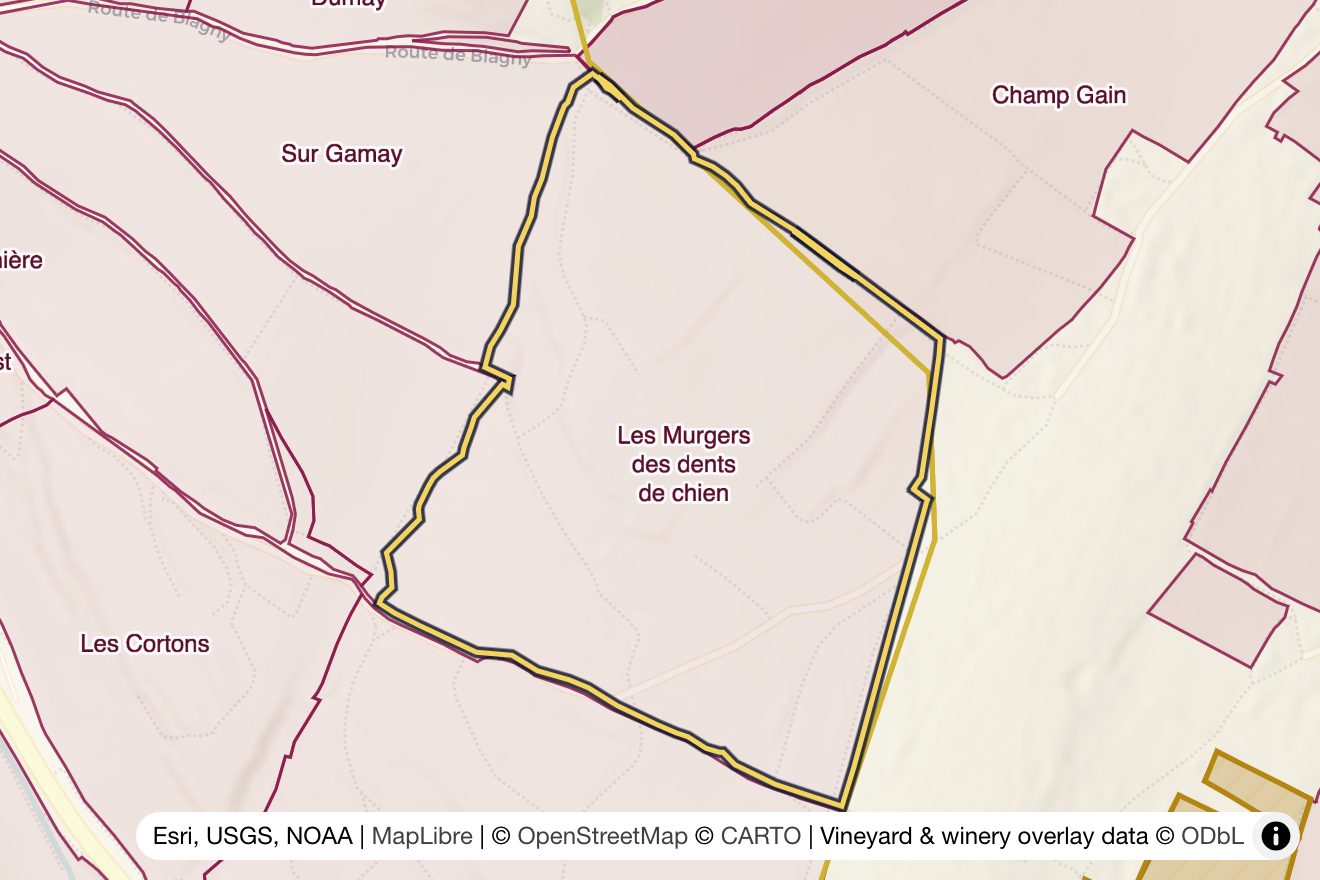
Overview & Location
The climat's unusual name, translating to "stone walls of the dog's teeth," reflects both the geological character of the site and the historical practice of building dry stone walls (murgers) from the limestone fragments found throughout the vineyard. These walls served the dual purpose of clearing the land for viticulture and creating microclimatic boundaries that would influence vine growth patterns for centuries to come.
Saint-Aubin itself represents a fascinating transition zone within Burgundy's hierarchy, sharing geological formations with its more famous neighbors while maintaining its own distinct character. Les Murgers des Dents de Chien exemplifies this position, producing wines that demonstrate the quality potential of Saint-Aubin's terroir while offering accessibility and value that the commune's Premier Crus are increasingly recognized for.
Size and Vineyard Configuration
Les Murgers des Dents de Chien encompasses approximately 16 hectares (about 39 acres) of vineyard land, making it one of the larger climats within Saint-Aubin's Premier Cru portfolio. This size allows for meaningful production while maintaining the intimate scale characteristic of Burgundy's finest sites. The vineyard is divided among several proprietors, with parcel sizes ranging from small family holdings of less than half a hectare to more substantial plots approaching one hectare.
The climat's boundaries are clearly delineated by natural topographical features and the aforementioned stone walls that give the vineyard its name. These boundaries have remained largely unchanged since the formal classification system was established, reflecting centuries of empirical understanding about where the optimal terroir begins and ends.
Terroir & Geology
The geological foundation of Les Murgers des Dents de Chien reveals the complex interplay between limestone, clay, and ancient marine sediments that characterizes the finest sites in the Côte de Beaune. The vineyard sits upon Jurassic limestone and marl, which provide the mineral backbone essential for producing wines of depth and longevity.
The soil profile varies significantly across the climat, with the upper slopes featuring shallow soils over fractured limestone bedrock, while the middle and lower sections display deeper accumulations of clay-limestone mixtures. This variation creates distinct microzones within the vineyard, each contributing different characteristics to the final wines. The limestone content provides excellent drainage while maintaining sufficient water retention during dry periods, a balance crucial for vine health and fruit quality.
Clay content ranges from 15-30% depending on the specific location within the climat, with higher concentrations found in the mid-slope positions where erosion has deposited finer particles over millennia. This clay component contributes to the wines' structure and aging potential while providing essential nutrients for vine development.
The vineyard faces south to southeast. This orientation ensures optimal sun exposure during the critical morning hours while providing some protection from the harshest afternoon heat. The slope gradient varies between 8-15%, creating natural drainage patterns that prevent water stagnation while moderating vine vigor.
Elevation ranges from 280 to 320 meters above sea level, positioning the vineyard within the optimal zone for Chardonnay cultivation in this region. This elevation provides sufficient cooling influence to maintain acidity while ensuring adequate heat accumulation for proper ripening.
Climate & Microclimate
Les Murgers des Dents de Chien benefits from a continental climate moderated by oceanic influences, characteristic of the Côte de Beaune but with specific mesoclimatic features that distinguish it from surrounding areas. The vineyard's southeastern orientation creates a unique thermal environment that promotes early-morning warming while maintaining cooler conditions during the afternoon heat peaks.
The climat is planted overwhelmingly to Chardonnay, with only a small Pinot Noir parcel. This natural ventilation system proves particularly valuable during the harvest season, when maintaining fruit health becomes paramount.
Cold air drainage patterns flow naturally down the slope, preventing frost accumulation in most years while ensuring that the vineyard benefits from the cooling effects necessary for maintaining acidity and aromatics in both white and red varieties. The stone walls throughout the vineyard create additional microclimatic variations, absorbing heat during the day and releasing it gradually at night, extending the effective growing season.
Annual precipitation typically ranges between 700-800mm, with the vineyard's excellent drainage ensuring that excessive moisture rarely becomes problematic. However, the water-retention capacity of the clay-limestone soils provides sufficient moisture reserves during drier periods, reducing vintage variation compared to sites with purely limestone soils.
Viticulture
The rare Pinot Noir from this climat expresses the character of limestone-grown red Burgundy. This distribution reflects both the site's suitability for white wine production and market demand patterns that have evolved over recent decades.
Vine ages vary significantly among different parcels, with some sections containing vines planted in the 1960s and 1970s, while others feature more recent plantings from the 1990s and 2000s. The older vines, particularly those on the steeper, rockier sections, produce wines of exceptional concentration and complexity, though yields are necessarily lower.
Planting density typically ranges from 10,000 to 12,000 vines per hectare, following traditional Burgundian practices that encourage competition among vines while ensuring adequate canopy development. The challenging terrain in some sections necessitates lower densities, while flatter areas can support higher vine populations.
Viticultural practices emphasize sustainable and increasingly organic approaches, with many growers implementing biodynamic principles. The rocky nature of much of the vineyard makes mechanical cultivation challenging, requiring significant hand work throughout the growing season. This labor-intensive approach, while costly, allows for precise canopy management and selective harvesting practices that maximize quality potential.
The presence of limestone fragments throughout the soil profile requires careful cultivation techniques to avoid damaging equipment and vine roots. Many growers have adapted their practices to work with rather than against these geological features, recognizing that the limestone contributes significantly to wine quality.
Yields are naturally moderated by the challenging growing conditions, typically ranging from 35-45 hectoliters per hectare for Chardonnay and 30-40 hectoliters per hectare for Pinot Noir. These yields, lower than permitted maximums, reflect the commitment of quality-focused producers to extract maximum expression from this distinctive terroir.
Wine Character & Style
Chardonnay from Les Murgers des Dents de Chien displays a distinctive mineral-driven profile that immediately identifies its limestone-rich origins. The wines typically exhibit a pale gold color with subtle green reflections in their youth, developing deeper golden hues with age. Aromically, these wines present a complex bouquet combining citrus fruits, particularly lemon and grapefruit, with subtle stone fruit notes of white peach and apricot.
The mineral signature is unmistakable, presenting as wet limestone, crushed shells, and subtle saline notes that provide backbone and definition. Floral elements, including acacia and hawthorn, add elegance and lift to the aromatic profile. With age, the wines develop honeyed characteristics and subtle nutty notes while maintaining their essential freshness.
On the palate, these Chardonnays demonstrate remarkable tension between richness and acidity. The limestone terroir provides a distinctive chalky texture that coats the palate without heaviness, while the clay component contributes to the wine's structural integrity and aging potential. Typical alcohol levels range from 12.5-13.5%, providing adequate body while maintaining elegance.
The Pinot Noir from this climat expresses the unique character of limestone-grown red Burgundy with particular finesse. Color tends toward deep ruby with purple highlights in youth, evolving to garnet and brick tones with maturity. The aromatic profile emphasizes red fruit characteristics (cherry, raspberry, and strawberry) complemented by subtle earth tones and mineral undertones.
Limestone's influence on red wine character appears in the wine's textural qualities, providing a distinctive chalky tannin structure that supports without overwhelming the delicate fruit flavors. The wines display excellent natural acidity, contributing to their food-friendliness and aging potential. Typical alcohol levels range from 12-13%, reflecting the site's ability to ripen fruit fully while maintaining balance.
Comparison to Surrounding Crus
Les Murgers des Dents de Chien occupies a distinctive position within Saint-Aubin's Premier Cru hierarchy, displaying characteristics that distinguish it from neighboring climats. Compared to Les Champlots, located further up the slope, Murgers des Dents de Chien produces wines with more obvious mineral expression and slightly less power, reflecting differences in soil depth and limestone exposure.
The contrast with Sur le Sentier du Clou, another well-regarded Saint-Aubin Premier Cru, reveals how seemingly minor terroir variations create significant stylistic differences. Sur le Sentier du Clou typically produces wines with greater richness and weight, while Murgers des Dents de Chien emphasizes finesse and mineral precision.
When compared to the Premier Crus of neighboring Chassagne-Montrachet, particularly those on similar geological formations, Les Murgers des Dents de Chien wines often display greater immediate accessibility while maintaining comparable aging potential. The Saint-Aubin location provides slightly cooler conditions that preserve freshness and aromatic intensity.
The relationship to Puligny-Montrachet Premier Crus reveals interesting parallels, particularly in terms of mineral expression and textural qualities. However, the Saint-Aubin wines typically show more immediate fruit character and somewhat less austere mineral presentation, making them more approachable in their youth while still rewarding extended cellaring.
Notable Producers
Several distinguished producers craft wines from Les Murgers des Dents de Chien, each bringing different philosophies and techniques to express the climat's potential. Domaine Joseph Colin bottles a Chardonnay from the climat. and consistently producing wines that exemplify the site's mineral-driven character. Their approach emphasizes minimal intervention winemaking that allows the terroir's voice to emerge clearly.
when vines were already established on the slopes of the Côte de Beaune. Their style tends toward purity and precision, with judicious use of oak aging that complements rather than masks the terroir characteristics.
Domaine Henri Prudhon et Fils represents another significant producer, with family holdings in the climat dating back multiple generations. Their wines often display exceptional longevity, reflecting both the terroir's potential and traditional winemaking approaches that emphasize cellar aging before release.
Several smaller domaines and négociant houses also source fruit from the climat, creating stylistic variations that demonstrate different interpretive approaches to the same terroir. These variations provide wine enthusiasts with opportunities to explore how winemaking philosophy interacts with terroir expression.
Historical Background & Classification
The history of viticulture in Les Murgers des Dents de Chien extends back to medieval times, came with the appellation decrees of the 1930s and 1940s (the premier cru list became definitive in 1943)
The climat's formal recognition as Premier Cru came with the establishment of Burgundy's modern classification system in 1936, though its reputation for quality was well established long before official recognition. Local records from the 18th and 19th centuries indicate that wines from this site commanded premium prices in regional markets, reflecting empirical recognition of their superior quality.
The unusual name has generated considerable historical interest, with several theories proposed for its origin. The most widely accepted explanation relates to the abundance of pointed limestone fragments found throughout the vineyard, which early vignerons likened to canine teeth. The "murgers" component reflects the practical necessity of building stone walls to clear the land and define parcel boundaries.
Throughout the 20th century, the climat maintained its reputation despite periods when Saint-Aubin wines received less attention than their more famous neighbors. The recent renaissance of interest in Saint-Aubin has brought renewed focus to Les Murgers des Dents de Chien, with critics and consumers increasingly recognizing the exceptional value and quality potential of wines from this site.
Aging Potential & Quality Level
Wines from Les Murgers des Dents de Chien demonstrate remarkable aging potential that often surprises those unfamiliar with Saint-Aubin's capabilities. Chardonnay from this climat typically shows optimal development between 5-12 years after vintage, though exceptional examples can continue evolving for 15-20 years. The limestone-driven minerality provides a structural foundation that supports extended aging while the wine develops complex tertiary characteristics.
Young wines often display primary fruit and mineral characteristics that can seem austere or underdeveloped. However, proper cellaring reveals the climat's true character as the wines integrate and develop the honeyed, nutty complexities characteristic of great white Burgundy. The key to successful aging lies in the wine's natural acidity and mineral structure, both hallmarks of this particular terroir.
Domaine Hubert Lamy stands among the most respected, holding a small parcel within the climat The combination of limestone-derived tannins and natural acidity provides an excellent framework for long-term development, while the inherent elegance ensures that the wines remain graceful even at full maturity.
Quality levels have shown remarkable consistency over the past two decades, reflecting both improved viticultural practices and increased recognition of the climat's potential. Even in challenging vintages, wines from Les Murgers des Dents de Chien tend to maintain their essential character while adapting to vintage conditions.
The climate change impacts visible throughout Burgundy have generally proven beneficial for this site, with warmer temperatures improving ripening consistency while the climat's natural cooling influences help maintain the acidity and freshness essential to wine quality. This adaptation suggests that Les Murgers des Dents de Chien may continue producing wines of exceptional quality even as regional conditions evolve.
Climate variation effects demonstrate the terroir's resilience, with the diverse soil types and exposures within the climat providing natural buffering against extreme conditions. This stability, combined with the site's proven aging potential, positions Les Murgers des Dents de Chien as one of Saint-Aubin's most reliable Premier Crus for both immediate enjoyment and long-term cellaring.