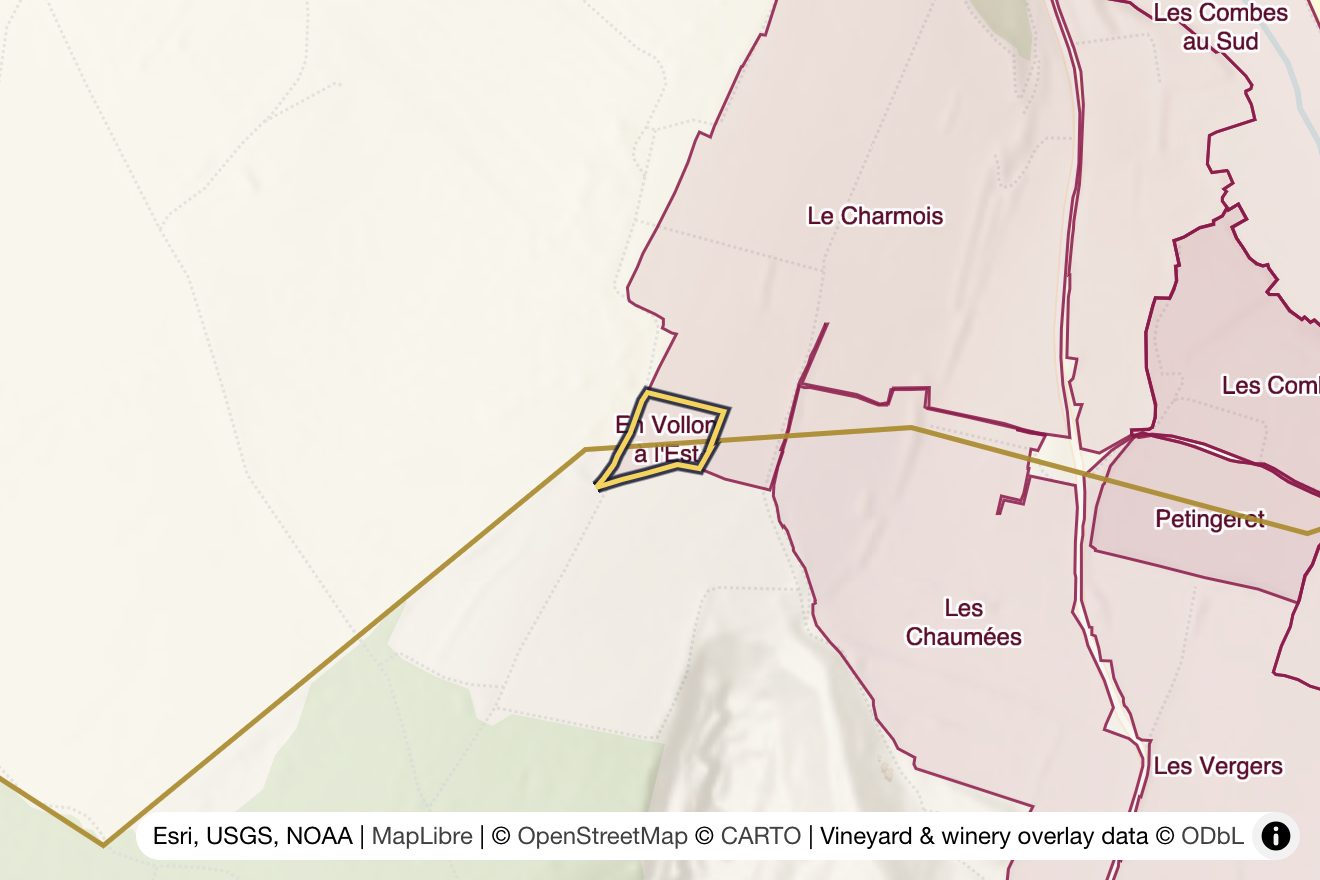
Overview & Location
Saint-Aubin itself sits in a side valley west of the more famous communes of Puligny-Montrachet and Chassagne-Montrachet, set back from the main Côte de Beaune slope. This geographical placement provides Saint-Aubin with a distinctive terroir profile that combines elements found in both neighboring appellations while maintaining its own character. En Vollon à l'Est benefits from this unique positioning, drawing influence from the mineral precision associated with Chassagne-Montrachet while retaining the generous fruit expression that characterizes the broader Saint-Aubin appellation.
The vineyard's location within the commune places it among the premier sites that have earned Saint-Aubin its reputation for producing wines of exceptional quality and remarkable value within the Burgundian hierarchy. Unlike some Premier Crus that occupy marginal positions within their respective communes, En Vollon à l'Est sits in a prime location that allows it to fully express the terroir characteristics that define Saint-Aubin's finest expressions.
Size
En Vollon à l'Est covers only about 0.41 hectares (1 acre), making it one of the smallest Premier Cru climats in the Saint-Aubin appellation.
The vineyard's size allows for meaningful production volumes while maintaining the terroir consistency that characterizes the finest Burgundian climats.
Terroir & Geology
The geological foundation of En Vollon à l'Est reflects the complex limestone formations that characterize the Côte de Beaune, with specific characteristics that distinguish it from neighboring sites. The underlying bedrock consists primarily of Jurassic limestone from the Bathonian period, overlaid with varying depths of clay-limestone soils that provide both drainage and water retention capabilities essential for quality viticulture.
The soil composition features a distinctive blend of white limestone and clay, with iron-rich elements that contribute to the wines' mineral complexity and aging potential. The limestone component provides excellent drainage while maintaining sufficient porosity to allow vine roots to penetrate deeply, accessing mineral nutrients and trace elements that contribute to the wines' characteristic terroir expression. Clay content varies throughout the vineyard, generally ranging from 15-25%, providing adequate water retention during dry periods while avoiding excessive moisture that could compromise grape quality.
Soil depth varies across En Vollon à l'Est, with depths ranging from 40 to 80 centimeters above the limestone bedrock. This variation creates subtle differences in vine behavior and grape characteristics, with vines in areas of deeper soil producing slightly more generous fruit expression, while those planted over shallower soils tend toward greater mineral precision and concentration.
The vineyard's slope characteristics contribute significantly to its terroir expression, with gradients ranging from 8-15% that provide natural drainage while ensuring adequate sun exposure throughout the growing season. This moderate slope prevents excessive erosion while allowing cold air to drain away from the vines during critical periods of the growing cycle.
En Vollon à l'Est enjoys a southeastern exposure that optimizes sun exposure throughout the day, particularly during morning hours when gentle warming helps prevent frost damage and encourages even ripening. This aspect ensures that grapes receive adequate solar radiation for proper phenolic development while avoiding excessive afternoon heat that could compromise acidity retention.
The vineyard sits at elevations ranging from 280 to 320 meters above sea level, positioning it within the optimal altitude range for Burgundian viticulture. This elevation provides sufficient cooling influence to maintain acidity levels while ensuring adequate warmth for complete physiological ripeness. The elevation differential across the vineyard creates subtle microclimate variations that contribute to the complexity found in wines from this climat.
Climate & Microclimate
En Vollon à l'Est benefits from the semi-continental climate that characterizes the Côte de Beaune, with specific mesoclimate modifications created by its topographical position and aspect. The vineyard's southeastern exposure moderates temperature extremes while providing optimal sun exposure during critical ripening periods.
The climat experiences slightly cooler temperatures than vineyards positioned on the main Côte de Beaune slope, creating conditions that favor retention of natural acidity while still achieving full physiological ripeness. This temperature profile contributes to the characteristic elegance and finesse found in wines from En Vollon à l'Est, distinguishing them from warmer sites that may produce riper, more powerful expressions.
Morning fog occasionally settles in the vineyard during autumn months, creating humid conditions that must be carefully managed to prevent botrytis pressure. However, the vineyard's drainage characteristics and air circulation patterns generally allow for rapid moisture evaporation once temperatures rise, minimizing disease pressure while contributing to the development of complex aromatic compounds.
Wind patterns play a crucial role in the vineyard's microclimate, with prevailing winds from the west and northwest providing air circulation that helps prevent fungal diseases while moderating temperature extremes. These air movement patterns contribute to the vineyard's reputation for producing healthy grapes with concentrated flavors and balanced acidity levels.
Rainfall distribution throughout the growing season generally follows regional patterns, with spring precipitation supporting vine development and summer conditions that typically provide adequate but not excessive moisture. The vineyard's drainage characteristics ensure that excess water moves through the soil profile efficiently, preventing waterlogging while maintaining adequate moisture reserves for sustained vine growth.
Viticulture
En Vollon à l'Est is planted primarily to Chardonnay, with small parcels dedicated to Pinot Noir, reflecting the dual-variety tradition that characterizes many Saint-Aubin Premier Crus. This distribution reflects the site's particular suitability for white wine production while acknowledging its capacity to produce quality red wines under appropriate conditions.
Vine age across En Vollon à l'Est varies considerably, with some parcels containing vines planted in the 1960s and 1970s that provide the backbone of production, while more recent plantings from the 1990s and 2000s contribute to overall volume. The average vine age approximates 35-40 years, providing the maturity necessary for complex wine production while maintaining adequate vigor for consistent yields.
Planting density typically ranges from 10,000 to 12,000 vines per hectare, following traditional Burgundian spacing that balances vine competition with management practicality. This density ensures adequate root competition while allowing sufficient space for mechanical cultivation where employed. Most producers favor closer spacing within this range, recognizing that vine competition contributes to concentration and terroir expression.
Viticultural practices in En Vollon à l'Est reflect a combination of traditional Burgundian methods and modern precision viticulture. Most producers employ sustainable or organic farming practices, recognizing that soil health and vine balance contribute directly to wine quality. Cover crop management varies among producers, with some favoring permanent grass cover in inter-rows while others prefer seasonal cover crops that can be worked into the soil to provide organic matter.
Pruning follows traditional Burgundian methods, primarily utilizing Guyot simple or double systems that balance fruit production with vine longevity. Bud counts are carefully managed to control yields, with most quality-focused producers targeting yields between 45-55 hectoliters per hectare for Chardonnay and slightly lower for Pinot Noir.
Canopy management receives careful attention throughout the growing season, with producers employing leaf removal, shoot positioning, and cluster thinning as needed to optimize grape quality. The vineyard's southeastern exposure requires careful management of leaf cover to prevent excessive sun exposure while ensuring adequate photosynthesis for flavor development.
Harvest timing represents a critical decision point, with producers monitoring sugar accumulation, acidity retention, and phenolic development to determine optimal picking dates. The vineyard's elevation and exposure typically result in harvest dates that fall in mid-to-late September for Chardonnay and slightly earlier for Pinot Noir, though vintage variation can shift these timings significantly.
Wine Character & Style
Wines from En Vollon à l'Est exhibit the refined elegance and mineral precision that characterize Saint-Aubin's finest expressions while displaying unique characteristics that distinguish this climat from neighboring sites. Chardonnay from En Vollon à l'Est typically displays a distinctive aromatic profile combining citrus fruits, white flowers, and subtle mineral notes that reflect the vineyard's limestone-rich soils.
The aromatic spectrum of En Vollon à l'Est Chardonnay frequently features primary notes of lemon zest, white peach, and pear, supported by floral elements including acacia and hawthorn blossoms. With bottle age, these primary aromatics evolve to include more complex notes of brioche, hazelnut, and honey, while maintaining the underlying mineral thread that defines the site's character.
Structural characteristics of En Vollon à l'Est wines include vibrant acidity that provides backbone and aging potential while supporting the fruit expression without overwhelming it. The acidity profile typically shows excellent integration with alcohol levels that generally range from 12.5-13.5%, creating wines with energy and precision rather than weight and power.
Textural elements distinguish En Vollon à l'Est wines through their combination of richness and finesse, avoiding the heaviness that can characterize some white Burgundies while providing sufficient body to support complex flavors. The mouthfeel typically exhibits a silky quality with subtle mineral tension that carries through the finish, creating wines that are both immediately appealing and capable of long-term development.
Pinot Noir from En Vollon à l'Est displays the elegant, perfumed character that defines quality Saint-Aubin reds, with aromatic profiles featuring red cherry, raspberry, and subtle spice notes supported by earthy undertones that reflect the limestone terroir. These red wines typically show excellent color intensity with bright ruby hues that evolve toward garnet with bottle age.
The structural profile of En Vollon à l'Est Pinot Noir emphasizes finesse over power, with tannins that provide support without overwhelming the delicate fruit expression. Acidity levels remain vibrant, contributing to the wines' aging potential while maintaining the freshness that characterizes the finest expressions from this climat.
Comparison to Surrounding Crus
En Vollon à l'Est occupies a distinctive position within Saint-Aubin's Premier Cru hierarchy, displaying characteristics that both align with and distinguish it from neighboring climats.
The wines from En Vollon à l'Est generally show more generous fruit expression than those from Sur le Sentier du Clou, another highly regarded Saint-Aubin Premier Cru, while displaying similar mineral precision. This difference likely reflects subtle variations in soil composition and microclimate between the sites.
When compared to La Chatenière, En Vollon à l'Est wines typically exhibit greater elegance and finesse, with La Chatenière often producing slightly more powerful expressions that reflect its different exposure and soil characteristics. Both sites produce wines of excellent quality, but with distinct stylistic profiles that reflect their respective terroirs.
In the context of Saint-Aubin's red wine Premier Crus, En Vollon à l'Est Pinot Noir displays characteristics that align closely with expressions from Les Frionnes, another site known for elegant red wines, while showing greater mineral precision than some of the commune's warmer sites.
Compared to Premier Crus in neighboring Chassagne-Montrachet, En Vollon à l'Est wines typically display similar mineral precision but with slightly more generous fruit expression, reflecting Saint-Aubin's generally more accessible style while maintaining the structural integrity that defines quality Burgundian Chardonnay.
Notable Producers
Several distinguished producers work parcels within En Vollon à l'Est, each bringing their own viticultural and winemaking philosophy to this exceptional terroir. These producers range from estate growers who have worked the vineyard for multiple generations to négociant houses that source grapes from contracted growers.
Their approach emphasizes traditional viticultural methods combined with modern precision in the winery, resulting in wines that faithfully express the climat's character while displaying the consistency that has built their reputation.
Their viticultural approach emphasizes low yields and careful canopy management, while their winemaking style favors indigenous yeast fermentation and judicious use of new oak to allow the terroir characteristics to dominate the final wine profile.
The Colin family's approach emphasizes sustainable viticulture and minimal intervention winemaking, resulting in wines that showcase the pure expression of the vineyard's limestone-rich terroir.
Their holdings, while smaller than some producers, contribute to the overall reputation of this climat through consistent quality and terroir expression.
Négociant houses, including some based in nearby Beaune, also source fruit from En Vollon à l'Est, though the most successful bottlings typically come from long-term contracts with specific growers who understand the vineyard's requirements and potential.
Historical Background & Classification
The history of En Vollon à l'Est as a recognized climat extends back several centuries, with historical records indicating vine cultivation on this site dating to at least the 16th century. The vineyard's name likely derives from local geographical features, with "Vollon" possibly referring to topographical characteristics that distinguished this site from surrounding areas.
Documentation from the 18th and 19th centuries indicates that En Vollon à l'Est enjoyed recognition as one of Saint-Aubin's superior vineyard sites, with wines from this climat commanding premium prices compared to village-level offerings. This historical reputation provided the foundation for its eventual classification as Premier Cru when the formal Burgundian classification system was established.
The climat received Premier Cru classification in 1970 as part of the broader recognition of Saint-Aubin's quality potential within the Burgundian hierarchy. This classification acknowledged both the historical reputation of the site and its demonstrated capacity to produce wines of exceptional quality that merited inclusion among Burgundy's elite vineyard sites.
Prior to formal classification, En Vollon à l'Est wines were often sold under broader Saint-Aubin designations or incorporated into négociant blends, limiting recognition of the site's distinct character. The Premier Cru classification enabled producers to market wines specifically from this climat, contributing to increased recognition of its unique terroir characteristics.
The classification process involved extensive evaluation of soil characteristics, historical performance, and wine quality, with En Vollon à l'Est meeting all criteria established for Premier Cru status. This recognition placed the climat among approximately 30 Premier Cru sites within Saint-Aubin, acknowledging its position within the commune's quality hierarchy.
Aging Potential & Quality Level
En Vollon à l'Est produces wines with exceptional aging potential that reflects both the vineyard's terroir characteristics and the structural qualities that define long-lived white Burgundy. Chardonnay from this climat typically displays optimal drinking windows that extend from 5-15 years after vintage, with the finest examples capable of graceful evolution for two decades or more.
The aging trajectory of En Vollon à l'Est Chardonnay follows classic patterns for quality white Burgundy, with primary fruit characteristics gradually giving way to more complex secondary and tertiary aromatics. During the first 2-3 years after vintage, wines typically display vibrant fruit expression supported by mineral undertones, with oak integration proceeding gradually.
Between 5-10 years of age, En Vollon à l'Est wines typically reach their first peak, displaying fully integrated oak influence while maintaining fruit freshness and developing increased complexity. The limestone-rich terroir contributes to this evolution through mineral elements that provide structural support while allowing aromatic development to proceed gradually.
Extended aging beyond 10 years reveals the full potential of En Vollon à l'Est terroir, with wines developing honeyed notes, nutty characteristics, and complex mineral expressions that reflect the deep limestone soils. The finest examples maintain their acidity throughout this evolution, preventing the heaviness that can affect some aged white Burgundies.
Pinot Noir from En Vollon à l'Est displays similarly impressive aging potential, typically reaching optimal drinking condition between 8-15 years after vintage. The wines' structural characteristics, including balanced tannins and vibrant acidity, provide the foundation necessary for graceful long-term evolution.
Quality consistency across En Vollon à l'Est varies somewhat among producers and vintages, but the climat's inherent characteristics provide a solid foundation for reliable wine production. The vineyard's drainage characteristics and favorable exposure minimize vintage variation compared to some Premier Cru sites, contributing to the consistent quality that has built its reputation.
The site's proven track record across multiple decades demonstrates its capacity to produce wines of Premier Cru quality regardless of vintage conditions, though the finest examples typically emerge from years that favor balanced ripening and acidity retention. This consistency has established En Vollon à l'Est as one of Saint-Aubin's most reliable Premier Cru sites for both immediate enjoyment and long-term cellaring.