One Climat, One Enclosure
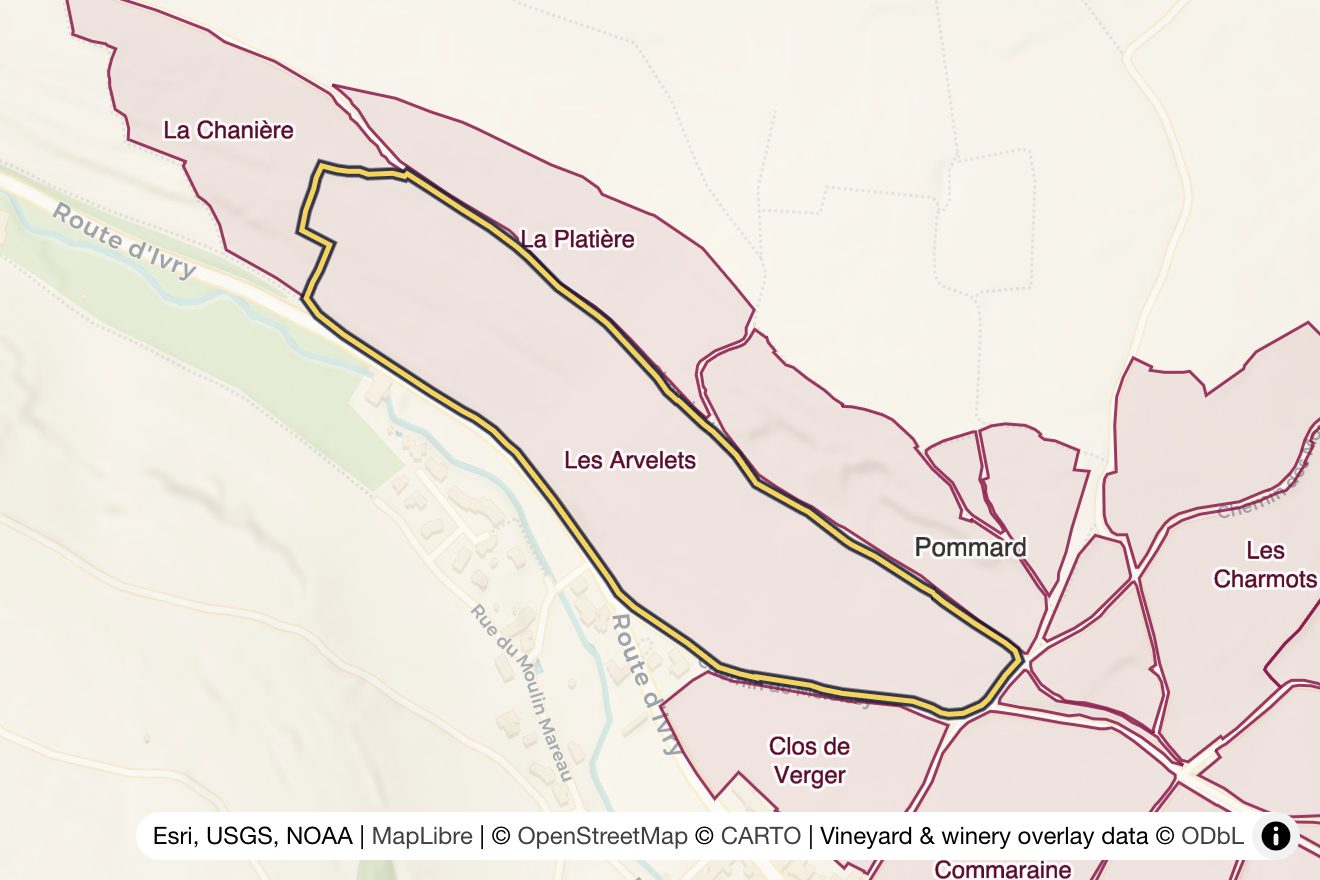
Measured on the delimitation, Les Arvelets covers 8.46 hectares in two pieces, and the split is almost nominal: a single block of 8.38 hectares carries the climat, with a thin ribbon of 0.07 hectares alongside it. That consolidation is unusual on the Côte, where a premier cru of this size is normally a mosaic of detached fragments, and it has a straightforward explanation. Part of Les Arvelets is a clos. Domaine Rebourgeon-Mure, which farms inside it, describes it as one walled part of Les Arvelets, ringed by high walls, and distinguishes the clos from the rest of the climat. The climat and the Clos des Arvelets are not the same ground.
What the wall does not do is unify ownership. The clos was long held by a single owner, and successive inheritances broke it into parcels that are now farmed and bottled separately, which is why the same enclosure appears on labels under two names. Rebourgeon-Mure, Virely-Rougeot and Château de Charodon all bottle Pommard 1er Cru Clos des Arvelets; Louis Latour, Domaine Berthelemot, Bernard Rion, Philippe Pacalet, François Parent and others bottle it as Les Arvelets. Rebourgeon-Mure holds the largest single share at 3.30 hectares, on old vines. At the other end of the scale, Berthelemot works a small parcel.
The Name and the Owners Behind It
Two readings of Arvelets circulate. One derives it from the Latin arva, meaning cultivated fields, applied to land worked along the Avant-Dheune valley. The other credits the Micault d'Harvelay family, châtelains of Pommard and builders of the château, who held the clos until 1763. The Rebourgeon-Mure account inverts that second reading: the family took its name from the clos, not the other way round. The wider evidence supports the toponym coming first, since Fixin has an Arvelets premier cru of its own at the far end of the Côte de Nuits, with no connection to any Pommard household.
After 1763 the clos passed to the Marey-Monge family, who held it until 1926, when it was broken up and the Rebourgeon family acquired their block. Parts of the enclosure had been abandoned after phylloxera and were replanted by the Virely family. That interrupted history is worth keeping in mind when reading vine ages here: the clos has been reconstituted in stages rather than farmed continuously.
Slope, Soil and Air
Les Arvelets occupies the north-western corner of the commune, where the Avant-Dheune valley opens onto the main slope. La Chanière and La Platière sit above and to the north-west; Les Charmots and Clos de Verger fall away to the east and south-east. Reported altitudes run from 260 to 280 metres, with Rebourgeon-Mure giving 287 metres for its own rows. The gradient is steep for Pommard, around 20 per cent, terraced in places and broken by short counter-slopes, which is one reason the enclosing walls exist at all.
Exposure is the site's real argument. Because it faces across the mouth of the valley rather than straight down the Côte, Les Arvelets picks up a southerly component that the commune's east-facing heart does not have; producers describe it variously as due south and as south to south-south-east, and both are defensible across eight hectares of terraced, tilted ground. The valley also moves air. Growers working the northern slope of Pommard credit that draught with drier fruit at harvest, thicker skins and cleaner ferments in damp years.
The soils are thin and warm-coloured. Descriptions converge on a shallow clay-limestone profile carrying alluvium, sand and ferruginous marl, which gives the earth a brown-red cast, over the hard Ladoix limestone that runs beneath this stretch of high slope. Nothing here holds much water.
The Wine
Les Arvelets does not produce the heaviest style of Pommard, and that is the point of it. The fruit reads dark and matte rather than sweet, the tannins arrive firm but fine-grained, and the wines carry a sappy, sinewy line that opens out with age rather than collapsing into weight. Latour describes roundness set against freshness and elegant tannins on a seven to ten year window; Virely-Rougeot pushes its cellaring advice to fifteen years and beyond; Rebourgeon-Mure's old-vine bottling shows supple, well-knitted tannin over concentrated fruit.
Historically the climat has never been ranked at the very top of the commune. Jules Lavalle placed every homologated Pommard premier cru on a single level, uniquely among the red communes of the Côte d'Or, and Camille Rodier's têtes de cuvée for Pommard were Rugiens-Bas, Grands Epenots and Clos Blanc. Modern opinion has been kinder to the high north-western climats, and the best Arvelets now stand comfortably among the commune's more interesting bottles without ever adopting its heaviest register.