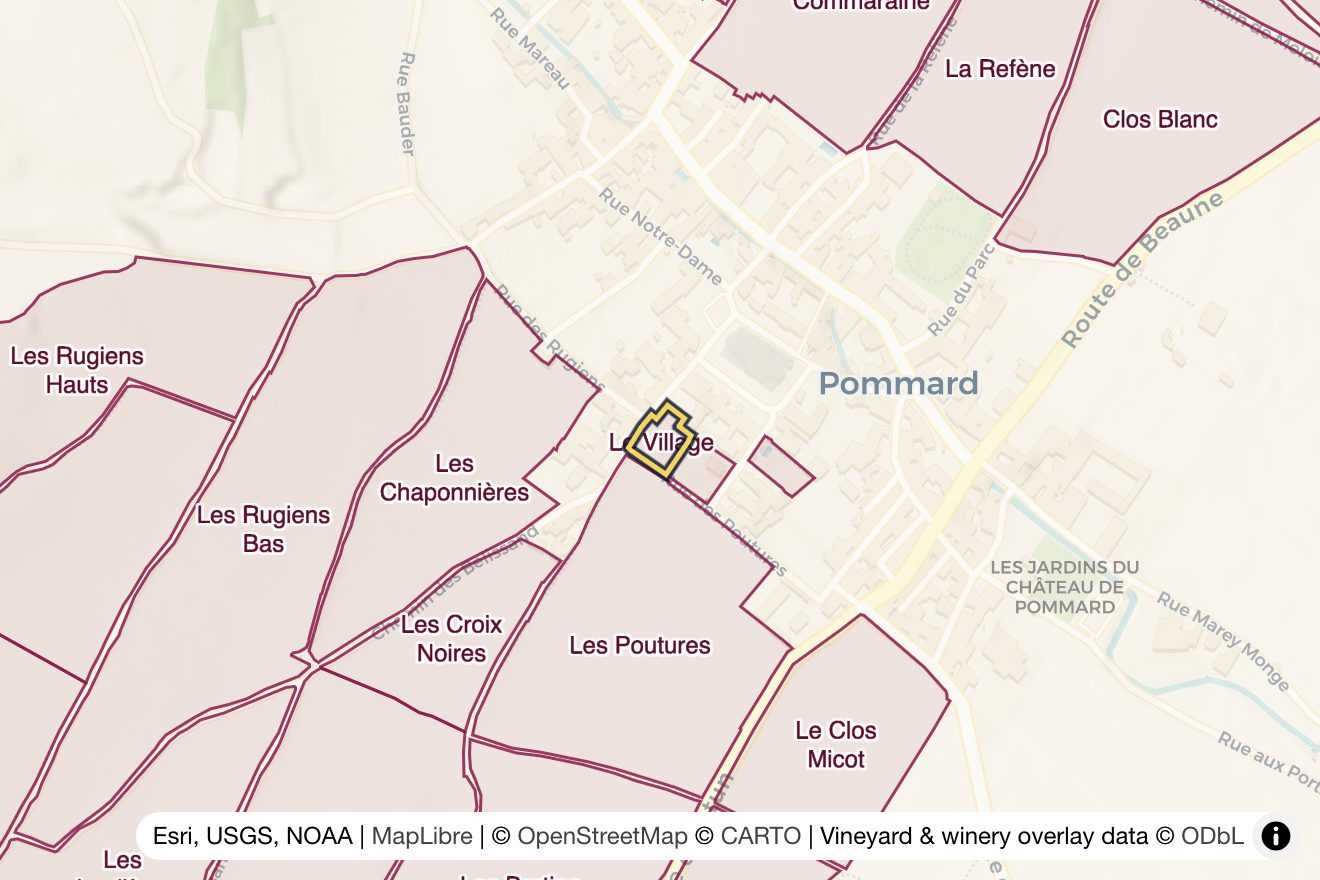
A Sliver Inside a Village-Level Lieu-dit
Pommard's premier cru belt runs almost without interruption from the Beaune boundary down to Volnay, and the single break in it is the built village, which sits in the mouth of the combe where the Avant-Dheune leaves the hills. Le Village is the cadastral name for that ground, roughly 20 hectares bounded by the D973 and D974. Almost none of it is cru. The Château de Pommard's 20-hectare Clos Marey-Monge lies on the edge of the village and is sold as commune-level Pommard. Measured geodesically from the delimitation polygons, the premier cru inside Le Village comes to 0.15 hectares. The name is one of the 28 premier cru climats listed, in part, in the appellation's current INAO specification.
The geology explains the imbalance. Torrential flows out of the combe laid an alluvial cone across the piedmont at the close of the last glaciation, and the resulting channel fills of clay and silt make this the least rewarding ground in the commune; only its north-western margin approaches the standard of Pommard's better lower-slope village sites. The cru line encloses what survived that assessment.
Why the Climat Arrives in Two Pieces
A Burgundy climat is a name in the land register before it is a vineyard, and premier cru status was granted parcel by parcel rather than around a block. One name can therefore attach to detached fragments separated by walls, lanes, buildings or unclassified soil. Le Village is that pattern at its most extreme: 0.15 hectares in two pieces, hemmed in by the village rather than sitting in an open run of vines.
What Actually Reaches a Bottle
At the appellation ceiling of 48 hectolitres per hectare the entire climat yields around seven hectolitres, close to three barrels, and real crops fall well short of that. No domaine, importer, retailer or critic listing for a wine labelled Pommard 1er Cru Le Village surfaces; fruit from holdings this small is normally folded into a blended Pommard 1er Cru bearing no climat name. Two naming traps follow. "Pommard Village" on a label denotes the commune appellation, not this cru. And Monthélie has its own premier cru called Le Village, roughly 0.2 hectares, so the name alone identifies nothing.