The name itself has two readings and no proof. Domaine Pierre Vincent's technical note traces it through a donation deed to Cîteaux from April 1306 that records a piece of Auxey ground as En Darayse, then links that to the Mâconnais word Daraises, the side-rails of a cart, and to a Gaulish sense of pasture barriers or the gate of an enclosure. Dry-stone shelters found at Volnay, Nantoux and Auxey-Duresses are offered as circumstantial support for grazing enclosures on this hillside. The commoner trade reading is blunter: hard lands, after the stones. Neither is settled. The stones are not in doubt.
How the climat is cut
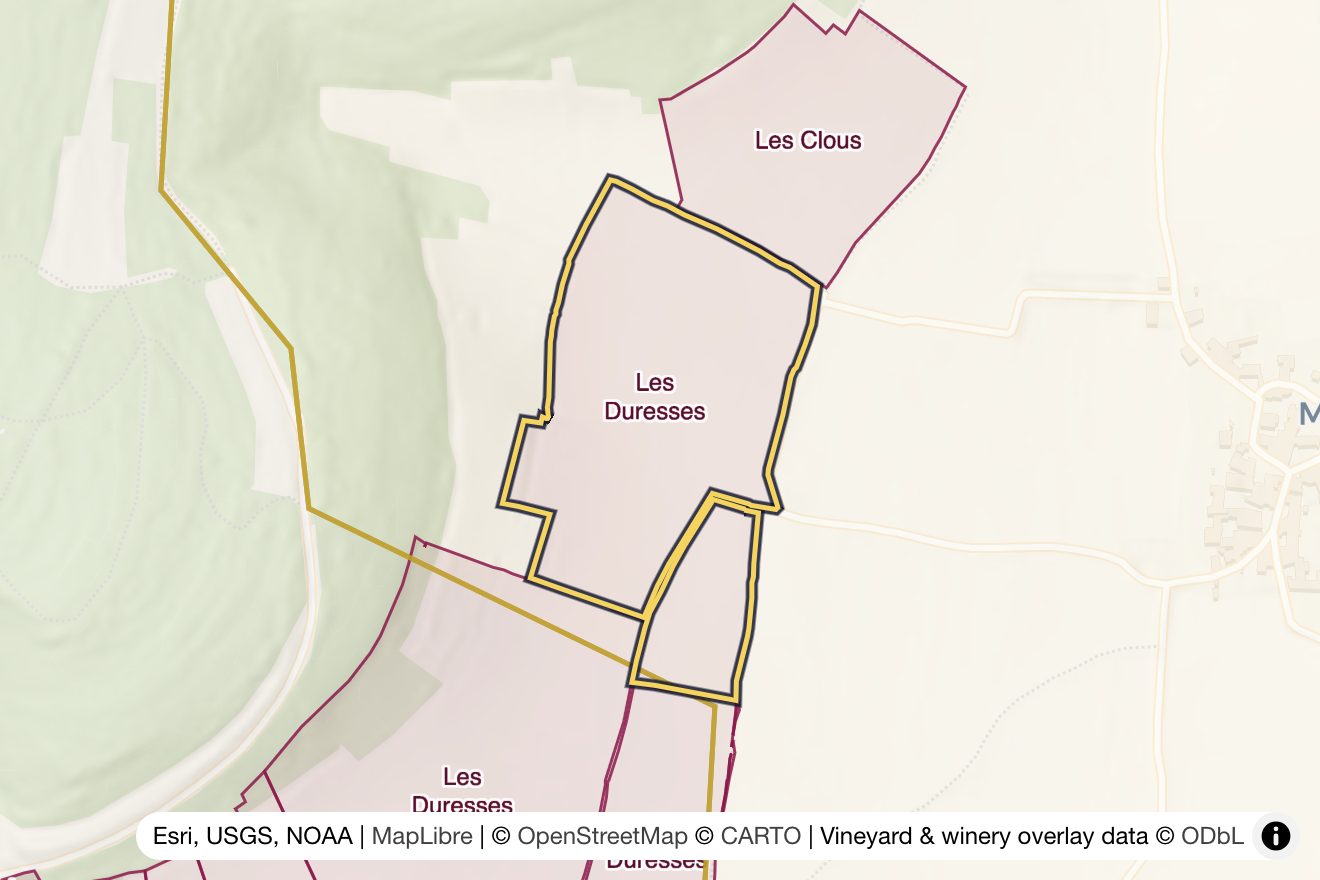
The delimited premier cru covers 6.58 hectares in five separate pieces, centred at about 46.9928 north, 4.7581 east. A single body of 5.47 hectares carries the bulk of it. A second parcel of 1.07 hectares hangs off the southern edge. The remaining three are slivers of under 200 square metres each, the residue of tracks and cadastral lines rather than working vineyard. Set against a commune whose entire premier cru area runs to only 31 to 37 hectares across 15 climats, Les Duresses is one of the two largest sites Monthélie has, behind Les Champs Fulliots and just ahead of Sur la Velle.
Its neighbours make the commune-line point better than any map key. Auxey-Duresses' Bas des Duresses runs along its southern boundary and Auxey's own Les Duresses touches the south-west corner, so the two communes' premier crus of the same name meet on the ground. Monthélie's Les Clous adjoins to the north. Everything else in the commune, from Le Village and Le Château Gaillard through Le Meix Bataille, Les Riottes and Le Clos Gauthey out to Les Champs Fulliots and Sur la Velle, begins some 600 metres east.
Slope, aspect and ground
Terrain modelling through the climat shows the hillside falling east-south-east at roughly fifteen percent, steepening along the upper western edge. Elevations across the delimited parcels run from about 260 metres at the eastern foot to a little over 300 metres at the top corner, and the hill keeps climbing west past 330 metres, where premier cru status stops and village-level Monthélie takes the highest ground. Growers state the exposure simply as east, sometimes east to south-east, and the modelling agrees. The vines take morning light and are out of the worst of the late afternoon.
The consequence is timing. Les Duresses ripens late. Domaine des Comtes Lafon picks it among the last of its parcels, and Dominique Lafon has compared its maturity curve to the Côte de Nuits rather than the Côte de Beaune. On a site this steep and this stony, that lateness is a feature: it buys hang time without heat.
Underneath is Argovian limestone of the Upper Jurassic, the base that runs the length of the Auxey combe. The working soil is a pebbly marl carrying a real share of clay, thickening as it goes downslope. Pierre Vincent describes its own parcel in three words, clay and stones. Between the gradient and the rubble the site drains hard, which keeps vigour and yields in check without much intervention, and the limestone underfoot is what growers point to when they describe the mineral edge in the finished wine.
Who bottles it
For a climat tucked this far off the main côte, Les Duresses is unusually well represented in the trade. Domaine des Comtes Lafon farms just over a hectare. Coche-Dury counts Monthélie among the six communes across which its nine hectares are scattered. Domaine de Montille, Bouchard Père et Fils, Vincent Girardin, Darviot-Perrin, Paul and Florent Garaudet, Domaine des Terres de Velle, Éric de Suremain at the Château de Monthélie, Éric Boussey, Domaine Changarnier and Monthélie Douhairet-Porcheret all appear on the climat or on the appellation around it.
Pierre Vincent's holding shows how finely the ground is divided: 0.1710 hectares planted in 1979, hand-picked and sorted, fermented with half the crop whole-bunch after a cold soak, fifteen days on skins, eighteen months in barrel with around a fifth new, then racked to steel before bottling.
Pinot Noir has most of the surface, but Chardonnay holds the upper slope, and white Les Duresses is a genuine if minor category, made by Domaine de Montille, Monthélie Douhairet-Porcheret, Xavier Monnot and Domaine Belleville among others. The reds are what the site is judged on: perfumed, firmly framed, slower to open than the sites nearer the village, and routinely compared to Volnay for the way they carry structure without weight.