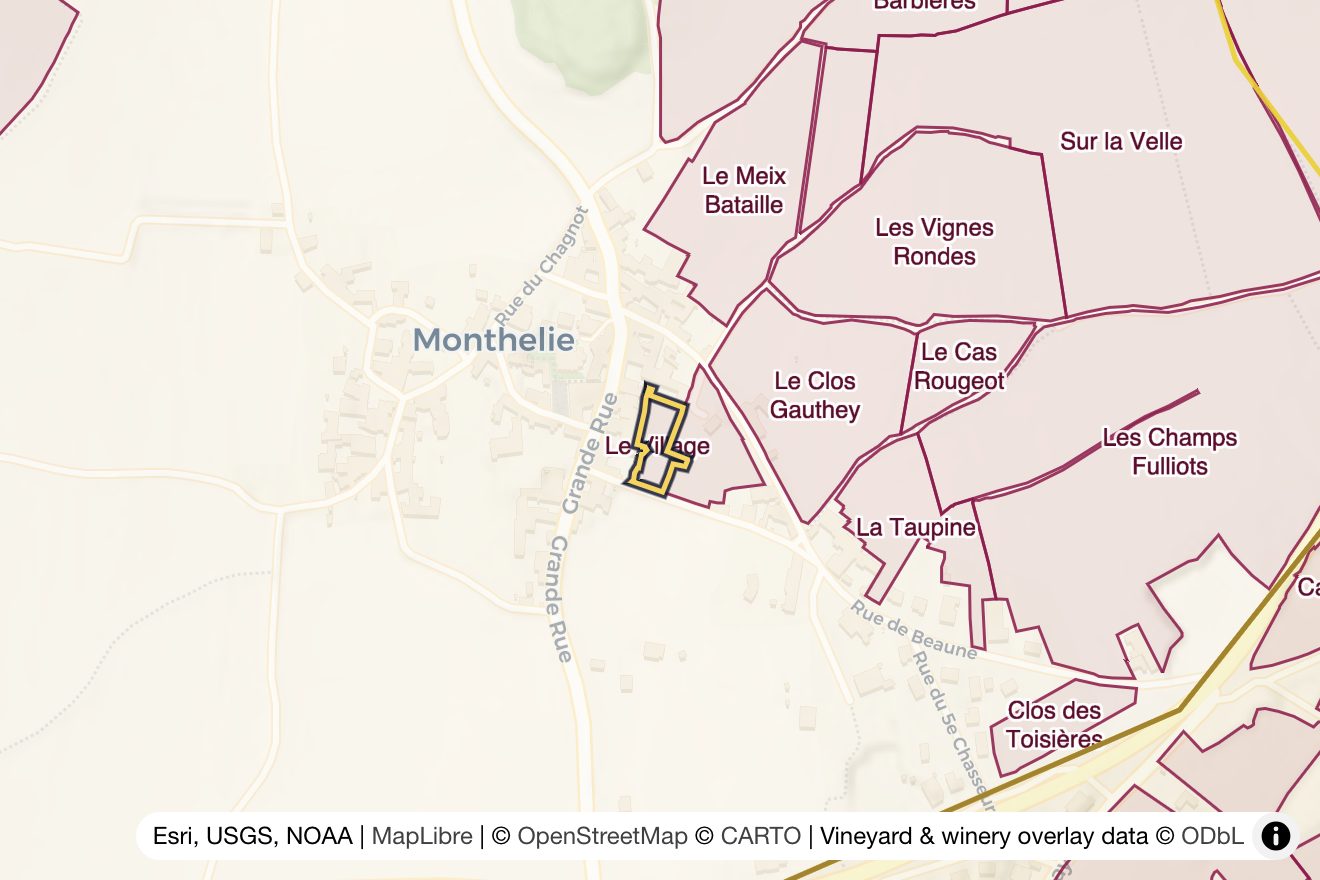
A Climat Named for the Settlement
The name is exactly what it says. Le Village is the land of the village itself, a toponym repeated across the Côte de Beaune (Volnay and Pommard both carry one) for the parcels that sit hard against the built-up core rather than out on the open slope. In Monthélie the built-up core is unusually assertive: the commune is a tight cluster of church, château, old houses and cellars pressed into the hillside, and the vineyard has to work around it.
The delimitation reflects that. Le Village measures 0.2 hectares in two detached pieces. The working parcel is a narrow strip of 0.196 hectares, roughly 45 metres across and 84 metres long, whose centre point falls on the Rue de Beaune inside the village. A second fragment of about 0.005 hectares, some 27 metres by 11, lies around 30 metres to the north-east. That makes it one of the smallest classified sites anywhere in the Côte de Beaune, and the fragmentation here is not the usual story of inherited slivers spread across a hillside; it is a single small holding interrupted by the settlement.
Ground, Neighbours and Trade Reality
The site lies between about 285 and 289 metres, a fall of only a few metres across its length, tipping gently to the south and west. Monthélie's vines run from roughly 230 to 370 metres, so this is mid-slope ground that has been flattened out by the village terrace rather than true coteau. The commune's premier cru band runs east from here toward the Volnay boundary, and Le Village is its western toe: Le Château Gaillard begins about 40 metres east, Le Clos Gauthey 135 metres east-north-east, Le Meix Bataille and La Taupine both a little over 200 metres away.
Monthélie's terroir is Bathonian gravelly limestone under red clay and marl, with south and south-east exposures on the best sites and roughly 31 to 36 hectares of premier cru within a commune of around 120 to 130 hectares. The village belonged historically to the abbey of Cluny.
Le Village is essentially invisible in the trade. No commercial bottling under the climat name turns up in French or export listings, which is what a fifth of a hectare should predict: at typical Côte de Beaune yields the whole site would fill only a few barrels. Fruit of this kind almost always disappears into a blended Monthélie 1er Cru, which the appellation rules permit when several classified climats are combined. The name survives on the map and in the register rather than on labels.