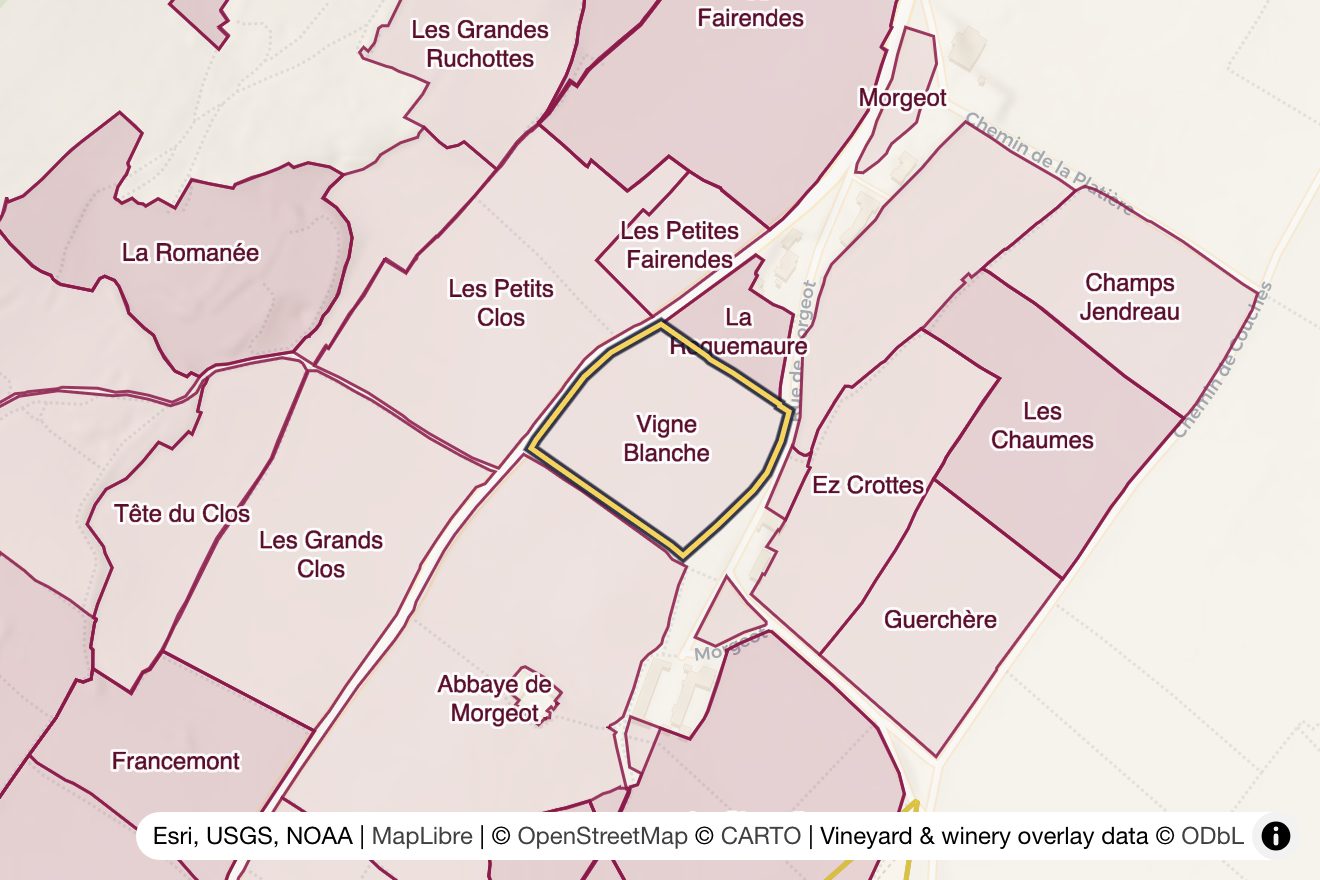
Overview & Location
Located some 13 to 15 kilometers south of Beaune, Vigne Blanche sits within the broader geological and climatic context that defines the Côte de Beaune's exceptional terroir. The vineyard lies within the Morgeot sector, in the southern part of the appellation toward Santenay. Its placement within the Chassagne-Montrachet appellation puts it inside the Morgeot premier cru, one of the commune's renowned climats alongside Les Caillerets and Les Chenevottes, each contributing to the commune's reputation for producing some of Burgundy's most refined and age-worthy white wines.
The vineyard's location within the broader Côte de Beaune context is particularly significant, as it lies in the southern part of this renowned wine-growing region. Here, the limestone-rich soils and favorable exposures that define the Côte de Beaune reach their culmination, creating conditions that are particularly well-suited to Chardonnay cultivation while still maintaining the geological characteristics that have made this region legendary for both white and red Burgundy production.
Size
Vigne Blanche is a premier cru lieu-dit within the larger Morgeot climat, which covers close to 60 hectares in all. This size places it among the mid-range Premier Cru climats in terms of total area, being one of the lieux-dits that make up the larger Morgeot climat.
The vineyard's parcellation follows the typical Burgundian pattern of multiple ownership, with the total area divided among several proprietors. This fragmentation, while characteristic of Burgundy's inheritance-driven ownership structure, means that the total production from Vigne Blanche comes from various producers, each working their individual parcels according to their particular viticultural and winemaking philosophies.
The size of Vigne Blanche allows for both consistency in terroir expression across the climat while still permitting subtle variations that reflect different positions within the vineyard and different approaches to viticulture and vinification. This scale provides sufficient volume to establish the vineyard's reputation in the marketplace while maintaining the exclusivity and precision that defines Premier Cru Burgundy.
Terroir & Geology
The geological foundation of Vigne Blanche reflects the complex sedimentary history of the Côte de Beaune, built upon Jurassic limestone formations that provide the mineral backbone essential for premium Chardonnay production. The vineyard sits primarily on Bathonian limestone, dating from the Middle Jurassic period, which forms the core geological structure throughout much of Chassagne-Montrachet's Premier Cru vineyard sites.
The soil composition in Vigne Blanche is characterized by a relatively shallow layer of brown limestone-derived soils over the underlying bedrock. The topsoil typically ranges from 30 to 60 centimeters in depth, containing a mixture of limestone fragments, clay minerals, and organic matter. The clay content varies across the vineyard but generally represents 15-25% of the soil composition, providing adequate water retention while maintaining the excellent drainage characteristics essential for quality viticulture.
The vineyard faces primarily southeast to south, an orientation that captures optimal morning sunlight while benefiting from extended afternoon exposure. This aspect is crucial for Chardonnay ripening in Burgundy's continental climate, ensuring adequate heat accumulation during the growing season while avoiding the excessive heat that could compromise the variety's characteristic acidity and mineral expression.
Vigne Blanche sits at elevations ranging from approximately 260 to 300 meters above sea level, positioning it in the ideal mid-slope zone that balances drainage, sun exposure, and protection from extreme weather conditions. The slope gradient varies from gentle to moderate, typically ranging from 5-12%, creating natural drainage while preventing excessive erosion that could deplete the precious topsoil layer.
The underlying geological formation includes occasional outcroppings of harder limestone and the presence of fossilized marine organisms, remnants of the ancient Tethys Sea that once covered this region. These geological elements contribute to the wine's mineral complexity and are thought to influence the characteristic tension and precision found in wines from this climat. The specific combination of limestone types, clay content, and slope characteristics creates a terroir that promotes slow, even ripening while encouraging deep root penetration and mineral uptake.
Climate & Microclimate
Vigne Blanche benefits from the continental climate characteristic of the Côte de Beaune, marked by distinct seasonal variations that provide the thermal amplitude essential for complex flavor development in Chardonnay. The vineyard's position within the broader Chassagne-Montrachet amphitheater creates specific mesoclimatic conditions that distinguish it from surrounding areas and contribute to its unique wine character.
The southeast to south-facing exposure ensures optimal solar radiation throughout the growing season, with morning sun exposure helping to dry dew and reduce disease pressure, while extended afternoon light promotes photosynthesis and sugar accumulation. The vineyard's mid-slope position provides protection from cold air drainage that can affect lower-lying areas, while avoiding the potentially excessive heat and wind exposure of higher elevation sites.
Local topographical features create subtle air circulation patterns that help moderate temperature extremes and promote healthy grape development. The vineyard benefits from warm, dry conditions during critical ripening periods while maintaining the cool nighttime temperatures that preserve acidity and aromatic intensity. These diurnal temperature variations, often exceeding 10-15°C during late summer and early autumn, are crucial for developing the balance between ripeness and freshness that characterizes fine Chassagne-Montrachet.
Precipitation patterns in Vigne Blanche follow the regional norm, with annual rainfall typically ranging from 700-800mm, distributed relatively evenly throughout the year but with drier conditions during late summer harvest periods. The vineyard's drainage characteristics and slope orientation help manage water availability, preventing both drought stress and excessive moisture that could dilute flavors or promote disease.
The microclimate within Vigne Blanche also reflects its position relative to surrounding vineyards and topographical features. Protection from harsh winds and optimal sun exposure create conditions that typically allow for harvest timing that balances physiological ripeness with maintained acidity, usually occurring in mid to late September under favorable vintage conditions.
Viticulture
Vigne Blanche is planted exclusively to Chardonnay, reflecting the variety's exceptional adaptation to the limestone-rich soils and climatic conditions of Chassagne-Montrachet. The vines in this Premier Cru site typically range from 25-40 years of age, with some older parcels containing vines planted in the 1970s and 1980s that provide additional complexity and concentration to the wines produced.
Planting density in Vigne Blanche follows traditional Burgundian practices, typically ranging from 10,000-12,000 vines per hectare. This high density encourages competition among vines, promoting deep root development and concentrated grape production. The traditional spacing allows for mechanization where appropriate while maintaining the precision required for premium viticulture.
Vine training follows the Guyot system, predominantly single Guyot, which is standard throughout the Côte de Beaune. This training method allows for controlled production while promoting even ripening and facilitating vineyard management practices. Pruning is typically performed to maintain 8-10 buds per vine, with further crop thinning often employed during the growing season to concentrate flavors and ensure optimal ripeness.
Viticultural practices in Vigne Blanche emphasize sustainable and increasingly organic approaches, with many producers adopting practices that enhance soil health and biodiversity. Cover crops are commonly employed between vine rows to prevent erosion, improve soil structure, and manage vine vigor. Organic and biodynamic viticulture has gained acceptance among several producers working within this climat, reflecting broader trends toward environmental responsibility and terroir expression.
Site-specific challenges in Vigne Blanche include managing the relatively shallow soils and limestone-heavy substrate, which can create vine stress during particularly dry vintages. The southeast exposure, while generally favorable, requires careful canopy management to prevent excessive sun exposure during extremely hot years. The vineyard's position also makes it susceptible to spring frost risks, requiring vigilant monitoring and potential protection measures during vulnerable periods.
Harvest timing in Vigne Blanche typically occurs during the second half of September, with picking decisions based on achieving optimal balance between sugar accumulation, acid retention, and phenolic ripeness. Hand harvesting remains the standard practice, allowing for careful selection and preservation of grape integrity during transport to the winery.
Wine Character & Style
Wines from Vigne Blanche exhibit the refined minerality and structural elegance that define premier Chassagne-Montrachet Chardonnay. The limestone-dominated terroir imparts a distinctive mineral backbone that provides both immediate appeal and long-term aging potential, creating wines that balance richness with precision and power with finesse.
The aromatic profile of Vigne Blanche typically features pure citrus notes, particularly lemon and lime zest, often accompanied by white stone fruit characteristics including white peach and nectarine. Floral elements frequently include acacia and white flowers, while the limestone terroir contributes subtle mineral notes reminiscent of wet stone, chalk, and occasionally flint. With age, the wines develop more complex secondary aromas including honey, toasted nuts, and subtle spice notes.
On the palate, Vigne Blanche demonstrates the characteristic tension between richness and freshness that marks exceptional white Burgundy. The wine typically shows medium to full body with excellent concentration, supported by vibrant acidity that provides structure and aging potential. The mineral backbone from the limestone soils creates a distinctive texture that combines creaminess with precision, offering both immediate pleasure and the backbone for extended cellaring.
The textural qualities of Vigne Blanche reflect its terroir's influence on grape development and wine structure. The limestone soils contribute to wines with excellent natural acidity and a mineral-driven mouthfeel that provides both elegance and substance. The wine typically shows good integration of oak when used judiciously, with the terroir's inherent character remaining prominent throughout the wine's development.
Stylistically, Vigne Blanche produces wines that embody the Chassagne-Montrachet character while maintaining their own distinct personality. The wines show greater mineral precision than many neighboring sites while developing complexity that rewards patience. The finish is typically long and persistent, with mineral notes extending well beyond the initial flavor impact.
Comparison to Surrounding Crus
Within the Chassagne-Montrachet appellation, Vigne Blanche occupies a distinctive position that differentiates it from neighboring Premier Cru sites through its specific combination of soil composition, exposure, and elevation. Compared with the rest of the Morgeot climat, of which it is a part, Vigne Blanche typically produces wines with more immediate mineral expression and perhaps slightly less weight, though with comparable aging potential and complexity.
When compared to Les Caillerets, another prestigious Premier Cru in Chassagne-Montrachet, Vigne Blanche tends to show more linear mineral character and may develop more quickly in youth, though both sites produce wines capable of extended cellaring. The limestone influence in Vigne Blanche often provides more pronounced mineral characteristics than the slightly richer soils found in some sections of Caillerets.
Relative to Chenevottes, Vigne Blanche typically demonstrates greater precision and mineral focus, while Chenevottes may show more immediate fruit richness. The elevation and exposure differences between these sites contribute to variations in ripening patterns and ultimate wine character, with Vigne Blanche often maintaining slightly higher acidity levels.
In comparison to the Grand Cru sites within Chassagne-Montrachet, specifically Montrachet itself and the portions of Bâtard-Montrachet and Criots-Bâtard-Montrachet within the commune, Vigne Blanche produces wines of exceptional quality that, while not achieving the ultimate complexity and aging potential of these legendary sites, nonetheless demonstrate remarkable terroir expression and development capability. The Premier Cru classification reflects wines that show clear distinction from village-level Chassagne-Montrachet while representing a step below the transcendent qualities found in the Grand Cru vineyards.
Notable Producers
Several distinguished producers own parcels within Vigne Blanche, each bringing their particular approach to viticulture and winemaking while respecting the site's inherent character. The fragmented ownership typical of Burgundy means that different sections of the vineyard are farmed and vinified according to varying philosophies, creating interesting stylistic variations within the overall terroir expression.
Among the notable producers working within Vigne Blanche are several established domaines that have built reputations for excellence in Chassagne-Montrachet. These producers typically maintain parcels of varying sizes within the climat, some holding significant holdings while others work smaller plots that nonetheless contribute to their Premier Cru portfolios.
The different approaches taken by various producers working within Vigne Blanche reflect broader stylistic variations in white Burgundy production. Some emphasize extended lees aging and judicious oak usage to build texture and complexity, while others focus on preserving the site's mineral character through more restrained winemaking techniques. Fermentation practices vary from traditional barrel fermentation to temperature-controlled stainless steel approaches, with many producers employing combinations of both techniques.
Several producers within Vigne Blanche have embraced organic or biodynamic viticulture, reflecting growing awareness of sustainable practices and their potential impact on terroir expression. These approaches often emphasize soil health and biodiversity, potentially enhancing the vineyard's ability to express its unique geological and climatic characteristics.
The variation in vine age among different parcels within Vigne Blanche also contributes to stylistic differences among producers, with those working older vine sections often achieving greater concentration and complexity, while newer plantings may emphasize freshness and immediate appeal.
Historical Background & Classification
Vigne Blanche's history as a distinguished vineyard site extends back several centuries, though detailed documentation of its specific reputation becomes clearer in the 18th and 19th centuries when systematic classification of Burgundy's vineyards began in earnest. The vineyard's name, translating to "White Vine," likely refers either to the Chardonnay variety planted there or to the pale limestone soils that characterize the site.
The formal classification of Vigne Blanche as a Premier Cru occurred with the establishment of the AOC system in the 1930s, when French wine authorities codified the hierarchical classification that had evolved over centuries of observation and market recognition. The vineyard's inclusion among Chassagne-Montrachet's Premier Cru sites reflected its demonstrated ability to produce wines of exceptional quality that commanded premium prices and critical recognition.
Historical records from the 18th and 19th centuries indicate that wines from this site were already commanding prices above those of village-level Chassagne-Montrachet, suggesting early recognition of its superior terroir characteristics. The vineyard's reputation was likely enhanced by its favorable location and the consistent quality of wines produced there, contributing to its eventual formal recognition as Premier Cru.
The development of Vigne Blanche's reputation paralleled the broader recognition of Chassagne-Montrachet as one of Burgundy's premier white wine communes. As understanding of terroir and site-specific characteristics evolved, Vigne Blanche emerged as one of the reliable sources of complex, age-worthy Chardonnay that helped establish the commune's reputation alongside neighboring Puligny-Montrachet.
Throughout the 20th century, Vigne Blanche maintained its reputation for quality while adapting to changing viticultural and winemaking practices. The vineyard survived the challenges of phylloxera, two world wars, and various economic difficulties while maintaining the essential character that earned its Premier Cru classification.
Aging Potential & Quality Level
Wines from Vigne Blanche demonstrate exceptional aging potential, typically developing complexity and depth over 10-20 years from vintage date under proper storage conditions. The combination of natural acidity from the limestone soils, mineral structure, and concentrated fruit flavors provides the foundation for extended cellaring and gradual development of secondary and tertiary characteristics.
In youth, typically within the first 2-3 years after vintage, Vigne Blanche wines show primary fruit characteristics and pronounced mineral notes, often displaying some restraint that benefits from additional bottle development. The wines typically begin showing increased complexity around 5-7 years of age, when integration of oak influence (where used) combines with evolving fruit characteristics and emerging secondary aromas.
The peak drinking window for Vigne Blanche generally occurs between 8-15 years after vintage, though exceptional examples from outstanding vintages may continue developing favorably for two decades or more. During this peak period, the wines achieve optimal balance between fruit, mineral, and developed characteristics while maintaining sufficient acidity and structure to support continued aging.
Quality consistency in Vigne Blanche reflects both the inherent advantages of its terroir and the generally high standards maintained by producers working within the climat. While vintage variation certainly occurs, reflecting annual climatic differences, the fundamental quality level remains high across different years and producers. The vineyard's favorable exposure, drainage, and soil characteristics provide natural advantages that help ensure consistent ripening and flavor development.
The aging trajectory of Vigne Blanche wines typically follows a pattern of initial fruit-forward appeal, followed by a period of relative restraint during adolescence, then gradual emergence of complexity and depth that rewards patient cellaring. The wines' evolution demonstrates the interaction between terroir characteristics and time, with the limestone influence becoming more pronounced as the wines mature and develop their full potential.
The quality level achieved in Vigne Blanche represents the essence of Premier Cru Burgundy: wines that combine immediate terroir expression with the structure and complexity required for extended development. While each producer's interpretation may vary, the underlying site character provides consistency that justifies the vineyard's prestigious classification and continued reputation among Chassagne-Montrachet's finest Premier Cru sites.